


This blog discusses the usage of Generative AI in data science with real life scenarios and use cases.
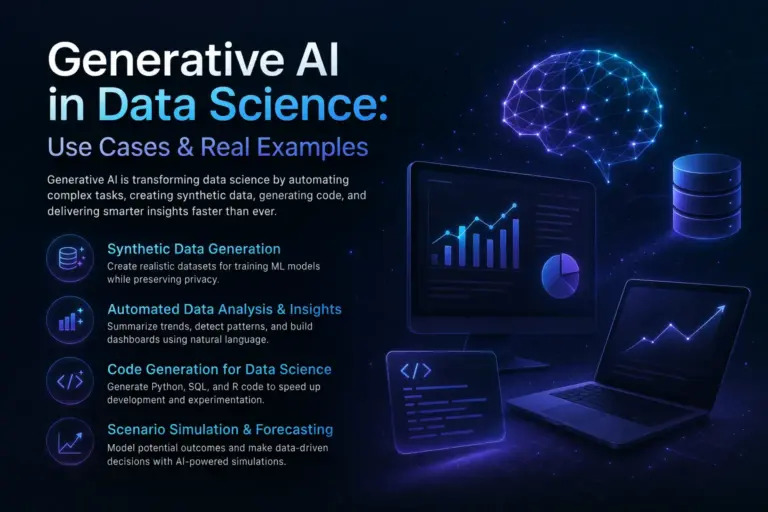
🤖 What is Generative AI in the context of Data Science?
In data science, this means:
- Generating synthetic datasets
- Automating data analysis
- Enhancing model performance
- Creating intelligent insights
🔥 Generative AI Applications in Data Science
1. Synthetic Data Generation
📌 Example:
AI from healthcare companies that generate patient information for research without breaking privacy rules
💡 Benefit:
- Ensures data privacy
- Improves model training accuracy
2. Data Cleaning & Preprocessing
📌 Example:
They can get autonomously detect errors in big sets of data and as well propose solutions, which is a lot less effort.
💡 Benefit:
- Saves time
- Improves data quality
3. Automated Data Analysis & Insights
📌 Example:
Business intelligence tools use AI to generate dashboards and explain trends in plain language.
💡 Benefit:
Faster decision-making
Easy-to-understand insights
4. Code Generation for Data Science
📌 Example:
Data scientists use AI assistants to generate code for data pipelines or predictive models.
💡 Benefit:
Increases productivity
Reduces coding effort
5. Predictive Modeling Enhancement
📌 Example:
E-commerce sites employ AI-powered recommendation systems.
💡 Benefit:
- Better predictions
- Higher accuracy
6. Natural Language Querying (NLQ)
📌 Example:
“Generate insights — Show me last quarter sales trends” — AI generates.
💡 Benefit:
- No technical expertise required
- Faster access to insights
7. Scenario Simulation & Forecasting
📌 Example:
For example, financial companies use AI to predict trends in the market and associated risks.
💡 Benefit:
- Better planning
- Risk reduction
🌍 Real-World Applications
🏥 Healthcare
Drug discovery using AI-generated data
Patient risk prediction
🛒 E-commerce
Personalized recommendations
Customer behavior prediction
💳 Finance
Fraud detection
Risk analysis
📊 Marketing
Customer segmentation
Campaign optimization
⚡ Benefits of Generative AI in Data Science
✔ Automates repetitive tasks
✔ Enhances productivity
✔ Improves accuracy and insights
✔ Reduces dependency on large datasets
✔ Enables faster decision-making
⚠️ Challenges to Consider
1. Data privacy concerns
2. Model bias and hallucination
3. High computational cost
4. Need for skilled professionals
🔮 Future of Generative AI in Data Science
The future of data science is closely tied to Generative AI. As technologies evolve, we can expect:
Fully automated data pipelines
AI-driven decision systems
Integration with Agent-based AI (AgentOps)
Real-time intelligent analytics
Businesses that adopt Generative AI early will gain a significant competitive advantage.
✅ Conclusion
For data professionals, learning Generative AI is no longer optional—it’s essential to stay competitive in 2026 and beyond. If you’re looking to build a strong career in this field, enrolling in the right Data Science Training In Hyderabad can help you gain practical skills, hands-on experience, and industry-ready knowledge.
❓ FAQs
1. What is Generative AI in data science?
Generative AI is a technology that creates new data, insights, or content using advanced AI models, helping automate and enhance data science tasks.
2. How is Generative AI used in data science?
It is used for synthetic data generation, data analysis, code automation, predictive modeling, and generating business insights.
3. What are the benefits of Generative AI in data science?
It improves productivity, reduces manual work, enhances accuracy, and enables faster decision-making.
4. Is Generative AI replacing data scientists?
No, it supports data scientists by automating tasks, allowing them to focus on strategy and advanced problem-solving.