

What is RAG (Retrieval-Augmented Generation)?
Key Features of RAG:
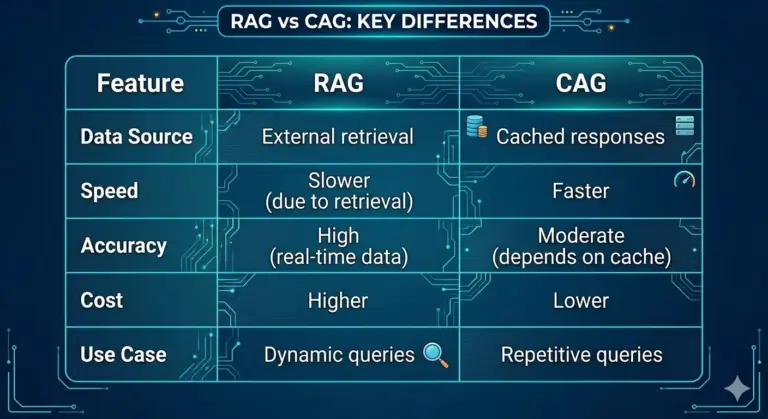
- Connects AI models to real-time or external data
- Improves factual accuracy
- Reduces hallucinations
- Ideal for dynamic knowledge environments
💡 Example:
A chatbot retrieving answers from a company knowledge base before responding to users.
What is CAG (Cache-Augmented Generation)?
Key Features of CAG:
- Faster response times
- Reduced computational cost
- Efficient for repetitive queries
- Optimized for scalability
💡 Example:
An AI assistant reusing cached answers for frequently asked questions.
Benefits of RAG
- Access to real-time information
- Higher accuracy and relevance
- Ideal for enterprise AI and knowledge systems
- Reduces misinformation
Benefits of CAG
- Faster response time
- Cost-efficient AI operations
- Great for high-traffic applications
- Improves user experience
🎯 Use Cases
RAG Use Cases:
- Customer support chatbots with live data
- Legal and medical AI assistants
- Enterprise knowledge management systems
- Research-based AI tools
CAG Use Cases:
- FAQ chatbots
- E-commerce product queries
- Customer service automation
- High-volume AI applications
When to Choose RAG vs CAG
Choose RAG when:
- You need accurate, real-time information
- Data changes frequently
- Quality is more important than speed
Choose CAG when:
- You need fast responses
- Queries are repetitive
- You want to reduce costs
Conclusion
Both RAG and CAG play a crucial role in modern AI systems. While RAG ensures accuracy through real-time data retrieval, CAG focuses on speed and efficiency through intelligent caching.
💡 The best approach?
Many advanced AI solutions combine both RAG and CAG to achieve the perfect balance between accuracy, performance, and scalability.
If you want to build real-world AI skills and understand how these architectures are used in industry, learning through hands-on projects is essential. At Coding Masters Data Science Training, you can gain practical experience in Generative AI, LLMs, RAG pipelines, and modern data science tools to become industry-ready.