


What Are Neural Networks?
Neural Networks, also known as Artificial Neural Networks (ANNs), are computational models inspired by the structure and function of the human brain. Just as biological neurons communicate with one another to process information, artificial neurons work together to analyze data and solve complex problems.
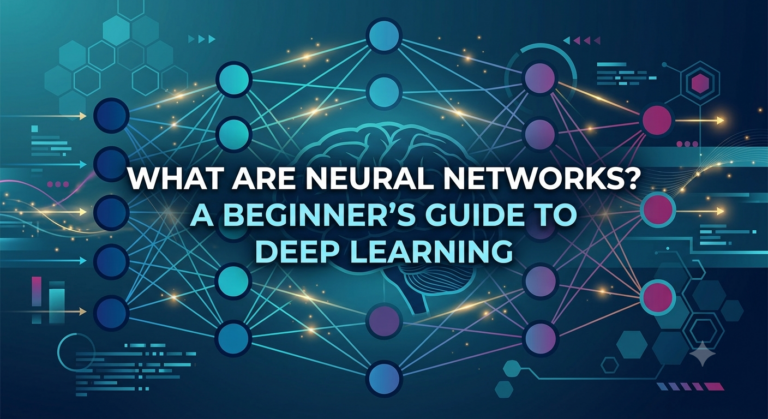
A neural network consists of interconnected nodes (neurons) organized into layers. These layers process input data and generate meaningful outputs through mathematical computations.
How Do Neural Networks Work?
Neural networks learn by processing data through multiple layers:
1. Input Layer
The input layer receives raw data such as images, text, numbers, or audio signals.
2. Hidden Layers
Hidden layers perform calculations and extract important features from the input data. Deep neural networks contain multiple hidden layers, enabling them to learn complex patterns.
3. Output Layer
The output layer generates predictions or classifications based on the processed information.
For example, when identifying whether an image contains a cat or a dog, the neural network analyzes patterns and features before making a prediction.
Key Components of Neural Networks
Neurons
The fundamental units that receive inputs, perform calculations, and pass information to other neurons.
Weights
Weights determine the importance of each input. During training, these weights are adjusted to improve accuracy.
Bias
Bias helps the network make better predictions by shifting activation values.
Activation Functions
Activation functions determine whether a neuron should be activated. Popular activation functions include:
1. ReLU (Rectified Linear Unit)
2. Sigmoid
3. Tanh
4. Softmax
Types of Neural Networks
Feedforward Neural Networks (FNN)
The simplest type where information moves in one direction from input to output.
Convolutional Neural Networks (CNN)
Designed for image and video processing. CNNs are widely used in facial recognition, medical imaging, and object detection.
Recurrent Neural Networks (RNN)
Ideal for sequential data such as text, speech, and time-series forecasting.
Long Short-Term Memory (LSTM)
A specialized RNN architecture that can remember information over long periods.
What Is Deep Learning?
Deep learning powers many modern technologies, including:
1. Voice assistants
2. Self-driving cars
3. Recommendation systems
4. Language translation tools
3. Chatbots
5. Image recognition systems
Applications of Neural Networks
Healthcare
Neural networks help diagnose diseases, analyze medical images, and predict patient outcomes.
Finance
Banks use neural networks for fraud detection, risk assessment, and algorithmic trading.
E-Commerce
Online platforms use recommendation engines powered by neural networks to personalize user experiences.
Natural Language Processing
Computer Vision
Image classification, facial recognition, and autonomous vehicles rely heavily on neural networks.
Advantages of Neural Networks
1. Can learn complex patterns from data
2. Improve accuracy through continuous training
3. Handle large volumes of data efficiently
4. Adapt to various applications and industries
5. Power modern AI and deep learning systems
Challenges of Neural Networks
1. Require large datasets for training
2. High computational costs
3. Longer training times
4. Difficult to interpret decision-making processes
5. Risk of overfitting if not properly trained
The Future of Neural Networks
Conclusion
Neural networks are the foundation of modern artificial intelligence and deep learning. By mimicking the way the human brain processes information, they can recognize patterns, make predictions, and solve complex problems across industries. Understanding neural networks is an essential step for anyone interested in AI, machine learning, and data science.
Whether you’re a student, developer, or technology enthusiast, learning about neural networks can open doors to exciting opportunities in the rapidly growing field of AI. To build practical skills and industry-ready expertise, enrolling in a Gen AI Training can help you understand advanced neural network concepts and real-world AI applications.
Frequently Asked Questions (FAQs)
1. What is a neural network in simple terms?
2. What is the difference between machine learning and deep learning?
Machine learning uses algorithms to learn from data, while deep learning uses multi-layer neural networks to learn complex patterns automatically.