

Deep Learning is one of the most important directions in the field of Artificial Intelligence (AI) and Data Science.
It is a specialized branch of Machine Learning that uses multi-layered Artificial Neural Networks to extract patterns from large-scale, complexly related datasets.
It does not need to rely entirely on manually defined rules, and can directly extract useful feature information from raw data, demonstrating strong capabilities in processing information that cannot be organized with conventional structured tables, such as images, text, audio, and video.
If you plan to pursue a career related to Data Science, Machine Learning, Artificial Intelligence or Generative AI, mastering the basics of Deep Learning first will lay a solid technical foundation for you. This knowledge will help you understand how modern AI systems process information, make predictions, or generate various types of output content.
How Neural Networks Work
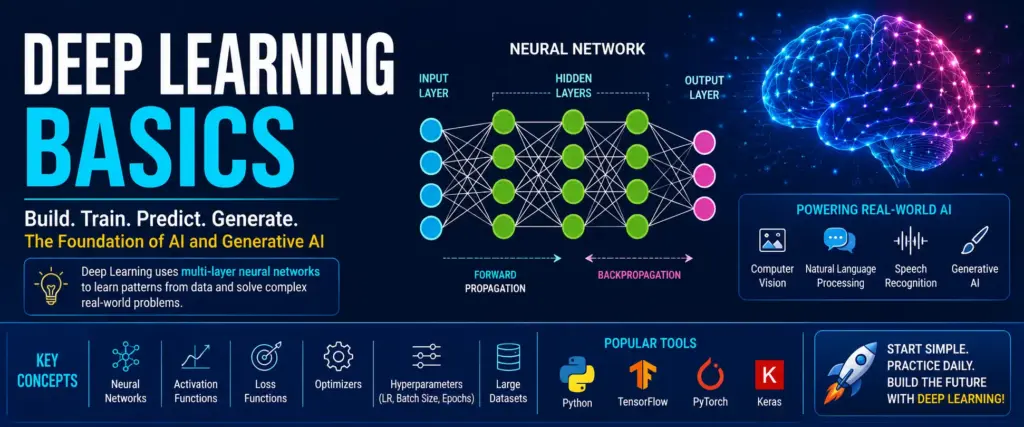
At the core of Deep Learning are Artificial Neural Networks (ANNs). The design logic of these networks roughly mimics the way biological neurons process information. A typical neural network includes an input layer, at least one hidden layer, and an output layer.
The input layer is responsible for receiving the information to be processed, the intermediate hidden layers exclusively process this information, and the final output layer transmits the completed processing results.
Understanding Neurons, Weights, and Activation Functions
Each neuron in the network first receives information, assigns weights to this information—
weights can be understood as numerical values used to judge the importance of information, where important information gets high weights and unimportant information gets low weights—
then processes it with an activation function, which is a tool that adds non-linear processing capabilities to the model, and finally transmits the generated new signal to the next layer.
During the model’s training process, it continuously adjusts these weights to minimize the error between its prediction results and the expected results.
Key Deep Learning Concepts
Important concepts including forward propagation, backpropagation, activation functions, loss functions, optimizers, epochs, batch size, and learning rate together form the foundation of Deep Learning.
Deep Learning in Data Science
When traditional Machine Learning methods cannot handle large-scale or extremely complex datasets, the advantages of Deep Learning become prominent. In a complete Data Science workflow,
you can use Deep Learning in combination with Python, SQL, statistics, Data Analytics, Machine Learning, and Data Visualization to develop complex predictive models.
CNNs, RNNs, and Transformer Architecture
For example, Convolutional Neural Networks (CNNs) are typically used to handle image-related tasks, while Recurrent Neural Networks (RNNs) and related network architectures are used to process data with sequential relationships, such as sequentially arranged text, which falls into this type of data.
Today’s Modern Transformer architecture has become extremely important for processing language, as well as other data with sequential features or multi-modal data.
Deep Learning and Generative AI
Deep Learning is also the core foundation of many current Generative AI technologies. Large Language Models (LLMs), image generation systems, voice models, and
all other types of generative applications rely on advanced neural network architectures trained on large-scale datasets to operate.
Understanding Modern Generative AI Technologies
Understanding concepts such as Transformers, embeddings, attention mechanisms, model training, fine-tuning, and inference will allow you to easily comprehend how Generative AI applications operate in the background.
Building Practical Deep Learning Skills
Learning Deep Learning is not just about memorizing concepts related to neural networks. Hands-on practical experience is as important as theoretical knowledge.
Learners need to practice with real datasets, build models using Python and mainstream Deep Learning frameworks, evaluate model performance, identify overfitting problems—
overfitting refers to the situation where a model performs well on old training data but its performance drops sharply when it encounters never-before-seen new data—and also experiment with different architectures.
Hands-on projects can help people learning Data Science and AI understand how to translate theories from textbooks into solutions that solve real-world problems.
Why Learn Deep Learning Basics?
Laying a solid foundation in Deep Learning will pave the way for you to enter more cutting-edge fields—
such as Generative AI, Large Language Models, Computer Vision, Natural Language Processing (NLP), AI Agents, and Machine Learning Engineering.
Whether you are a student, a Data Analyst, a developer, a working professional, or an enthusiast who wants to become a
Data Scientist, learning Deep Learning step by step will solidify your AI foundation and help you cope with all kinds of increasingly advanced technologies.
Start with Deep Learning Fundamentals
The goal of learning is not to fully master all neural network architectures all at once. You can start with basic content, practice with real data, work on projects, understand the output results of models, and then gradually advance tocontact more complex applications of Deep Learning and Generative AI.
Gen AI and Agentic AI Training – Coding Masters
Address
flat no 101,
Bhavya Krishna Residency,
OPP: Siddartha Degree College,
Ameerpet Rd,
Kumar Basti,
Nagarjuna Nagar colony,
Yella Reddy Guda,
Hyderabad,
Telangana 500073,
India
phone no.91- 87121 69228