

Introduction to Prompt Engineering
The Prompt Engineering Roadmap is a systematic learning path. Specifically, it helps you master the skills needed to communicate smoothly with Generative AI. Currently, AI tools and Large Language Models (LLMs) are becoming increasingly popular. Therefore, you might want to enter the industry or just use AI more effectively. To achieve this, this roadmap offers a planned skill progression sequence. Furthermore, you can repeatedly practice core concepts and apply them to real projects. Ultimately, this helps you use various AI applications more efficiently.
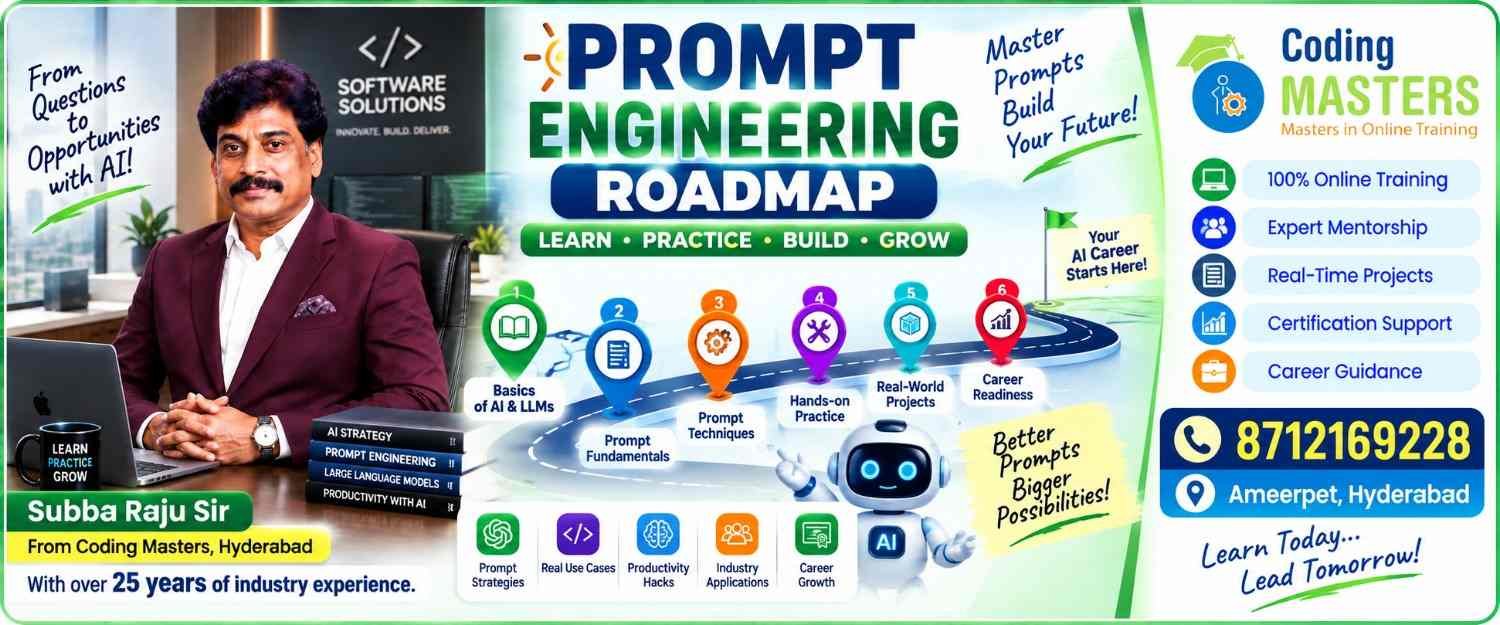
Prompt Engineering Roadmap: What Is the Prompt Engineering Roadmap?
This roadmap lists out all the core concepts and skills. Consequently, you need to master them one by one. By doing so, this staged approach prevents you from taking on too much content at once. For instance, complete beginners can start with the basic content of Generative AI. First, you must figure out how your prompts shape the AI’s generated content. After all, different instructions produce completely different output results. Indeed, this is the very first lesson for entry-level learners.
The next stage after understanding this basic logic is to start learning core prompt writing skills. Specifically, these skills include zero-shot, few-shot, and role-based prompting. Moreover, you will also learn chain-of-thought-style task structuring. Additionally, you learn to provide clear background information and instructions to AI. Fortunately, you do not need to rush into large projects. Instead, repeatedly test these skills in small daily practice sessions. Consequently, you will see how adjusting a few phrases affects the AI’s output quality. In the end, this helps you grasp the usage of different instructions.
Prompt Engineering Roadmap: Generative AI and LLM Fundamentals
You must fully grasp the core concepts of Generative AI first. In fact, do this before approaching more complex advanced prompting techniques. First, understand the macro-level operating logic of LLMs. Next, clarify the actual meanings of tokens and context. Also, understand how AI models process human instructions. Undeniably, these are the essential foundations for all subsequent learning. As a result, a solid foundation prevents you from getting stuck on deeper content later.
Next, practice writing prompts for various common tasks. For example, you can direct AI to generate copy or condense long reports into abstracts. Alternatively, you can also organize messy information into categories. Other tasks include extracting specific information from large materials. Furthermore, you can brainstorm new ideas and complete question-and-answer tasks to solve problems. Ultimately, practice through these common scenarios to master using prompts.
Prompt Engineering Roadmap: Refine Practical Prompt Engineering Skills
The roadmap’s next stage centers on hands-on trial and error. Clearly, merely understanding knowledge points falls short. Therefore, you must test them yourself to gain practical intuition. For instance, you can use mainstream AI tools like common chatbots. Try writing different prompts for the exact same task. Then, conduct repeated tests to see how models respond to varying instructions. Overall, this trial and error builds your practical experience.
Soon you will gain experience building basic prompt workflows. Then you can explore more advanced usage. Specifically, this includes structured prompts, reusable templates, and multi-step workflows. Additionally, you can also require AI to output specific formats like tables and lists. Subsequently, you will learn to evaluate the quality of AI outputs. Then you can optimize your prompts based on those results. Consequently, this makes them increasingly convenient to use.
You can also complete hands-on projects to build your personal portfolio. For example, these projects include building AI assistants and content generation workflows. Similarly, you can write research prompts or simulate customer service scenarios. Moreover, developing efficiency tools is another great option. Ultimately, completing these end-to-end projects connects core concepts to real-world applications. As a result, you stop merely reciting knowledge points. Instead, you truly use this skill to solve practical problems.
Prompt Engineering Roadmap: Advanced AI Workflows and Continuous Learning
The roadmap’s final stage combines prompt engineering with broader AI workflows. At this point, you stop focusing solely on writing a single good prompt. Instead, you integrate this ability into larger AI application processes. For instance, advanced learners can explore Retrieval-Augmented Generation (RAG) and AI agents. Furthermore, they can also study tool usage and automated AI workflows. Consequently, this expands the boundaries of their capabilities.
A final reminder: you must keep learning continuously. After all, developers constantly update and iterate AI models and tools. For example, a prompt might work perfectly today. However, an update could reduce its effectiveness half a year later. Therefore, regularly review the output results of your prompts. Additionally, identify shortcomings, test different instruction methods, and record useful techniques. Ultimately, this helps you refine a practical, long-term reusable skill system. Moreover, it also helps you keep up with AI’s rapid updates.
Frequently Asked Questions
Q: What Is the Prompt Engineering Roadmap?
A: It is a step-by-step learning path. Specifically, it covers Generative AI basics, prompting techniques, hands-on projects, and advanced workflows.
Q: Is prompt engineering suitable for beginners with zero prior experience?
A: Yes. Initially, beginners can start learning from the basic concepts of Generative AI. Eventually, hands-on practice and repeated training build complex skills.
Q: What knowledge do I need to prepare before starting to learn prompt engineering?
A: First, fully grasp the core concepts of Generative AI and LLMs. Consequently, this lays a solid foundation for advanced techniques and tools.
Q: Which prompting techniques should I learn first?
A: Entry-level learners should start with zero-shot, few-shot, and role-based prompting. Next, they should also learn structured prompts and background information instructions. Finally, reusable prompt templates help build a complete capability system.
Q: Can prompt engineering be learned entirely through hands-on projects?
A: Yes. In practice, projects help learners apply core skills to real scenarios. For example, examples include AI assistants, content creation, research, and customer service.
Q: After mastering core prompt engineering skills, what else can I learn?
A: Learners can explore advanced directions like RAG and AI agents. Furthermore, tool usage and automated workflows further expand professional capabilities.
Want to learn more about Prompt Engineering Roadmap in Hyderabad? Contact Coding Masters:
Gen AI and Agentic AI Training – Coding Masters
Flat No. 101, Bhavya Krishna Residency,
OPP: Siddartha Degree College,
Ameerpet Rd, Kumar Basti,
Nagarjuna Nagar colony,
Yella Reddy Guda,
Hyderabad, Telangana 500073
 Phone: 8712169228
Prompt Engineering Tutorial: Learn Prompting Step by Step
[…] prompting and few-shot prompting. After all, these two approaches form the foundation of all prompt engineering skills. Therefore, practicing them proficiently makes advancing to advanced techniques very smooth. […]