

Nowadays, more and more companies are integrating Artificial Intelligence and Machine Learning into their applications. Because of this, AI testing has become an important skill for software testers.
Earlier, testers mainly focused on checking whether traditional software functions were working correctly. With AI becoming part of modern applications, testers also need to check whether the AI component is reliable, accurate, stable, and secure.
Unlike traditional software testing, AI testing involves checking several additional areas. Testers need to verify whether the AI provides consistent results, handles different types of inputs correctly, and avoids potential security risks.
Because of these additional requirements, many companies now include AI Testing Interview Questions in their technical interviews. They want candidates who understand both traditional software testing and the specific challenges involved in testing AI systems.
If you are preparing for an AI testing position, start by strengthening your basic software testing knowledge. Then, learn the important AI concepts related to testing. Understanding both areas will help you answer interview questions more clearly and confidently.
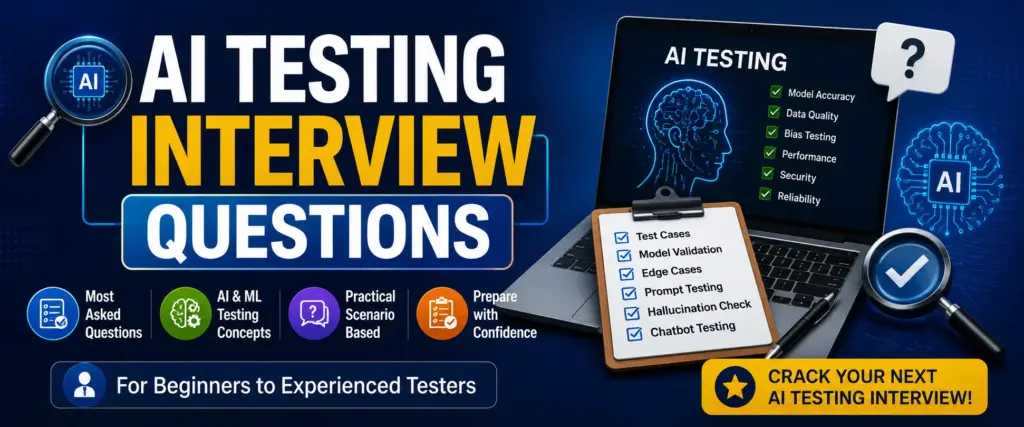
What Is AI Testing?
AI testing refers to the processes and methods used to evaluate applications that contain AI functionality. The main goal is to make sure the AI-enabled software performs as expected across different usage scenarios.
In simple terms, AI testing is like a complete health check for AI-powered software.
Testers need to evaluate several areas, including:
- Model accuracy
- Data quality
- Output content
- Performance
- Security
- Bias
- Overall application functionality
Testing should cover both normal situations and unusual scenarios. Testers may need to check whether the training data is reliable, whether the AI produces biased results, whether the application performs smoothly, and whether there are security vulnerabilities.
AI Testing vs Traditional Software Testing
One of the most common interview questions is:
“What is the difference between AI testing and traditional software testing?”
Traditional software testing usually works with predefined inputs and expected outputs. If the actual output matches the expected result, the test passes. If it does not, the tester identifies a defect.
AI systems work differently. Their behavior can depend on training data, model structure, user prompts, and the context in which they are used.
As a result, the output is not always fixed. Even when the same question is asked, the response can change because of differences in context, data, or model updates.
This is why AI testing requires additional testing methods to handle these uncertain and dynamic behaviors.
Common AI Testing Interview Questions
Here are some questions that interviewers frequently ask when hiring for AI testing roles.
1. What Is AI Testing?
Explain what AI testing means and describe its main objectives. You should also explain how AI testing helps identify risks that traditional software testing may not detect.
Rather than simply memorizing a definition, try to explain what problems AI testing is designed to identify and prevent.
2. What Is the Difference Between AI Testing and Traditional Testing?
Focus on important differences such as model behavior, probabilistic outputs, dependence on training data, and the different accuracy metrics used for AI systems.
Explaining these points clearly shows that you understand the actual differences instead of simply memorizing an interview answer.
3. How Would You Test an AI Model?
Explain how you would use suitable test datasets, expected results, accuracy metrics, and edge cases to evaluate the model.
A good answer should describe your testing approach clearly and show how you would identify unexpected failures.
4. What Is Hallucination in Generative AI?
A hallucination occurs when an AI system generates information that sounds believable but is actually incorrect or unsupported by reliable facts.
The response may appear logical and well-written, but the information itself may not be accurate.
5. How Would You Test a Chatbot?
When testing a chatbot, you should consider several areas, including:
- Accuracy of responses
- Context handling
- Invalid user inputs
- Response consistency
- Security mechanisms
- Overall user experience
You should test both normal conversations and unusual situations. Repeating the same question in different ways can also help identify inconsistencies in the chatbot’s responses.
6. What Is Prompt Testing?
Prompt testing involves providing different prompts to a Generative AI system and checking whether the responses are appropriate, relevant, and consistent.
Testers should consider different ways users may ask the same question, including unclear or indirectly worded prompts. The goal is to identify irrelevant or unexpected responses.
7. How Would You Test AI Bias?
Testers can use different groups of inputs and scenarios to check whether an AI system produces unfair, biased, or contradictory results.
The purpose is to identify whether the system treats particular groups differently or produces unreasonable results for certain users.
8. What Is Model Accuracy?
Accuracy is one of the important metrics used to evaluate how well an AI model performs its intended task.
It helps determine how many outputs produced by the model are correct and provides a way to measure its performance.
How to Prepare for AI Testing Interviews
Preparing for an AI testing interview requires knowledge of both software testing fundamentals and AI concepts.
First, revise functional testing, API testing, automation testing, test case design, defect management, and performance testing. These are important testing skills regardless of the type of application you work with.
At the same time, learn AI-specific concepts such as:
- Machine Learning
- Generative AI
- Large Language Models
- Prompt Engineering
- Hallucinations
- Model Evaluation
- AI Security Risks
Understanding both areas will help you answer interview questions more effectively.
Get Practical Experience
Practical experience is just as important as theoretical knowledge.
Try testing AI-enabled applications in a safe environment. Create different prompts, check whether responses remain consistent, explore unusual scenarios, and document the problems you find.
Even simple practice with a public AI model can help. Try different questions, test edge cases, observe how the responses change, and record your findings.
This type of hands-on practice can be much more useful than simply memorizing interview answers.
Conclusion
A strong combination of software testing knowledge and practical AI experience can help you approach AI Testing Interview Questions with confidence.
More importantly, it allows you to demonstrate that you understand the real challenges involved in maintaining the quality of AI-powered applications. Instead of only memorizing interview questions, you can explain how you would identify and handle AI testing problems in real-world situations.
Gen AI and Agentic AI Training – Coding Masters
Address
flat no 101,
Bhavya Krishna Residency,
OPP: Siddartha Degree College,
Ameerpet Rd,
Kumar Basti,
Nagarjuna Nagar colony,
Yella Reddy Guda,
Hyderabad,
Telangana 500073,
India
phone no.91- 87121 69228