

AI vs Software Testing
AI is changing Software Testing by making test automation smarter, faster, and more efficient. Traditional software testing depends heavily on manually created test cases, scripts, and predefined rules. AI-powered testing can analyze application behavior, identify patterns, generate test cases, detect defects, and even predict potential failures. While traditional testing remains important for functional validation and quality assurance, AI can reduce repetitive work and improve test coverage. Testers who learn AI-based tools can automate complex testing tasks, analyze results faster, and adapt to modern development practices. Combining Software Testing skills with AI knowledge can create better career opportunities in today’s technology industry.
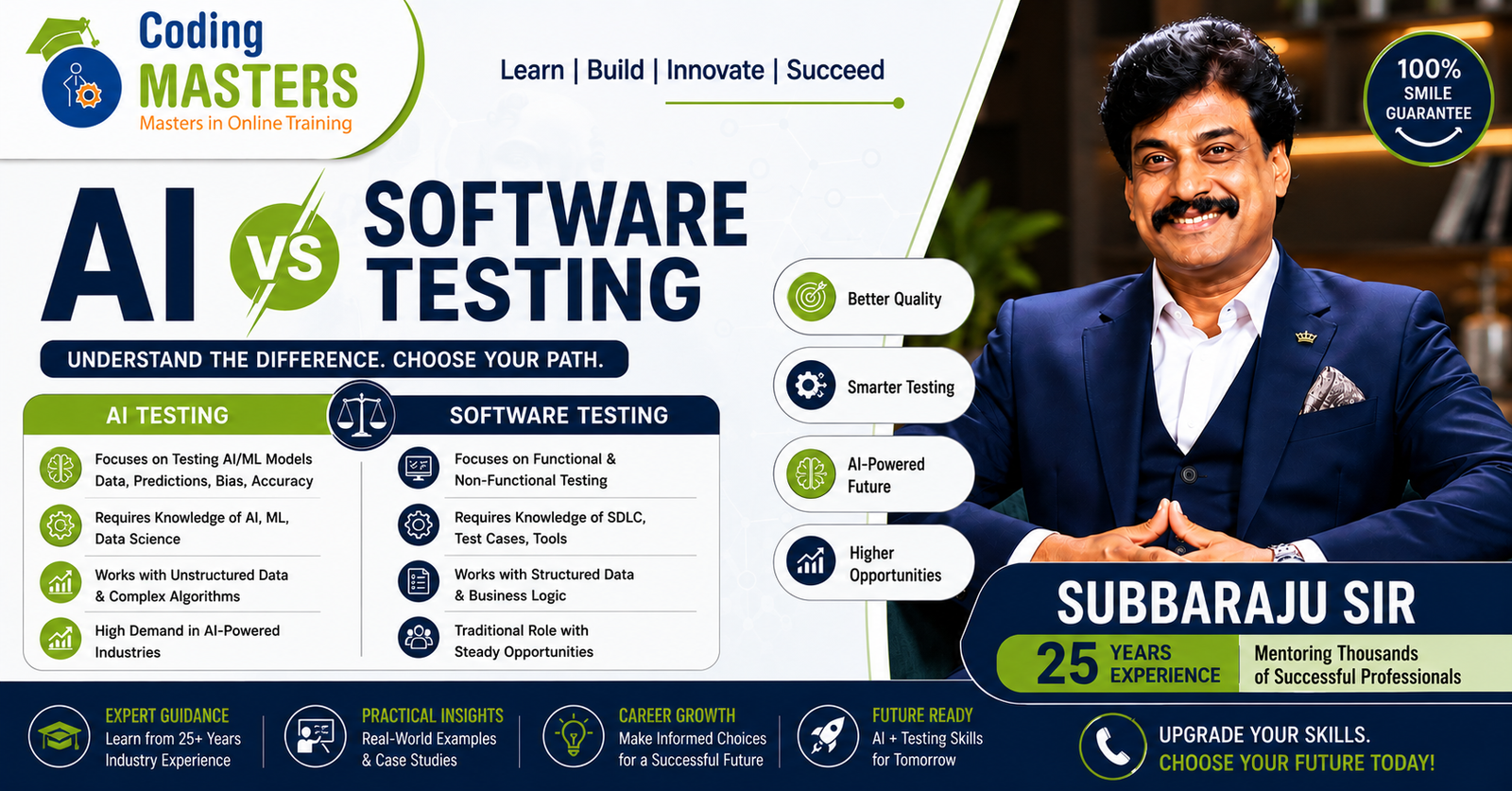
AI is restructuring the software testing industry, making the entire testing process faster, smarter, and more efficient. The software testing we refer to is the work dedicated to checking whether newly developed software has any defects. In the past, this entire process relied entirely on manual organization, but now that AI has been introduced, the overall pace of work has completely changed.
In the past, software testing relied entirely on manual design of test items, pre-written fixed scripts, and repeated rounds of verification to judge whether the software’s operating status was qualified. Back then, without the assistance of AI, which functions and scenarios of the software to test all depended on testers to sort out on their own. The fixed code used to trigger tests and verify results also had to be written out line by line by people in advance. From start to finish, testers had to repeatedly check whether the software met the requirements, and a huge amount of time was wasted on identical repetitive tasks.
AI in Software Testing
AI is restructuring the working mode of software testing. The AI in software testing mentioned here refers to the work dedicated to checking whether there are any problems in software. In the past, to complete these checks, people had to repeatedly handle a large number of repetitive and tedious processes. Now AI in software testing can fully automatically take over these repetitive core testing processes, eliminating the need for people to manually operate over and over again. It can even process and analyze the massive data accumulated during the testing process in batches.
Traditional Software Testing
In the past, carrying out software testing work relied on three things: pre-written test cases, manual step-by-step verification procedures, and automated scripts written by the testers themselves. The so-called test cases refer to specific plans that define in advance which functions to test and how to test them; those automated scripts are nothing complex either—they are just small programs that help automatically complete part of the repetitive testing work, eliminating the need for testers to manually start from scratch every time.
Career Opportunities in AI Testing
The integration of artificial intelligence and AI in software testing has spawned many new development possibilities for quality assurance professionals and software testers. Simply put, this means the artificial intelligence technology is practically applied to the daily work of software testing. Full-time staff originally responsible for software quality inspection and frontline software test engineers can all access brand-new career development opportunities. Anyone proficient in test automation, AI tools, and concepts related to machine learning, and familiar with modern testing frameworks, can take on more demanding advanced testing projects—that is, cutting-edge testing projects in the industry with higher technical thresholds and greater complexity, instead of being confined to routine basic testing work. Taking the initiative to master Learning AI-powered testing technology brings tangible benefits to testers: first, they can avoid performing a large amount of repetitive mechanical work, and do not need to spend a great deal of time on repeated operations over and over again; second, they can substantially improve work efficiency, and invest the saved energy into more valuable work. Furthermore, during the continuous iteration of software development, they can always maintain their workplace competitiveness, avoid being eliminated as the industry develops, keep pace with the industry’s progress, and retain their competitive edge in the workplace.
AI-Powered Test Case Generation
AI tools can automatically generate software test cases. They first analyze the software’s functional requirements, users’ actual usage behaviors, and all previously retained test data, then produce the corresponding test cases. In this way, testers no longer need to manually build repetitive test scenarios, which can save a large amount of time—all the effort that would have been spent on building similar test environments and writing repetitive test scripts over and over again can be saved for more important work.
AI-Based Bug Detection
The AI tools we usually mention can help testers whose job is specifically to find problems in software to root out hidden vulnerabilities in applications. When it investigates issues, it does not guess out of thin air; it must first analyze several types of solid, factual information—the system operating status of the software when it is actually running, the test output results obtained from previous tests, the event logs automatically recorded by the system during the software’s operation, and the historical project data stored for this project or similar projects. It relies entirely on this information to locate areas that may have problems. What supports AI to complete these analyses is machine learning algorithms. This set of algorithms can identify abnormal patterns that do not fit right from a large amount of daily operating data. After detecting discrepancies from normal conditions, it will specifically mark out sections in the code that may contain unrepaired vulnerabilities, to remind testers to focus on those parts.
Test Automation with AI
AI can optimize automated testing, transforming the originally rigid automated testing process to become more flexible and intelligent. The automated testing mentioned here refers to the mode where software testing work that was originally completed manually is changed to a mode that runs automatically through programs. After AI is introduced, this process is no longer as inflexible as before, and can adapt to more sudden changes. Traditional automated testing scripts used in the past had a common flaw: these scripts can only inspect software in accordance with fixed procedures. As long as the interface of the application software is modified — for example, a button is moved, or the page layout is changed — the original scripts cannot recognize the operation path and cannot run normally. They require frequent manual updates to the code before they can continue to be used.
Skills for AI Testing Careers
Practitioners who want to engage in AI testing must not only focus on learning content related to artificial intelligence. They must first lay a solid core foundation in software testing, and also develop professional capabilities in automated testing; all these aspects of competence must be fully equipped. To list out the specific skills that need to be refined one by one: first, the capability for manual testing; proficiency in using Selenium or similar automated tools; the ability to conduct API testing; mastery of the Python programming language; understanding of how to use various testing frameworks; and also comprehension of basic machine learning concepts.
flat no 101, Bhavya Krishna Residency, OPP: Siddartha Degree College, Ameerpet Rd, Kumar Basti, Nagarjuna Nagar colony, Yella Reddy Guda, Hyderabad, Telangana 500073