

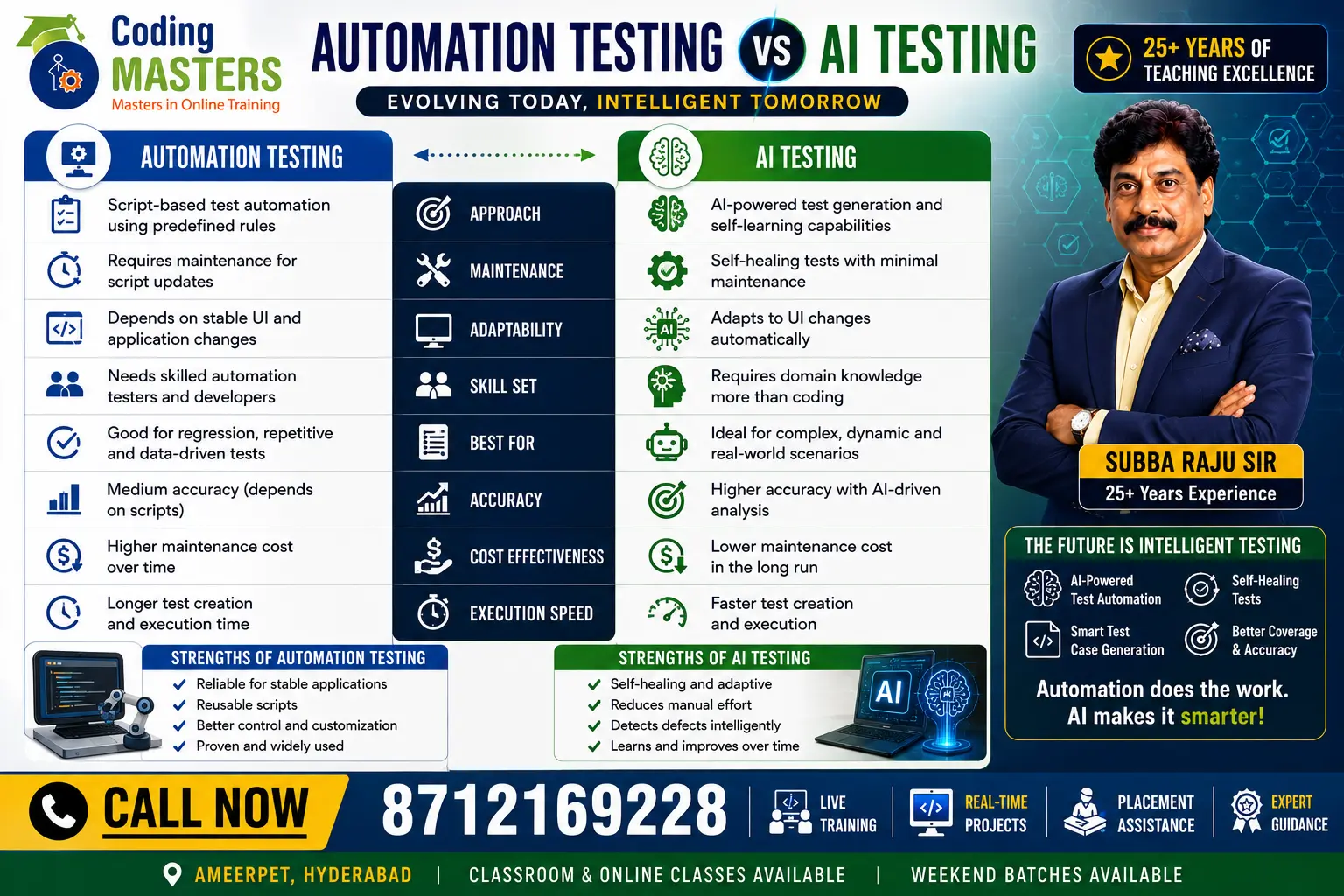
Automation Testing vs AI Testing
The software testing industry is evolving rapidly, and artificial intelligence is reshaping how organizations develop and test applications. For many years, automation testing has been the mainstream solution to reduce manual labor and boost testing efficiency.
With the rise of AI-enabled technologies, AI testing has emerged as a new generation of intelligent software testing solutions. Many beginners, software testing engineers, and IT professionals struggle to tell the two apart.
Clarifying these differences is a core prerequisite for building a career path in software testing and ensuring your skills remain aligned with industry development long-term. This guide compares the two testing approaches, breaks down their strengths and weaknesses, introduces common tools, and helps you assess which career path has stronger prospects for 2026 and beyond.
What is Automation Testing?
Automated testing refers to a testing process that uses software tools and scripts to automatically execute test cases without human intervention. Unlike the model of manually verifying each function one by one, testers can repeatedly check an application’s functions through self-written scripts.
Main Applications of Automation Testing
Automated testing is mainly applicable to:
- Regression testing
- Smoke testing
- Functional testing
- API testing
- Performance testing
- Cross-browser testing
Popular Automation Testing Tools
Mainstream automated testing tools include:
- Selenium
- Cypress
- Playwright
- TestNG
- Appium
- Robot Framework
It can greatly shorten test duration while improving the consistency and accuracy of testing.
What is AI Testing?
AI testing refers to the use of artificial intelligence and machine learning to make software testing smarter, faster, and more adaptable.
Unlike traditional automated testing, AI-driven testing tools can achieve the following:
- Automatically generate test cases
- Self-heal failed test scripts
- Identify interface changes
- Predict application defects
- Optimize test execution workflows
- Intelligently analyze test results
- Reduce maintenance workload
Popular AI Testing Tools
Mainstream AI testing tools include:
- Testim
- Applitools
- KaneAI
- Mabl
- Functionize
- ACCELQ
- TestRigor
As enterprises gradually implement AI technology, AI testing has become one of the fastest-growing areas in the quality assurance field.
Core Differences Between Automated Testing and AI Testing
The most core difference between the two is that automated testing runs strictly in accordance with pre-set scripts, while AI testing can continuously learn and adapt to various changes that occur in an application.
Comparison Table
| Comparison Dimension | Automated Testing | AI Testing |
|---|---|---|
| Underlying Technology | Script-based | AI and Machine Learning |
| Test Case Creation | Manually write scripts | Automatically generate test cases |
| Maintenance Cost | High | Low (Self-Healing) |
| Script Update | Manual operation | Completed automatically |
| Learning Ability | None | Can learn from data |
| Execution Logic | Based on fixed rules | Intelligent decision-making |
| Speed | Fast | Faster after optimization |
| Accuracy | High | Extremely high |
| Defect Prediction | Not available | AI-based prediction |
| Human Resource Input | Moderate | Extremely low |
Operational Logic of Automated Testing
Automated testing follows a set of standardized processes.
Standard Workflow
- Analyze requirements
- Create test scripts
- Configure the testing framework
- Execute automated tests
- Generate test reports
- Repair failed scripts when the application is updated
Whenever the application’s user interface changes, testers usually need to manually update the relevant scripts.
Operational Logic of AI-Powered Testing
AI-powered testing integrates machine learning and intelligent algorithms on top of basic automation to achieve capability upgrades.
Standard Workflow
- Understand application behavior
- Learn from historical execution records
- Automatically generate test cases
- Identify UI changes
- Automatically repair invalid locators
- Predict potential defects
- Optimize the test execution process
- Generate intelligent reports and improvement suggestions
This makes AI-powered testing more suitable for modern software development environments, with stronger adaptability and efficiency.
Advantages of Automated Testing
With its proven practicality, automated testing remains a reliable choice for many enterprises.
Key Benefits
- Faster regression testing
- Reduced manual workload
- Reusable test scripts
- Improved test consistency
- Broader test coverage
- Shorter release cycles
- Supports Continuous Integration/Continuous Deployment (CI/CD)
- Cost advantages for testing repeated scenarios
Automated testing is particularly suitable for stable applications with predictable processes.
Advantages of AI-Powered Testing
AI-powered testing adds a completely new level of intelligence to software quality assurance.
Key Benefits
- Automatic test case generation
- Self-repairing test scripts
- Reduced script maintenance workload
- Faster execution speed
- Intelligent defect prediction
- Optimized test execution strategies
- Better visualized test results
- AI-driven test reports
- Further expanded test coverage
- Lower long-term maintenance costs
Enterprises that adopt AI-powered testing can deliver software products faster while maintaining high quality.
Limitations of Automated Testing
Despite its advantages, automation testing has certain challenges.
Common Challenges
- Requires programming knowledge
- High script maintenance
- Scripts break after UI changes
- Time-consuming framework setup
- Limited adaptability
- Cannot learn from previous executions
These limitations become even more prominent in Agile and DevOps environments that feature rapid iteration cycles.

Limitations of AI Testing
While AI testing has powerful capabilities, it remains in a developmental stage.
Common Challenges
- High initial investment costs
- A learning curve exists for AI tools
- Costs incurred from tool licensing
- A requirement for high-quality training data
- Not all projects need AI capabilities
That said, as AI technology gradually matures, these limitations are slowly being resolved.
How to Choose Between Automated Testing and AI Testing?
The answer depends on your project’s needs.
Choose Automated Testing When
- Stable application status
- A need to conduct regression testing
- An automated testing framework that has already been built
- Relatively limited budget
- Projects that require repeated test execution
Choose AI Testing When
- Frequent application changes
- A desire to reduce script maintenance costs
- A need for faster release cycles
- A need for intelligent defect analysis
- Enterprises that adopt Agile, DevOps, or continuous testing models
Today, many modern enterprises combine the two solutions to improve efficiency.
Career Opportunities
Automation testing professionals are still in demand across various industries.
Automation Testing Job Roles
- Automation Test Engineer
- Selenium Automation Engineer
- QA Automation Engineer
- Test Architect
- SDET (Software Development Engineer in Test)
AI Testing Job Roles
AI Testing is creating exciting new career opportunities such as:
- AI Test Engineer
- AI QA Engineer
- Intelligent Automation Tester
- AI Validation Engineer
- Machine Learning Test Engineer
- AI Quality Analyst
Professionals with AI testing skills are being fiercely recruited by product companies, startups, and multinational organizations.
Future of Automation Testing and AI Testing
Automated testing remains a core part of software quality assurance, and it is particularly well-suited for structured, repetitive testing scenarios.
However, the future of the testing industry is increasingly shifting toward AI-driven models.
Industry Trends
- AI-generated test cases
- Self-healing automation
- Intelligent visual testing
- Predictive analytics
- Autonomous testing
- AI-assisted code generation
- Natural language-based test creation
AI does not replace automated testing; instead, it empowers automated testing by improving its efficiency, resilience, and scalability.
Recommended Learning Path
Newcomers to software testing can first master foundational knowledge by learning automated testing, then expand their career prospects by upskilling in AI testing.
Step-by-Step Roadmap
- Learn basic manual testing knowledge.
- Master automated testing tools such as Selenium, Playwright, and Cypress.
- Understand content related to CI/CD and version control.
- Learn AI-powered testing tools such as Testim, Applitools, and KaneAI.
- Build a practical project by combining automated and AI testing technologies.
By integrating these two sets of skills, you can easily adapt to the constantly evolving needs of the software testing industry.
Conclusion
Automated testing and AI testing are both indispensable components of modern software quality assurance systems.
Automated testing delivers speed, reliability, and consistency for repetitive tasks, while AI testing injects intelligence, adaptability, and predictive capabilities into the testing process.
As more and more enterprises implement AI-driven development practices, professionals who are proficient in both types of testing will gain standout competitiveness in the job market.
By refining these skills now, you can secure high-quality career opportunities and stay ahead in the fast-growing software testing field.
Whether you are a new entrant to the industry or a senior testing practitioner, understanding the core strengths of both methods will help you choose the right tools, improve software quality, and build a testing career path that is prepared for the future.
Coding masters
flat no 101, Bhavya Krishna Residency, OPP: Siddartha Degree College, Ameerpet Rd, Kumar Basti, Nagarjuna Nagar colony, Yella Reddy Guda, Hyderabad, Telangana 500073