

The Value of Generative AI: How It Improves Productivity and Empowers Business and Careers
Generative AI has gained traction far faster than anyone could have imagined, and in a short span of time, it has become a core technology that practitioners across all industries cannot ignore. Whether employees at various companies, developers who write code, current students, marketers who run promotions, software test engineers who hunt for software vulnerabilities, or professionals in other fields, everyone has placed it at a vital position in their work.
It is fundamentally different from the traditional software we have used in the past. Old software can only operate step by step following fixed rules written in advance by programmers, and it cannot complete new tasks if it deviates from preset instructions. Generative AI is different: as long as you input a prompt stating what you want, and combine it with all the existing information it can call on, it can create brand-new content that never existed before. Whether it is full-length articles, runnable code, images of various styles, condensed summaries of long texts, divergent creative ideas, or formal office documents, it can generate almost any digital content.
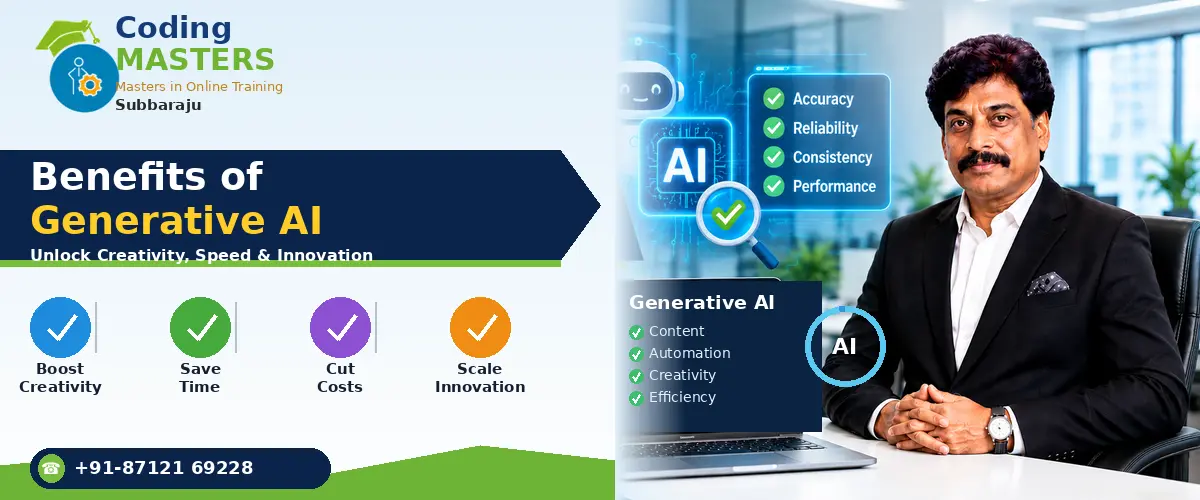
The uses of Generative AI go far beyond just creating new content. For businesses, teams are using it to complete more core work: achieving Increased Productivity, automating those trivial daily repetitive tasks, providing data and information support for management’s decision-making, optimizing the experience of every customer interacting with the brand, and even developing completely new applications that no one has built before. For ordinary workplace practitioners, learning to use Generative AI can also help them master technical capabilities that meet current industry needs, streamline the existing work processes they have been running, and reduce wasted effort.
Major Benefits of Generative AI
Boost Work Efficiency
One of the biggest benefits of Generative AI is that it can help people improve their work efficiency. Today, practitioners in all industries are swamped with many repetitive, time-consuming miscellaneous tasks that take up most of their energy, leaving them no time to focus on truly important core work. Various AI tools can just take over these trivial tasks, freeing people up to focus on what matters.
For example, it can help write the first draft of reports, summarize dozens of pages of long documents, brainstorm new ideas, build email frameworks, organize scattered and hard-to-understand information into clear explanations, and sort out all kinds of messy content. In the past, to complete these tasks, everyone had to build content from scratch and spend a lot of time to produce a rough prototype. Now, practitioners can use AI-generated content as a base, revise it to fit their actual needs, and take charge of the final quality check.
In this way, people can not only finish their work faster without wasting time on repetitive startup work, but also maintain full control over the content throughout the process, avoiding being led astray by AI-generated content, and firmly guarantee the quality of the final output.
Faster Content Creation
Generative AI can be a huge help for content creation. Whether it is professional writers who make a living from writing, marketers who need to follow up on various projects, social media operators who have to update content daily, or businesses that need to produce various promotional materials, everyone can use AI tools to build first drafts of content, come up with attention-grabbing headlines, draft product descriptions, create complete article frameworks, make first drafts of advertisements, or generate any other type of content they need.
In addition to creating new content from scratch, it can also rewrite existing old content, adjust the tone according to different publishing channels, condense large sections of information into abstracts, and even adapt the same core idea into several different versions suitable for different platforms and audiences.
Even though AI can save so much effort, before officially publishing AI-generated content, it is essential to carefully check it first. Confirm that its information is accurate, that it is original with no plagiarism, that it fits the needs of the current project, and that it complies with all the brand’s tones and requirements. It cannot be used directly as it is.
Improved Software Development
Generative AI can bring many tangible benefits to software developers. The various AI coding assistants on the market today can help developers write code for basic functions, explain unfamiliar open-source code they cannot understand, put forward modification suggestions for optimizing existing code, scan for potential program vulnerabilities, and generate supporting documentation for projects, saving developers from spending a lot of time writing these supporting materials.
Developers can also use Generative AI to brainstorm technical solutions for complex problems, or generate test cases that cover different scenarios, avoiding detours at the initial stage.
For example, developers using Python, Java, JavaScript, or any other programming language can use AI assistance in all stages of the development process: requirement sorting, coding, testing, and launch. They do not have to wait for a specific specific link to use it.
But mastering Generative AI does not mean you no longer need to learn programming knowledge; it cannot replace a developer’s own technical capabilities. Developers still need to understand the basic principles of programming. Before integrating AI-generated code into their projects, they must carefully check the logic, test the functionality, and confirm that it is actually usable and will not cause problems. They cannot directly copy AI-generated code into their projects.
Support for Software Testing
Another important use of Generative AI is its application in software testing work. It can help testers generate various scenarios required for testing, create data needed for testing, organize specific test cases, analyze problems that appear in programs, and record all work in all testing links as standardized documents for preservation.
Professionals specializing in automated testing can also combine Generative AI with various existing technical tools, including commonly used testing tools such as Selenium and Playwright, as well as API testing and various commonly used programming languages, to gradually develop a complete set of work processes for AI-assisted testing.
After this adjustment, testing teams can reduce repetitive manual operations, and spend the saved time on more core work such as more complex testing scenarios, in-depth quality analysis, and final result verification.
Automation of Repetitive Tasks
Generative AI can also help automate those repetitive and extremely time-consuming work processes.
Businesses can use systems with AI capabilities to handle various daily tasks, such as organizing various documents, responding to customers’ routine inquiries, extracting required content from massive amounts of information, generating various needed content, compiling various reports, and managing the enterprise’s internal knowledge base.
If Generative AI is combined with dedicated workflow automation tools and API, businesses can also build a complete system to handle multiple sequential steps in a business process.
After these repetitive tasks are automated, it reduces duplicated work for employees, allowing them to focus their energy on tasks that require human judgment and human creativity to complete well.
Better Access to Required Information
Generative AI can process large amounts of accumulated information to make it easier to understand. AI systems can condense long-winded documents into abstracts, break down complex and hard-to-understand concepts into straightforward explanations, extract important information separately, and organize scattered, unformatted messy data clearly.
For example, industry practitioners can first ask AI to summarize a very long technical document into an abstract, then review the complete original document for in-depth verification. Students can also use AI to understand those obscure and hard-to-grasp knowledge points through simple and easy-to-understand explanations.
However, in scenarios that require absolutely accurate information, especially when making technical, financial, legal, or medical-related judgments, or core decisions that affect business operations, it is still necessary to verify the original information. You cannot rely entirely on AI-generated content.
Personalized Learning
Generative AI can help you create a learning experience tailored to your own situation. Whether you are a current student or a workplace practitioner, you no longer have to force yourself to work through obscure tutorials that do not match your current level. As long as you tell the AI your knowledge background, the AI system can break down the knowledge points to be learned and explain them in a way you can understand.
For example, a beginner who has just started learning programming and has not yet mastered the basic grammar will be completely confused if they read professional documentation directly. At this time, they can ask the AI to explain core programming concepts in simple and straightforward terms. If a developer with years of experience is very familiar with the basic content and wants to dig deeper, they can ask the AI to provide a more in-depth and professional technical analysis of the same topic, without wasting time on content they already understand.
In addition to helping explain knowledge points that match your level, AI can also generate customized practice questions, explanatory examples to help you understand knowledge points, study plans that fully adapt to your learning progress, hands-on programming exercises, and detailed supplementary explanations for the corresponding content. It can assist in all links from planning to practice to Q&A.
For anyone who wants to learn new technical skills, Generative AI will be a practical learning assistant.
Improved Customer Experience
Businesses can use Generative AI, via AI-powered chatbots and virtual assistants, to make interactions with customers smoother. Customers no longer have to wait in long queues for human customer service, or flip through fixed FAQ pages. These systems can answer customers’ frequently asked questions at any time, provide relevant product or service information, handle basic support requests, and help buyers find the specific details they are looking for.
Generative AI can also help businesses create tailored responses to each customer’s question. It will combine the customer’s specific problem with the existing information within the business, so it will not miss key information or use generic clichés, making every response fit the customer’s needs and be precise and useful.
However, when encountering complex, sensitive, or rare customer problems, such as large after-sales disputes or special customized needs that cannot be handled by standardized logic, human customer support remains essential. AI cannot fully meet the needs of all special scenarios.
Faster Data Analysis and Summarization
Today, all industries have to process massive amounts of information. It would take several days for humans to read through the mountain of various reports and data documents. Generative AI can help practitioners understand large volumes of information. It can condense long reports to extract core content, identify key points scattered across different places, organize scattered and messy information clearly, and help users explore various data-related questions, so they do not feel lost staring at a pile of data.
When paired with the right data analysis tools, Generative AI can help data analysts and business teams understand all kinds of information faster, compressing the sorting work that originally took several days into a much shorter period, leaving their energy for in-depth analysis rather than organizing information.
However, the quality of the final analysis results depends on the quality, completeness, and reliability of the underlying raw data. If the raw data used for analysis itself has errors or omissions, AI cannot produce reliable results. At the same time, the final quality is also related to the specific AI system used; not any AI tool can produce accurate conclusions.
Supports Innovation
It can help individuals and various organizations promote innovation together. Whether you are an individual creator or a large team, you can use Generative AI to explore new ideas. Businesses can use this technology to brainstorm, sort out product concepts, create prototypes, develop usable marketing ideas, optimize internal workflows, and conceive new application directions. Developers can also use Generative AI to test brand-new software functions or build native applications with AI capabilities. This ability to quickly test and explore various ideas allows the entire team to maintain continuous innovation and always be willing to try new possibilities.
Development of AI Applications
Learning Generative AI can help technical practitioners break through the limitation of only using ready-made commercial AI tools. Developers can learn to use APIs, LLM, prompt engineering, databases, automation, and other core technologies to build fully customized AI applications. The applications that can be built include AI chatbots, document question-answering systems, content assistants, coding assistants, knowledge-base applications, and Retrieval-Augmented Generation (RAG) systems. Hands-on practical projects can help learners understand how different technologies cooperate and operate smoothly in real operating scenarios, rather than only staying at a fragmented understanding of individual technologies.
Career Skill Development
Generative AI is becoming an important skill for practitioners in the technology industry and many other industries. Learning Generative AI can add value to your existing knowledge of programming, software testing, data science, automation, cloud computing, business analysis, and more, allowing your original capabilities to exert greater value. Practitioners can also dive deep into specialized fields such as Generative AI development, AI application development, AI automation, AI testing, prompt engineering, LLM application development. The specific skills required to succeed in these fields are not fixed; they depend on the learner’s own position, the company they work for, and the actual requirements of their industry.
Why Learn Generative AI
Generative AI brings so many benefits that it is valuable for anyone to understand this technology: current students, new professionals just entering the workforce, development engineers, testers, data professionals, business analysts, and even senior practitioners who have been working in the IT industry for many years. Learning Generative AI cannot stop at only learning how to write efficient prompts; reaching only that step will never unlock the full value of this technology. A solid and systematic learning path must cover AI basic principles, prompt engineering, AI tools, programming, APIs, automation, application development, and also include practical hands-on projects to put the learned theory into practice. By combining the specialized knowledge of Generative AI with their existing professional skills, learners can find practical, value-generating methods to apply AI to their current work and their long-term career development path, expanding the boundaries of their professional journey.
Conclusion
The core advantages of Generative AI include Increased Productivity, Faster Content Creation, Improved Software Development, Support for Software Testing, Automation of Repetitive Tasks, Personalized Learning, Improved Customer Experience, sorting and summarizing information, Supports Innovation, and Development of AI Applications. It is not just a single tool that can only generate text or images; it has gradually integrated into modern work processes in fields such as technology, business, education, marketing, software development, testing, and automation, becoming an indispensable part of many people’s daily work. For anyone who wants to build future-oriented technical skills, understanding Generative AI and learning to use it responsibly is a critical step that can change your career trajectory. The best way to master this technology is to combine specialized AI knowledge with solid core foundations, practical projects, continuous learning, and always conduct manual checks on all AI-generated content to avoid risks from AI output.