

The Complete Step-by-Step Learning Path
Search “how to learn LLMs” and you’ll get fifty unrelated tutorials, three conflicting opinions, and no clear order to follow. Most learners don’t fail because the material is too hard. They fail because they never had a sequence to follow.
This LLM roadmap fixes that. It lays out the exact phases — in order — that take you from Python basics to building and deploying real LLM applications. Each phase ends with something you can actually build, not just another set of notes.
Use it as a full LLM learning roadmap if you’re starting from zero, or skim ahead if you already know the fundamentals and want an LLM roadmap for developers moving into GenAI work.
What Is an LLM Roadmap?
An LLM roadmap is a structured, sequential learning path that takes you from programming and prompting fundamentals through retrieval, application frameworks, agents, and deployment — in the order real projects and employers actually use them.
It’s different from a random playlist of tutorials in one key way: each phase builds directly on the skill you built in the one before it. You don’t jump to building an AI agent before you understand how a basic prompt-response chain works, the same way you wouldn’t study calculus before algebra.
A good roadmap also tells you when you’re done with a phase — not by a certificate, but by a small working project.
Why You Need an LLM Roadmap in 2026
- It stops wasted effort. Scattered YouTube videos and unrelated courses often repeat the same basics without building toward a job-ready skill set.
- It mirrors how GenAI interviews are structured. Roles now test foundations, RAG, framework usage, and agent design in that rough order — the same order this roadmap follows.
- It gets you to a portfolio project faster. Recruiters care more about one working RAG app than five completion certificates.
- It’s cheaper. One focused path beats five overlapping paid courses that all teach the same introduction twice.
If you’d rather follow this roadmap with a mentor and project reviews instead of alone, our Gen AI Training in Hyderabad program is built around this exact sequence.
The Complete LLM Roadmap: Step by Step
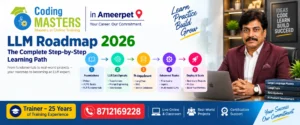
Phase 1: Programming and Foundations (1–3 weeks)
Solid Python, comfort calling APIs, and basic intuition for vectors and probability. You don’t need deep math here — just enough to reason about why similarity search works.
Phase 2: How LLMs Actually Work (1–2 weeks)
Tokens, embeddings, the transformer architecture at a conceptual level, context windows, and the difference between training and inference. Enough to reason about a model’s limits, not to build one from scratch.
Phase 3: Prompt Engineering and API Usage (1 week)
Calling LLM APIs directly, structuring prompts, using few-shot examples, and getting reliable, structured output back instead of free-form text.
Phase 4: Retrieval-Augmented Generation (2–3 weeks)
Embeddings, chunking strategy, vector databases, and building a working RAG pipeline that answers questions from your own documents instead of the model’s training data.
Phase 5: Frameworks and Application Development (2–3 weeks)
Frameworks like LangChain or LlamaIndex, so you’re not wiring every piece by hand. Build real chains, add memory, and parse structured output for an actual application.
Phase 6: Agents and Orchestration (2 weeks)
Tool-calling, multi-step planning, and frameworks like LangGraph for agents that decide their own next action instead of following one fixed chain.
Phase 7: Evaluation, Deployment, and Monitoring (2 weeks)
Tracing tools like LangSmith, cost and latency management, guardrails, and the basics of shipping an API instead of a script that only runs on your laptop.
Phase 8: Specialization (Ongoing)
Fine-tuning and LoRA for teams that need it, deeper MLOps for production reliability, or a shift toward GenAI product work. Pick this once the earlier phases feel solid, not before.
Benefits of Following a Structured LLM Learning Path
Learners who follow a sequenced LLM development roadmap consistently move faster than those learning at random, for a few clear reasons: each phase reinforces the one before it, every phase ends with a demo-able project instead of just notes, and progress is measurable — you always know exactly which phase you’re on. It also avoids the classic trap of “tutorial hell,” where you watch hours of content without ever shipping anything.
Best Practices for Getting Started
- Time-box each phase — two to three weeks — instead of letting it stretch indefinitely.
- Build one small project at the end of every phase. A working script beats another page of notes.
- Keep a public log of what you build, on GitHub or LinkedIn. It becomes portfolio proof as you go.
- Don’t skip RAG or prompting fundamentals to jump straight to agents — that’s where most learners stall out.
- Join a structured program or community, so you have a way to get unblocked instead of stalling alone.
- Revisit evaluation and deployment before calling any project “done.” A demo that only runs on your laptop isn’t finished yet.
Final Thoughts
An LLM roadmap only works if you follow the order and build something at every stage. Start with the fundamentals, move through RAG and frameworks, and treat agents and deployment as the finish line, not the starting point.
If you want this exact LLM career roadmap delivered with structured batches, project reviews, and mentorship, our Gen AI Training in Hyderabad program walks you through every phase above with real projects at each step.
Talk to our team to see the syllabus and find a batch that fits your schedule.
Coding Masters:
Flat No: 101, OPP: Siddartha Degree College,
Ameerpet Rd, Kumar Basti, Nagarjuna Nagar colony,
Yella Reddy Guda, Hyderabad, Telangana 500073
📞 Call/WhatsApp: 8712169228