


Introduction to API Testing
Initially, Playwright API testing allows testers and automation engineers to complete verification without relying solely on the software’s user interface. Instead, they directly connect to the interface to troubleshoot problems. Currently, all types of applications rely on interfaces to transmit information. Specifically, interfaces support all communication between front-end pages, back-end services, databases, and external systems. Consequently, teams can detect functional anomalies and module connection errors by starting interface testing early. Ultimately, this early testing prevents a massive outbreak of problems after finishing software development.
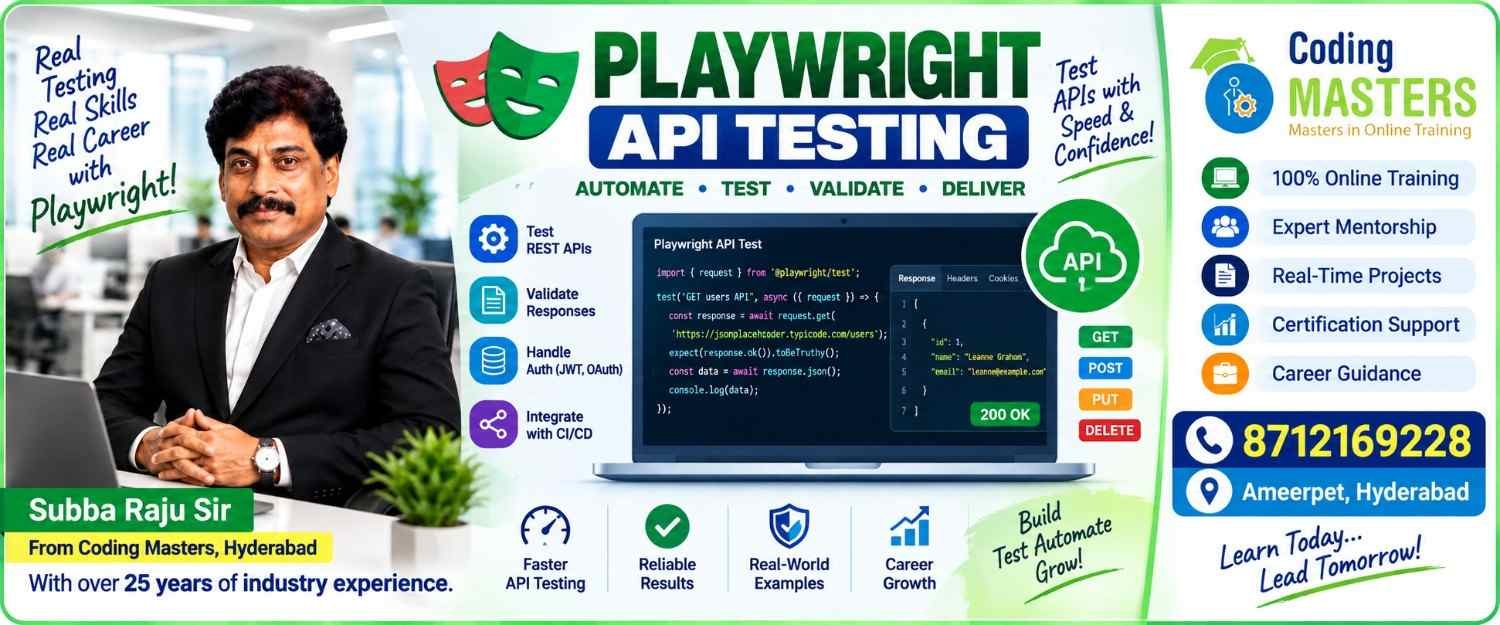
What Is Playwright API Testing?
Fundamentally, Playwright has native functionality to send interface requests and inherently supports interface testing. Furthermore, testers can integrate HTTP requests and result verification into a fully automated test suite. As a result, these tests run automatically without manual effort each time.
Specifically, common interface testing tasks supported by this functionality include:
-
Sending GET, POST, PUT, and DELETE requests.
-
Validating HTTP status codes.
-
Checking core returned data.
-
Verifying request and response header information.
-
Testing authentication workflows.
-
Validating JSON return format and content.
-
Testing the interface’s handling of abnormal scenarios.
-
Managing dedicated interface test data.
-
Combining API and UI testing processes.
Therefore, this unified toolset makes Playwright particularly suitable for projects needing both browser automation and interface verification within one framework. Additionally, it eliminates the need to combine multiple testing tools.
Usage and Advantages
First, testers create a dedicated interface request context to connect directly to any application interface. Moreover, these requests carry custom parameters, header information, authentication details, and the content body. Thus, this flexibility fully adapts to the target interface’s requirements.
Next, testers use the tool’s built-in assertion function after the interface returns results. This automatic verification checks if the status code, content body, and attributes meet expectations. Consequently, the system triggers an alert upon detecting any mismatch.
Furthermore, teams use interface testing to prepare stable test data before running page tests. This approach bypasses the need to build environments via manual page operations. For example, interface requests can create required test users and database records before browser-side tests run. Accordingly, this strategy saves preparation time and cuts out invalid repeated steps.
First and foremost, interface testing runs much faster than full-process page testing. Specifically, testers verify back-end functionality and find code problems without clicking through every application layer. Consequently, teams can invest this saved time into more complex test scenarios.
Additionally, Playwright seamlessly connects API testing to support a complete end-to-end testing process. For instance, testers can run interface operations and then launch the application in a controlled browser environment. Ultimately, this process verifies if end users see the expected data, effectively linking the interface and page layers.
Finally, teams use all interface and browser automation tools within the same test system. Playwright’s native testing functions and built-in reports help teams organize tests and track results. Therefore, testers avoid switching back and forth between different tools’ reports to find problems.
Best Practices for Interface Testing
To begin with, write clear and completely independent API test cases. Importantly, each case must not depend on the running results of other cases. Furthermore, it must cover normal successful scenarios and abnormal failing scenarios. Testers must also verify the status code, returned content, headers, and authentication processes. Specifically, they should validate all core rules bound to the interface’s business objectives.
In addition, test abnormal boundary scenarios by inputting invalid content or omitting required parameters. Similarly, send unauthorized requests or incorrectly formatted data to ensure the interface intercepts these errors. Instead of only testing smooth scenarios, try to isolate each test data source to reduce fragile dependencies. Consequently, this isolation prevents one failed case from causing a cascade of failures.
Moreover, teams must integrate interface testing into regular regression testing and CI/CD processes. By doing so, this integration continuously verifies core back-end functions whenever developers modify code. Ultimately, it prevents broken old interface functions from going unnoticed when adding new features.
In conclusion, a reasonably designed test architecture helps the team efficiently verify interfaces with Playwright. Additionally, it works well with existing browser-side automation strategies and eliminates connectivity problems.
FAQs
-
Q: What Is Playwright API Testing?
A: It is the process of using Playwright’s native capabilities to send HTTP requests and then verify interface responses.
- Q: Can Playwright test REST API?
A: Yes, Playwright sends HTTP requests to any interface address and verifies results, making it suitable for REST testing. -
Q: What HTTP methods can you test?
-
A: Specifically, Playwright’s request functionality tests all common methods, including GET, POST, PUT, and DELETE.
-
-
Q: Can you use API testing and UI testing together?
A: Yes, teams can combine interface operations and browser-side testing. For example, interfaces can create required test data before page-related verifications run.
-
Q: Why choose Playwright for API testing?
A: Fundamentally, Playwright integrates interface and browser automation within the same framework. Consequently, this integration helps teams build easy-to-maintain automated test suites.
Want to learn more about Playwright API Testing in Hyderabad? Contact Coding Masters:
Gen AI and Agentic AI Training – Coding Masters
Flat No. 101, Bhavya Krishna Residency,
OPP: Siddartha Degree College,
Ameerpet Rd, Kumar Basti,
Nagarjuna Nagar colony,
Yella Reddy Guda,
Hyderabad, Telangana 500073
 Phone: 8712169228