

Prompt Optimization is a practical skill that anyone using contemporary large language AI tools can leverage. Many people have encountered this situation: after sending instructions to an AI, the generated responses are either incomplete with missing content, logically confusing and unreadable, or completely unrelated to what they actually asked for. AI Testing Training in Hyderabad Most of the time, these problems are not caused by the AI being ineffective, but by the overly vague requirements you wrote at the start, which prevent the AI from grasping your true intentions. Prompt Optimization exists specifically to solve this problem—it helps you refine those requirements you send to the AI, so that the final output truly aligns with your original needs.
What Is Prompt Optimization?
Prompt Optimization does not require you to discard all your original requirements and write an entirely new prompt from scratch. Instead, it involves making adjustments to the prompt you have already drafted, with the sole goal of obtaining results that better match your expectations.
The specific aspects to adjust are clear: use more accurate phrasing, add details that help the AI understand your needs, remove any content that might confuse the AI, and finally fully articulate the output you want, so that all your requirements are completely communicated to the AI.
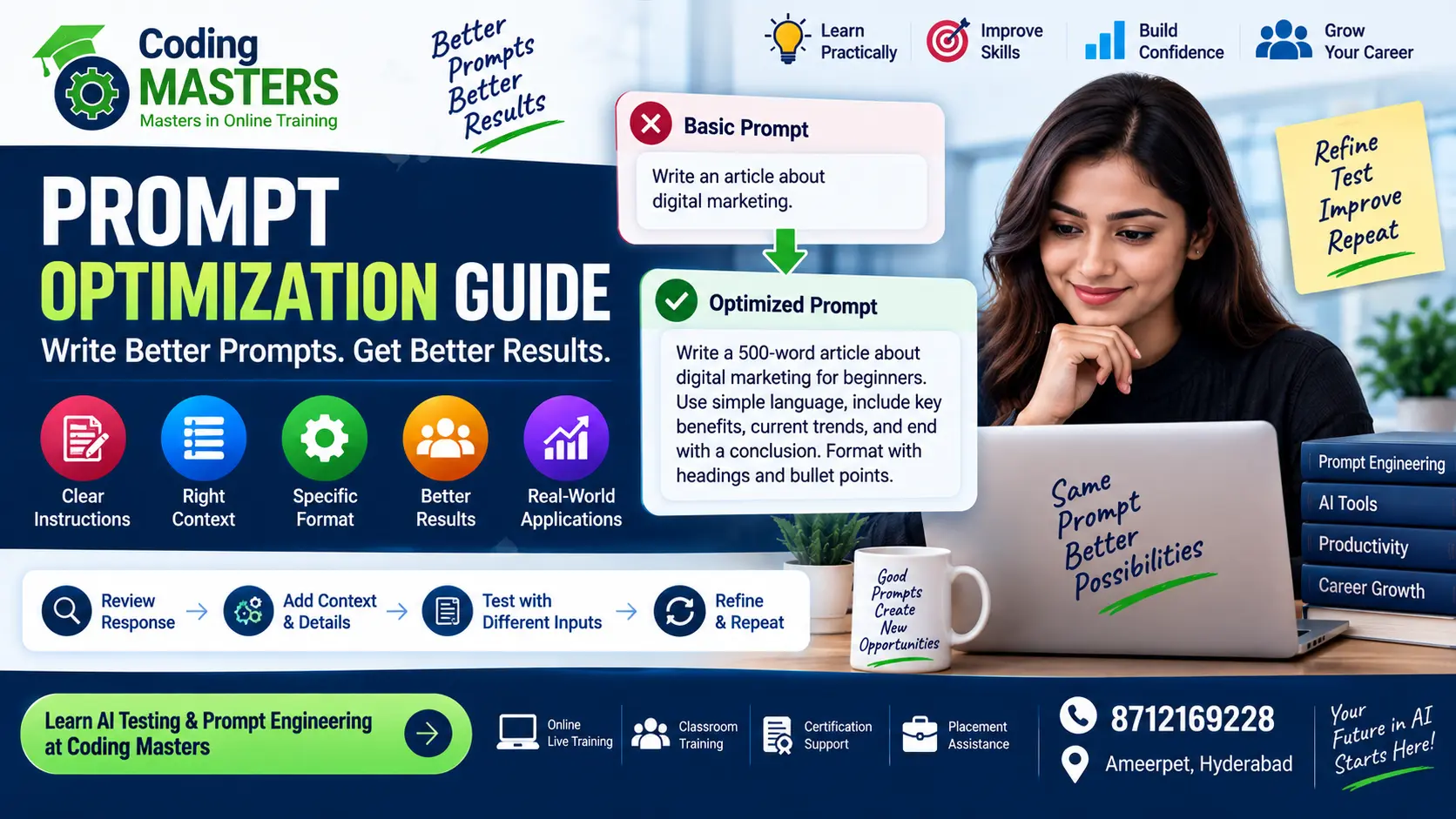
You can understand this with a practical example. If you only send the AI a simple request like “write a piece of content related to digital marketing”, this overly vague requirement will only lead the AI to output a generic piece of content that touches on everything but delves deep into nothing, which can never meet your real needs.
But if you refine your prompt thoroughly and add several key pieces of information—your target audience for this content, the required word count, the writing tone and style, the specific topic within digital marketing you want to discuss, and the content format, whether it is an official account push post or an industry report. With these details added, the AI will have a clear grasp of the task it needs to complete, and will no longer produce vague, generic content.
One more point must be clarified: the core of Prompt Optimization is to refine existing requirements, not to create a brand-new prompt from scratch. When is this method most suitable to use? In most cases, it is when you send your initial requirements to the AI and the response you receive fails to meet your expectations—at that point, you can use Prompt Optimization to make adjustments.
Why Is Prompt Optimization Important?
A comprehensive and clearly written prompt can tangibly improve the quality of the AI’s responses: the output will never go off-topic, has strong relevance, is clear and easy to understand, and maintains logical coherence throughout. More importantly, it saves you from a lot of unnecessary detours—you will not have to repeatedly send your request to the AI and revise its output over and over again.
Whether you are a content creator who needs to write articles on a daily basis, a software developer who collaborates with AI, a customer support specialist who handles client inquiries, a researcher who sorts through reference materials, an educator who prepares and teaches classes, or even a professional handling internal business communications, this skill is applicable in all these scenarios.
Conversely, if your requirements are unclear and the AI cannot accurately capture your needs, it can only guess content to fill in the gaps, which naturally leads to all kinds of problems in its output.
Adding appropriate background information to your requirements eliminates much of this confusion, making it easier for the AI to understand exactly what you want. However, it is also important to note that even with a well-optimized prompt, you cannot guarantee that every AI response will be completely correct. Before using any important information generated by the AI, you must personally review and verify it—you cannot use it directly without checks.
Core Principles of Prompt Optimization
To implement Prompt Optimization well, your first step is to clarify what goal you want to achieve with that specific prompt. You must first answer two core questions: what is the specific task you want the AI to complete, and what does a reliable final result look like? Once you have clarified these two core questions, you can add background information related to the task to your requirements.
When stating the task, avoid convoluted, complex language; use simple, straightforward phrasing to explain what needs to be done to the AI.
Beyond background information, you can also specify additional detailed requirements in your prompt: the tone you want the content to use, your target audience, the required word count, and the final output format.
If you require the AI to follow a specific structure—for example, writing a report that presents the background first before introducing the conclusion—it is best to provide a clear example for the AI. A concrete example helps the AI quickly understand the output pattern it needs to follow, so it does not deviate from your requirements.
Another equally important task is to remove all unnecessary requirements from your prompt. Piling on too many requirements unrelated to the core task will overcomplicate your entire request, leaving the AI unable to identify the priority and unsure which requirement to fulfill first.
Only a prompt with prominent core information is easier to test, adjust, and conveniently continue optimizing in the future.
Specific Steps to Optimize Your Prompt
You do not need to pursue perfection from the very start when optimizing your prompt. You can first send a simple, basic version of your requirements to the AI. Once the AI outputs its response, you can check it line by line, carefully noting which content you wanted is missing, and which parts do not meet your expectations.
After identifying these issues, you can make targeted adjustments: either add more background information to your original requirements, revise unclear phrasing to make it more accurate, or explain your desired outcome in greater detail to fill in the gaps.
After revising one version of your prompt, do not just use it once and set it aside. You should test this revised requirement multiple times with different inputs. Compare the responses generated by the AI each time to check if the adjustments you made have actually improved the output content.
If there are still issues, continue adjusting and refining your requirements until the AI can consistently produce stable, reliable results. There is also a small tip: record any prompts that you have tested and confirmed to work well. When you encounter a similar task later, you can reuse them directly, saving you the work of refining a prompt from scratch.
Career Opportunities Related to Prompt Engineering
Mastering the skill of Prompt Optimization is beneficial for professionals across many industries: whether you are a content creator who relies on writing for a living, a developer who writes code, a tester responsible for product testing, a digital marketer who runs promotion campaigns, a researcher working in a laboratory, or a business professional who manages client accounts on a daily basis, learning this skill will improve your work efficiency.
If you are a beginner just starting to learn this skill, do not worry about having no way to practice. You can start practicing with common daily scenarios: for example, optimizing the prompt you use to ask the AI to write documents, refining the requirements that ask the AI to generate test cases, or practicing with prompts that ask the AI to extract data, summarize long articles, or handle customer inquiries. These common scenarios are all suitable for practice to help you master the skill.
These practical skills you develop will also help you access learning and development opportunities in more related fields: whether you choose to pursue Prompt Engineering, AI Testing, automation, or language model evaluation, having a foundation in Prompt Optimization will allow you to get up to speed faster and gain space for further advanced study and growth.
Learn Prompt Engineering at Coding Masters
Coding Masters helps learners explore concepts related to Prompt Engineering through practical examples and a skill-centric learning approach.
Students who want to expand their knowledge in this field can also learn about the AI Testing Training in Hyderabad offered by the institution. You can also visit the Coding Masters Training Centre in Hyderabad to learn more about the available training options.

Frequently Asked Questions
What is Prompt Optimization?
Prompt Optimization means improving an existing prompt to receive clearer, more relevant, and more useful results.
How can I improve a prompt?
Add clear instructions, useful context, examples, specific requirements, and the expected output format.
Is Prompt Optimization useful for beginners?
Yes. Beginners can start with simple prompts and improve them through regular practice.
Why should prompts be tested?
Testing helps you understand whether the revised prompt produces the expected results across different situations.
Gen AI and Agentic AI Training – Coding Masters
Flat No. 101, Bhavya Krishna Residency,
OPP: Siddartha Degree College,
Ameerpet Rd, Kumar Basti,
Nagarjuna Nagar colony,
Yella Reddy Guda,
Hyderabad, Telangana 500073
 Phone: 8712169228