

A Complete Prep Guide
You built a RAG demo, read a few blog posts, and now an interviewer asks you to walk through how you’d design a RAG pipeline for 10 million documents.
Do you have a solid answer?
This guide contains the RAG interview questions candidates actually get asked in 2026, from basics to system design-level questions.
It’s designed for freshers on their first GenAI interview, experienced developers looking to pivot into AI, and everyone in between who wants a structured RAG interview prep guide instead of fragmented internet notes. We focus on responses that are short enough to say out loud in an interview.
What Are RAG Interview Questions?
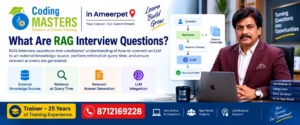
RAG interview questions test candidates’ understanding of how to connect an LLM to an external knowledge source, perform retrieval at query time, and ensure relevant answers are generated.
They’re distinct from prompt engineering questions in that a prompt engineering question will ask how you’d phrase an instruction, while a RAG question will ask how you’d design a chunking strategy, choose an embedding model, or prevent hallucination.Interviewers use RAG questions because the majority of production GenAI systems are not fine-tuned models, but rather RAG pipelines built on top of a company’s document collection, support tickets, or product database.
Why RAG Interview Questions Are Important in 2026 Hiring
RAG has become one of the most sought-after interview topics for a good reason: almost all GenAI Engineer, AI Engineer, and ML Engineer job descriptions explicitly list it.
RAG questions let interviewers differentiate between candidates who have actually built a RAG pipeline and those who only know ChatGPT.
Moreover, recruiters are starting to ask architecture-level RAG questions during system design interviews.
Having thorough RAG interview prep for freshers and experienced professionals has become a true differentiator, not a bonus.
In our Gen AI training in Hyderabad program, you’ll get hands-on experience with a RAG project so you can demonstrate your understanding of chunking, retrieval, and evaluation at an interview.
RAG Interview Questions for Freshers
1. What is RAG (Retrieval-Augmented Generation)?
RAG connects an LLM to an external knowledge source at query time. Instead of being limited to just the information it was trained on, the model can retrieve relevant text from an external corpus and generate an answer based on that information.
2.How is RAG different from fine-tuning?
Fine-tuning requires modifying the model weights. RAG, on the other hand, leaves the model untouched and simply adds additional context during inference in the form of the retrieved text. RAG is much cheaper and easier to update; fine-tuning bakes the behavior into the model weights permanently.
3. What are the main components of a RAG pipeline?
The components are a document loader and chunker, an embedding model, a vector store or retriever, and an LLM that uses the retrieved context to generate an answer.
4. What is a vector embedding? Why does RAG need one?
A vector is a numeric representation of text that captures its meaning. Embeddings allow the RAG system to perform semantic search during the retrieval step.
5. Name a few vector databases used in RAG systems. FAISS,
Pinecone, Chroma, and Weaviate are all popular RAG vector databases. RAG Interview Questions for Experienced
6. What is chunking? Why does chunk size affect performance?
Chunking is splitting the text into smaller pieces before encoding them as vectors. Larger chunks reduce retrieval accuracy and precision, while too small chunks lead to losing the context.
Most teams experiment with chunk sizes between 300 and 800 tokens and pick the size that maximizes performance on the given task.
7. How do you evaluate a RAG system?
The evaluation has two stages: retrieval and generation. For retrieval, you need to answer the questions of precision and recall. For generation, the most important metrics are faithfulness and relevance. RAGAS is a popular framework for evaluating RAG systems.
8. What causes hallucination in RAG? How can it be reduced?
When the generated answer has information not present in the retrieved documents. Hallucination can be reduced by stricter prompting, requiring the model to cite the relevant contexts, and reranking the retrieved chunks by relevance to the query.
9. What is the difference between dense and sparse retrieval?
Dense retrieval uses vector embeddings to represent the document meaning and find semantically similar chunks. Sparse retrieval, on the other hand, relies on keyword matching, with TF-IDF or BM25 algorithms. Most production systems use combinations of both.
10. What is a reranker? Where does it fit in the RAG pipeline?
A reranker is a model that takes the retrieved chunks in the context of the query and reorders them, with the highest ones scoring being the most relevant. Reranking is a separate step that happens after retrieval and before the chunks are sent to the LLM for answer generation.

RAG Architecture Interview Questions
11. How would you design RAG for large and frequently updated document sets?
Such a system would need an incremental indexing pipeline so that adding a new document does not require reindexing the entire database. Additionally, you can use metadata filtering and hybrid search to narrow down the retrieval scope. To control latency, you could also implement a caching layer for frequently searched terms.
12. How does agentic RAG differ from standard RAG?
In standard RAG, the model retrieves relevant chunks and directly answers the query. In agentic RAG, the model can decide whether it retrieved enough information and if not, what additional query to make to get more relevant documents.
13. How would you handle multi-turn conversations in a RAG chatbot?
The model needs to be able to use the context from previous interactions. This can be implemented by transforming each subsequent turn into a self-contained question given the conversation history. You can also use retrieval with the conversation history to ground the response.
Common Mistakes Candidates Make
Reciting definitions without trade-offs.
Talking about trade-offs only at a theoretical level. Being able to describe the strengths and weaknesses of chunking, or dense and sparse retrieval, is not enough: a candidate should be able to walk through when they would pick one option over another.
Ignoring evaluation.
Evaluation. Candidates sometimes forget to mention retrieval evaluation, when describing how they’d measure a RAG system’s effectiveness.
Treating chunking as an afterthought
Chunking should also be part of the evaluation design.Answers that talk about chunking as an afterthought. Chunk size and overlap directly impact the quality of answers: having an answer that is too long or too short is a common mistake, as well as not understanding the trade-offs between the two.
Skipping failure modes.
Failing to discuss failure modes. Candidates should be able to describe what would happen in your RAG system if the retrieval component returned no results.
Best Practices for RAG Interview Preparation
Create your own end-to-end RAG prototype before the interview.
Practice talking about chunking, embeddings, and retrieval out loud in under 30 seconds.
Learn one evaluation framework (e.g. RAGAS or a manual precision/recall check) well enough to walk through it without notes.
Finally, prepare a bug story: walk through an issue you’ve had with your RAG system and how you resolved it.
We also recommend brushing up on agentic RAG and LangGraph-style orchestration, as many interviews are now shifting towards it.
Practice time yourself on five questions from this list until you’re comfortable and confident.
Final Thoughts
RAG interview questions are designed to identify candidates who have built a RAG system, not just read about it. Know the core components, practice the trade-offs, and make sure you have one project you can talk through in detail.
If you want that hands-on foundation prior to your next interview, our Gen AI training in Hyderabad program walks you through a complete RAG build with project reviews along the way. Talk to our teams to see the syllabus and pick a date that works for you.
Coding Masters:
Flat No: 101, OPP: Siddartha Degree College,
Ameerpet Rd, Kumar Basti, Nagarjuna Nagar colony,
Yella Reddy Guda, Hyderabad, Telangana 500073
📞 Call/WhatsApp: 8712169228