

Introduction
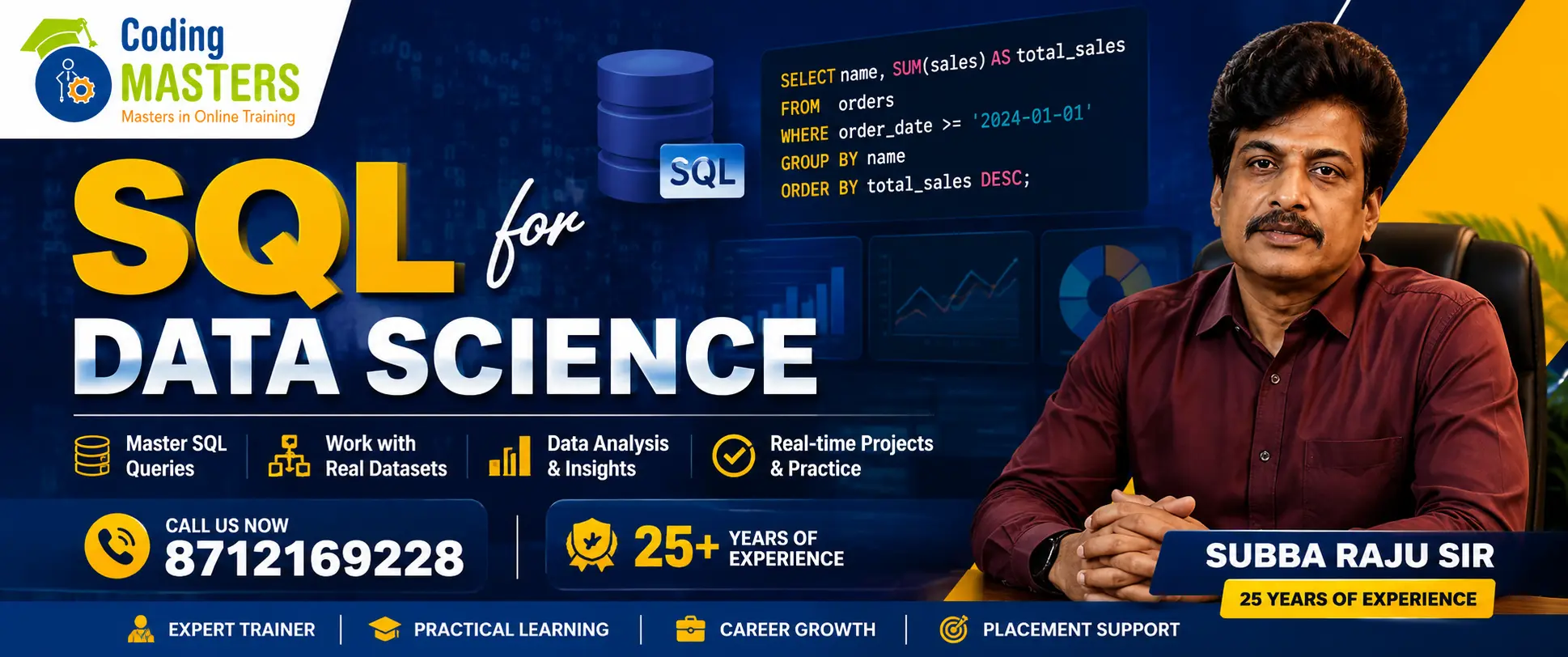
SQL is a core tool in the field of data science. The course SQL for Data Science helps practitioners confidently work with all types of structured data. Data teams can rely on SQL to complete data collection, cleaning, and transformation, as well as analyze business information. Solid SQL skills can optimize data science workflows and improve analytical thinking. Moreover, SQL can connect data scientists with the standard databases used in modern companies, enabling operations such as filtering records, joining tables, calculating metrics, and mining valid patterns. In addition, it can support exploratory analysis before a machine learning model is built. For these reasons, SQL knowledge is a practical foundation for data science projects. As a result, most learners tend to choose training programs that improve both their SQL and analytical skills at the same time. Online learning fits the flexible schedules of working professionals. Currently, Coding Masters offers a guided version of this course. Its instructor, Subba Raju Sir, has 25 years of industry experience. There are also related training programs with hands-on support available in the Ameerpet area. Furthermore, learners can build confidence in their practical skills through regular practice.
Why SQL Matters for Data Science
SQL allows data practitioners to directly access structured information within databases and conduct research into business problems without relying on complex tools. It can quickly filter for useful columns and sift out relevant records, and it can also join four types of core business data—customer, sales, product, and transaction data—to calculate key business metrics using aggregate functions, such as comparing revenue across regions and across products. In addition, SQL supports data quality checks before advanced analysis, identifying null values, duplicate records, and anomalous entries through simple queries, which makes data preparation work more efficient and organized. Furthermore, solid SQL skills help practitioners communicate smoothly with database and analytics teams and strengthen their logical thinking. For these reasons, SQL has remained a highly valuable core skill in modern data science workflows.
SQL Skills Covered in Data Science Training
Learners who want to systematically study SQL can start with a tiered learning path that progresses from entry-level to advanced skills: first master database principles and basic query structures, then become proficient in core query operations, before moving on to learning multi-table joins, query optimization, window functions, and practical utility functions. These skills can support the preparation of datasets for dashboards and analytical models. Project-based practice can improve proficiency far faster than pure theoretical learning. Data Science Coaching, located in Amirpet, offers guided practice and instructor feedback. Subba Raju Sir from Coding Masters has 25 years of training experience and is able to provide clear explanations. The accompanying hands-on assignments can also help you link SQL commands to business outcomes, laying a solid foundation for subsequent data analysis projects.
Career Benefits of Learning SQL for Data Science
SQL brings clear career benefits to job seekers in the data field. Employers generally require data practitioners to master data extraction and database querying skills, so SQL can support two core roles: data analyst and data scientist. Moreover, SQL can use reliable database information to answer business questions, and it can also improve the efficiency of collaboration with Python and visualization tools. This combination can support hands-on projects and optimize analytical workflows. As a result, these projects help you demonstrate your problem-solving skills in job interviews.
If you are screening top-tier Data Science Courses in Ameerpet, you must check whether the courses include sufficient hands-on SQL training, and also compare their supporting projects, instructor experience, practice exercises, and career support services. A local institution called Coding Masters has set SQL as a core module throughout its full training process. Subba Raju Sir from this institution has 25 years of experience in industry training. Targeted SQL practice can support your long-term growth in a data career, while also strengthening your professional portfolio and improving your interview performance.
SQL Topics Every Data Science Learner Should Practice
To learn SQL, one must first solidify the foundational knowledge before moving on to advanced analytical queries. Mastery of knowledge points can be achieved in the following sequential order: first, grasp the SELECT statement, WHERE clause, ORDER BY clause, and basic functions; next, practice using GROUP BY and HAVING, which are applied for aggregated business comparisons; then learn join techniques such as inner joins and left joins; after that, practice subqueries and common table expressions used for analysis.
Additionally, one must master window functions for ranking and rolling calculations, CASE expressions for categorizing business segments, date functions for analyzing trends across time dimensions, and string functions for cleaning and standardizing text. Regular practice builds confidence in writing accurate queries. Most Data analysis courses offered in Ameerpet, India cover these contents. It is recommended to choose training programs that provide sufficient practice opportunities and real-world datasets. Regular review helps learners memorize query patterns and avoid common mistakes.

How SQL Supports Real-Time Data Projects
Most enterprises use relational databases to store their operational data. SQL can support a large number of real-world business projects. Learners can use it to conduct multi-dimensional analysis on revenue, orders, customers, and products for sales projects, or analyze user retention and engagement for customer-facing projects. They can also prepare datasets for Power BI, Tableau, Python, and machine learning applications, build analytical tables for reports, and mine trends that support decision-making. Hands-on projects help learners understand the meaning of SQL commands, and develop both their technical skills and analytical thinking at the same time. Relevant courses in Ameerpet, India, can add this type of hands-on practice. The institution Coding Masters integrates SQL with broader data science concepts, and its courses are taught by Subba Raju Sir, who has 25 years of training experience. These projects also help learners refine their professional portfolios and perform better in job interviews.
Choosing the Right SQL and Data Science Course
When choosing a data science course, never use tuition fees as the sole decision-making criterion. First, you must verify the core dimensions of the course: whether the SQL syllabus covers advanced topics, whether the instructors have reliable professional experience and teaching methods, whether the course provides real datasets and hands-on assignments, and whether it includes core content such as Python, statistics, machine learning, and data visualization. In addition, for local training institutions in Ameerpet, India, local tuition fees fluctuate based on the depth of training provided. It is recommended that you prioritize training outcomes as your evaluation standard. For example, the local institution Coding Masters offers guided hands-on training, and its courses are taught by Subba Raju Sir, who has 25 years of industry experience. Ultimately, your course selection must align with your own career goals and learning pace. Mastering SQL can also add value to your resume and performance in technical job interviews.
FAQs
Regarding SQL in the field of data science, we have compiled core answers to the most frequently asked questions from beginners:
What is SQL?
It is a universal structured query language for the data field.
Why learn SQL?
It is a core tool for data extraction and analysis.
Is SQL difficult to learn?
People with no foundational knowledge can master the basics quickly.
Do I need to learn other programming languages first?
No, you can start learning it directly.
What are the core contents to learn?
Query statements, table joins, data filtering and aggregation.
What can it be used for?
It supports all scenario-based tasks including data analysis, user portrait construction, and business report generation.
What should I pay attention to when choosing a training program?
Prioritize evaluating the instructors’ practical work experience and the course’s hands-on practicability.
Where is a good place to learn it?
We recommend the specialized course launched by Coding Motors. The course instructor is Subba Raju Sir, who has 25 years of industry experience. The training is held in Ameerpet, and it covers all stage requirements from introductory learning to practical operation.
Address:
Flat No: 303,
Bhavya Krishna Residency,
Siddartha Degree College,
OPP: Ameerpet Rd,
Kumar Basti,
Nagarjuna Nagar colony,
Yella Reddy Guda,
Hyderabad,
Telangana 500073
📞 Call Now: 8712169228