

Artificial Intelligence (Artificial Intelligence, AI) and Data Science are two of the fastest growing fields in the technology sector. They are closely linked, but they are fundamentally not the same thing. Many people confuse these two fields;
in fact, both fields use data, algorithms and computer technology, but their core objectives and application scenarios are very different.
Understanding the difference between the two can help students still in school, working professionals already in the workforce, technical developers who write code, or people planning to switch industries and
change career tracks, to choose a career path that suits their own needs, rather than picking the wrong track because of unclear direction.
What is Artificial Intelligence?
The core of Artificial Intelligence is to build a set of systems that can complete tasks that originally required human intelligence to accomplish.
In other words, tasks that previously required humans to think and work through can be handled independently by this AI system.
Specifically, AI systems can learn from information, identify patterns hidden in various types of data, understand and interpret human language, make judgments and decisions autonomously,
generate never-before-seen new content, and even automate all complex tasks with tedious steps, eliminating the need for continuous human supervision and intervention throughout the process.
Key Areas of Artificial Intelligence
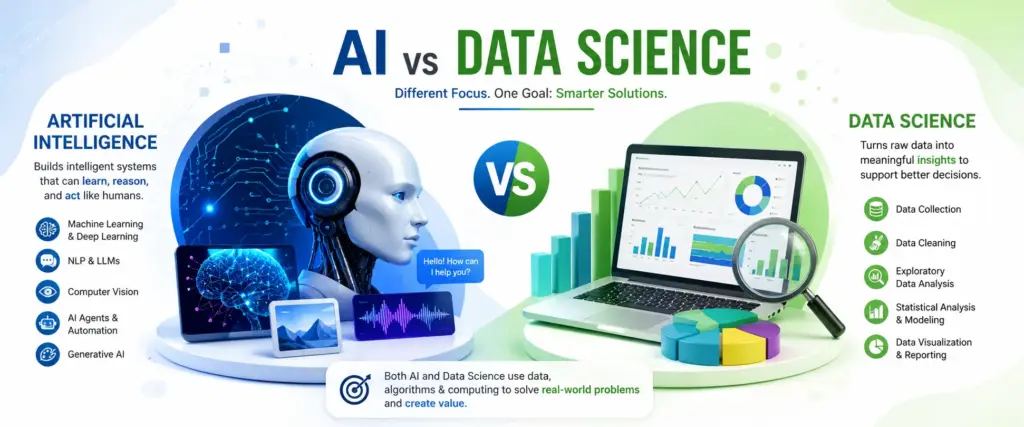
Today’s Artificial Intelligence covers many subfields, such as Machine Learning, Deep Learning, Generative AI, Natural Language Processing (NLP), Computer Vision, Large Language Models (LLMs), AI Agents, and Robotics.
All these subfields are part of Modern AI. Among them, Generative AI can produce text, images, audio, video, and even code.
This capability has allowed AI to be applied in a growing number of different industries, finding use cases in media, manufacturing, and the internet, among others.
What is Data Science?
The core of Data Science is to extract meaningful insights and knowledge from data to help people make more reasonable decisions.
Unlike Artificial Intelligence, Data Science revolves around data from start to finish, digging out truly useful content from massive, disorganized amounts of data. Data Scientists process various types of structured and unstructured data—t
hat is, formatted data neatly stored in tables, and unstructured scattered data such as text and images without fixed formats.
The tools they use include Python, SQL, statistics, Data Analytics, Machine Learning, Data Visualization, and Deep Learning, which they rely on to sort out chaotic data and make sense of it.
Data Science Workflow
A standard Data Science workflow generally includes these steps:
collecting data, cleaning datasets, exploring patterns in the data, conducting statistical analysis, building predictive models, validating model results, and finally synchronizing the organized information to business teams.
Every step in the entire process centers around the same core goal: this goal is not simply to analyze data and call it a day, but to turn scattered raw information into usable knowledge, converting it into quantifiable business value—
that is, value that can be practically implemented in business and calculate specific returns, rather than vague, useless information.
AI vs Data Science: Key Difference
To distinguish the core difference between Data Science and Artificial Intelligence, it is sufficient to first look at their respective core objectives.
There is no need to get wrapped up in complex technical jargon; starting from the most fundamental original purpose of each field, the two can be immediately separated.
What Does Data Science Focus On?
What Data Science does is interpret data, dig out hidden patterns, produce actionable insights, and rely on these insights to help enterprises make business decisions.
Simply put, it means taking a pile of data, disassembling and organizing it, digging out content that no one can directly see—
such as user preferences and business bottlenecks hidden in the numbers—and turning it into specific references that business teams can use.
Whether adjusting pricing or expanding to new customer groups, decisions can be made based on these organized conclusions, rather than making impulsive choices.
What Does Artificial Intelligence Focus On?
Artificial Intelligence is different; its focus is on building intelligent systems. These systems can learn autonomously, predict outcomes, use logical reasoning, generate original content, and independently complete various complex tasks even with minimal human intervention.
It does not need to wait for humans to interpret and analyze it;
instead, it becomes an executable tool that takes over tasks that originally required humans to spend time and energy on, freeing people from repetitive work or work that requires continuous supervision.
How AI and Data Science Work Together
There are also many overlapping areas between the two fields. Data Scientists often use Machine Learning and AI technology to optimize their analytical work.
That is, people working in Data Science also use Artificial Intelligence tools to speed up their work of digging out patterns and producing insights, making their analytical results more accurate.
Conversely, for AI systems to complete their core training and verification processes, they are also extremely dependent on high-quality data support.
Artificial Intelligence systems do not become smart out of thin air; they need to be fed large amounts of reliable data to learn from, and rely on accurate data to verify whether their outputs are correct.
Without high-quality data, even the most advanced Artificial Intelligence frameworks cannot function.
Which Career Path Should You Choose?
When choosing between AI and Data Science as a career direction, the core depends on your own interests and the long-term career goals you want to achieve.
There is no need to struggle over which field others say is more popular or has more prospects; choosing according to your own preferences and plans will let you progress smoothly.
Choose Data Science If You Enjoy Working With Data
If you enjoy immersing yourself in datasets, doing statistics, running business analyses, creating data visualizations, and building predictive models, then Data Science may be more suitable for you.
Working with all types of data every day, digging out concrete patterns from chaotic information, and outputting conclusions that help businesses make decisions will make this type of work feel fulfilling and natural for you.
Choose AI If You Enjoy Building Intelligent Applications
If you would rather build intelligent applications that can think on their own, and are interested in fields such as Generative AI, Deep Learning, LLMs, Computer Vision, NLP, and AI automation, then choosing a job in the AI direction will be a better fit.
You can dive deep into these subfields, personally build intelligent tools that can understand language, recognize images, and generate content, and watch the products you create launch and solve practical problems, which aligns with your expectations for technical work.
Combining AI and Data Science Skills
For many practitioners, mastering the skills of both fields solidly can build a unique advantage for their career development. Only understanding the content of one field can easily lead to ability bottlenecks; if you grasp both, you will have far more opportunities available to you than someone who only specializes in one.
With a solid foundation in Data Science, paired with skills in AI and Generative AI, you can both understand the logic behind data, build intelligent models, and develop practical AI solutions to solve specific problems encountered in real business scenarios.
You will not be unable to interpret the underlying logic of data like someone who only understands AI, nor will you be unable to build self-operating intelligent products like someone who only understands Data Science.
No matter what business needs you encounter, you will be able to come up with a complete, implementable solution.
Gen AI and Agentic AI Training – Coding Masters
Address
flat no 101,
Bhavya Krishna Residency,
OPP: Siddartha Degree College,
Ameerpet Rd,
Kumar Basti,
Nagarjuna Nagar colony,
Yella Reddy Guda,
Hyderabad,
Telangana 500073,
India
phone no.91- 87121 69228