

Artificial Intelligence, Machine Learning, and Data Science are the three most discussed and sought-after fields in today’s technology industry. Whether in casual chats or industry exchanges, people always use these three terms interchangeably, but they are not the same thing. The core objectives, implementation scenarios, commonly used tools, and long-term career development paths of each field are different from the other two.
Taking the time to clarify the differences between these three fields will help students, recent graduates looking for jobs, and working professionals with existing work experience to choose a career direction that suits them. They can also targetedly develop the skills required by the technology industry to keep up with industry demands.
In this blog, we will break down the similarities and differences between AI, ML, and Data Science, clarify their core distinctions, the skills that must be mastered to excel in each field, the career opportunities available after entering the industry, and the deep connections that bind these three disciplines together.
What is Artificial Intelligence (AI)?
Artificial Intelligence, or AI, is a broad branch of computer science. Its core goal is to create machines and software that can complete specific tasks—tasks that originally could only be accomplished using human intelligence. AI systems can process and interpret the information they receive, identify stable patterns hidden in the data, make independent decisions, solve complex problems, understand human language, and even generate original content.
In practical applications, common Examples of AI implementations include:
- Chatbots and virtual assistants
- Generative AI tools
- Recommendation systems
- Self-driving cars
- AI-powered customer support systems
- Image and speech recognition
- AI Agents
- Fraud detection systems
Current AI development also leverages core technologies such as Generative AI, Large Language Models (LLMs), Natural Language Processing (NLP), Computer Vision, and AI Agents to expand its capability boundaries.
What is Machine Learning (ML)?
Machine Learning, or ML, is a specialized subfield under the broad umbrella of Artificial Intelligence. Unlike standard system development, which requires developers to manually code every operating rule, ML algorithms do not need to hardcode all rules. They can independently identify patterns from massive amounts of training data, then use these learned patterns to generate new predictions or decisions.
Take a real-world application scenario: an ML model analyzes historical customer behavior data to predict the probability that a specific customer will stop using the company’s services. Common implementation scenarios for Machine Learning include:
- Customer churn prediction
- Fraud detection
- Sales forecasting
- Product recommendations
- Spam email identification
- Predictive maintenance
- Image classification
- Credit risk prediction
The mainstream Machine Learning technologies that support these scenarios are supervised learning, unsupervised learning, and reinforcement learning.
What is Data Science?
Data Science is an interdisciplinary field that integrates statistics, programming, mathematics, data analysis, Machine Learning, and industry-specific expertise to extract actionable, meaningful insights from raw data. Data Scientists typically work with both structured and unstructured datasets to identify new trends, answer core business questions, build predictive models, and guide management to make decisions based on solid data rather than intuition.
The workflow of a standard data science project generally progresses through the following steps:
- Collect raw data
- Clean and preprocess data to remove errors or fill in missing values
- Conduct Exploratory Data Analysis (EDA) to identify initial trends
- Create data visualizations to clearly communicate insights
- Perform feature engineering to optimize the input data used for modeling
- Conduct statistical analysis to verify observed patterns
- Build Machine Learning models to create predictive tools
- Conduct model evaluation to test and improve the model’s accuracy
- Share core business insights with relevant stakeholders
Precisely because of these characteristics, Data Science and Machine Learning are closely interconnected in their work, but Data Science covers a much broader scope—it is a full set of end-to-end work from data collection to implementation, far beyond just building models.
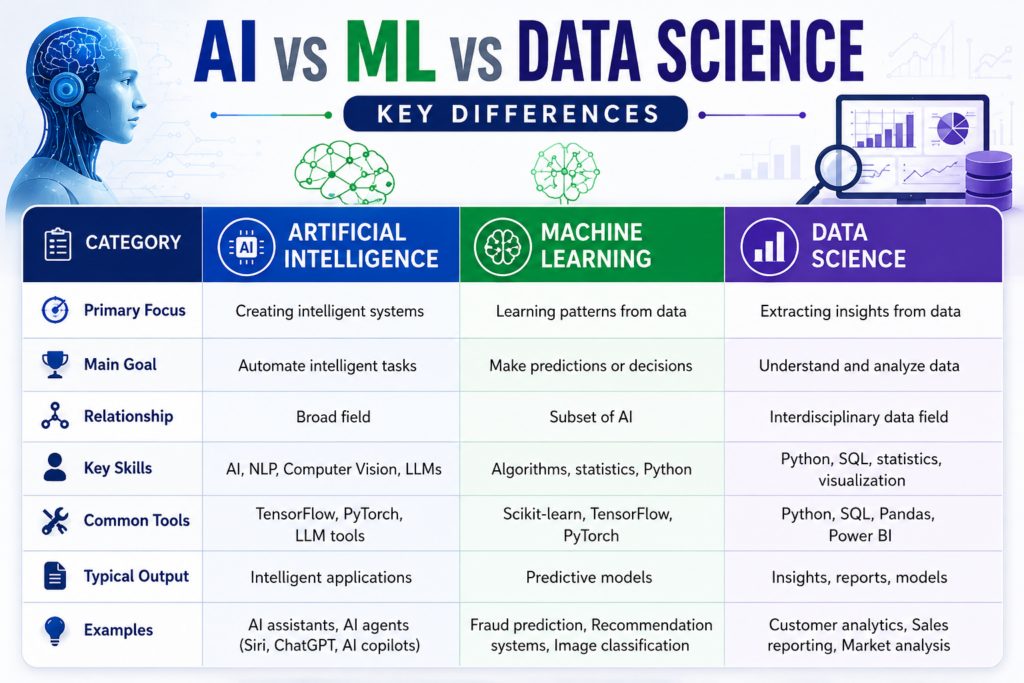
What is the relationship between Artificial Intelligence, Machine Learning, and Data Science?
These three fields are deeply connected, intertwined, and inseparable.
You can think of AI as the overarching goal—we ultimately want to create systems that can act autonomously through “intelligence”. Machine Learning is the specific technical method to achieve this grand goal, enabling these systems to summarize experience from historical data on their own, without requiring humans to hardcode every rule. Data Science, meanwhile, undertakes the most fundamental and core foundational work: it is specifically responsible for collecting, disassembling, interpreting, and utilizing various types of data, digging out actionable and useful conclusions from the data, and using these conclusions to create truly data-backed solutions.
An example can clearly explain how this collaboration works. An e-commerce company first uses Data Science to analyze each customer’s shopping habits and all their interaction tracks with the website, such as which products they clicked on, how long they stayed, and which items they added to their cart but abandoned. Next, Machine Learning comes into play: using these sorted behavioral data, it predicts which products the customer is most likely to buy next. These predictions are then fed into an Artificial Intelligence framework, which supports an intelligent personalized recommendation tool that pushes corresponding products to shoppers—the “You may also like” feature that everyone often sees when browsing e-commerce platforms.
In short, these three fields come together to support the same practical, functional implementation project; they are not independent silos.
AI vs ML vs Data Science: Skills Required
Skills Required for the Artificial Intelligence direction
To work in AI-related roles, you need to master the following:
- Python programming
- Machine learning fundamentals
- Deep learning
- Natural language processing
- Computer vision
- Generative AI
- Large language models
- AI agents
- TensorFlow or PyTorch
Skills Required for the Machine Learning direction
Machine Learning practitioners typically master these content areas:
- Python
- Statistics and probability
- Linear algebra
- Machine learning algorithms
- Data preprocessing
- Feature engineering
- Model evaluation
- Scikit-learn
- TensorFlow or PyTorch
- MLOps fundamentals
Skills Required for the Data Science direction
Data Scientists usually proficient in:
- Python
- SQL
- Statistics
- Probability
- Pandas and NumPy
- Data visualization
- Exploratory data analysis
- Machine learning
- Power BI or Tableau
- Business and communication skills
Career Opportunities in AI, ML and Data Science
As more and more enterprises adopt data-driven, AI-powered tools and workflows, both traditional industries and internet companies are transitioning in this direction. Market demand for professionals who master skills in these three fields has been rising, and the talent gap continues to widen.
Relevant positions you can apply for include:
- AI engineer
- Machine learning engineer
- Data scientist
- Data analyst
- AI/ML engineer
- NLP engineer
- Computer vision engineer
- Generative AI engineer
- MLOps engineer
- AI solutions architect
No single position is suitable for everyone. The position that fits you must match your personal interests and existing knowledge background. Clarifying your own situation before choosing a direction will help you avoid detours.
If you get excited about building functional, intelligent applications, a career focused on AI will be very suitable for you.
If you enjoy researching algorithms, mathematics, and predictive models, and savor the process of digging out patterns from data to make predictions, Machine Learning may be a more suitable direction for you.
Assume you are good at data analysis, statistics, and visualization, can dig out business-aligned conclusions, and can translate dry data into language that business teams can understand, Data Science will be an ideal choice for your career path.
Which of the three fields is better to choose: Artificial Intelligence, Machine Learning, or Data Science?
There is no universal answer that declares one of these three fields as the optimal choice; the best option is the one that suits you.
If you are interested in intelligent applications, Generative AI, Large Language Models, automation, and AI agents, and enjoy the process of letting machines complete complex tasks independently, Artificial Intelligence will be a great choice.
In Case you like mathematical modeling, algorithm design, and predictive work, can build models from scratch, and enjoy turning abstract mathematical logic into usable tools, Machine Learning will be a good fit for you.
you are interested in data analysis, statistics, visualization, business intelligence, and predictive analytics, and enjoy piecing together the truth of a business from messy data, Data Science is a good choice.
For most entry-level learners, there is no need to force yourself to lock into a single direction right at the start. First master core skills such as Python, SQL, statistics, and basic data concepts to build a solid foundation. Afterwards, diving into Machine Learning and more advanced Artificial Intelligence content will be much smoother, leaving you room to adjust your path.
AI vs ML vs Data Science: Final Conclusion
As long as you understand the core objectives of each field, the boundaries between the three will become very clear, and you will no longer confuse them.
The core of Artificial Intelligence is to build systems that can complete tasks requiring human-level intelligence. Machine Learning is a branch of Artificial Intelligence, which enables these systems to learn patterns from data. The core of Data Science is to combine statistics, programming, visualization, and Machine Learning to dig out meaningful conclusions and tangible value from data.
These three fields are not competitors; there is no absolute hierarchy of which is superior, or which one contains the others. Instead, they are complementary, and each field’s shortcomings can be compensated for by the other two. Today, more and more cross-industry Modern AI projects integrate all three to deliver results. It is difficult to build a complex, implementable product relying on just one field alone.
If you plan to build a career in the technology industry, learning skills related to Artificial Intelligence, Machine Learning, Data Science, Generative AI, and Agentic AI will help you master the professional capabilities needed to keep up with today’s rapidly changing digital environment, and avoid being eliminated by the industry’s fast updates.
If you want to build strong practical skills and start a successful career in the data field, Data Science Course In Hyderabad can help you learn essential concepts such as Python, SQL, Machine Learning, data analysis, and real-world projects. With the right training and hands-on experience, you can prepare for exciting opportunities in the growing world of Data Science.
FAQ
Is AI and Machine Learning the same thing?
No. Machine Learning is a branch of Artificial Intelligence. Artificial Intelligence is a broader, more far-reaching field, while Machine Learning is specifically responsible for identifying and learning patterns from data, making up only a part of the larger Artificial Intelligence framework.
Which is easier to learn: Artificial Intelligence or Data Science?
This depends on your existing background and experience; there is no absolute measure of difficulty.
Is Data Science part of Artificial Intelligence?
Data Science and Artificial Intelligence share a large amount of overlapping content, most notably that both rely on Machine Learning, and many technical tools are common to both. However, Data Science is a broader interdisciplinary field.
Should I learn Artificial Intelligence first or Data Science first?
For most people, the safest starting point is to first master core skills such as Python, SQL, statistics, and data analysis. After building this foundation, you will find it much smoother to learn professional content in Machine Learning, Artificial Intelligence, Generative AI, or other subfields, and you will not fall behind in the learning pace of advanced content due to a weak foundation.
Which career is better: Data Scientist or AI Engineer?
Both positions have good, growing Career Opportunities, and it is difficult to rank them generally. The core work of a Data Scientist is to work with data, conduct analysis, build predictive models, and produce conclusions that support business decisions. The core work of an AI Engineer, meanwhile, is to develop and implement AI-powered intelligent applications that underpin modern tools, producing products that can be directly used by end users.
Address:
Coding Masters – Data Science Online Training Hyderabad
Flat No: 303, Bhavya Krishna Residency, Siddartha Degree College, OPP:, Ameerpet Rd, Kumar Basti, Nagarjuna Nagar colony, Yella Reddy Guda, Hyderabad, Telangana 500073
Phone Number: 8712169228