


Almost anyone planning to enter the data field has struggled with the same question: choose Data Engineer, or Data Scientist? Whether they are students still in school, new graduates, or IT practitioners looking to switch career tracks, they will always compare these two roles side by side. This is the most common comparison among people entering data-related fields, and many people delay making a decision simply because they cannot figure out what exactly sets the two positions apart.
In this data-driven era, both roles are indispensable, hold high industry value, and are mutually dependent. However, their daily tasks, required technical skills, and long-term career development paths are completely distinct and cannot be conflated.
The core work of a Data Engineer is to build and maintain a complete set of data infrastructure capable of end-to-end operations: collecting data, storing it securely, processing it as required, and delivering it to all teams within the company that need data, without delays or errors. Data Scientists, by contrast, use these organized datasets to extract actionable, valuable insights, build predictive models, and support the company’s critical business decisions—essentially turning data into a tool that guides business operations.
If you are a new entrant to the field, or are switching from another technical role and have not yet decided which path to take, this guide will break down the core differences between the two positions, their respective Skills Required, daily work content, salary ranges, development prospects, as well as criteria to match your own strengths and interests, to help you sort out the path that suits you.
What Is a Data Engineer?
Simply put, Data Engineers are technical practitioners who specialize in building the “skeleton” of data. Their core job is to design, build, and maintain systems that can process massive volumes of data, systems that can withstand the constant influx of large datasets. Every step, from design to deployment to long-term maintenance, falls within their scope of work.
They must collect all scattered data from different sources, convert raw, disorganized formats into directly usable formats, store it securely without loss or issues, and finally make this processed data accessible to analysts, Data Scientists, and business teams, so that everyone who needs data can smoothly obtain usable data.
For example, an e-commerce company generates millions of data points every day from users’ purchase records, website behaviors, payment information, and product searches. These scattered data points are completely unusable when piled together. Data Engineers must build data pipelines and supporting infrastructure that can efficiently process this information, organizing the millions of messy data points into structured data ready for subsequent use.
Key Responsibilities of Data Engineers
Among the specific tasks they perform daily, the most common include:
- Design and develop data pipelines
- Collect data from multiple sources
- Clean and transform raw data
- Building ETL/ELT workflows
- Manage databases and data warehouses
- Work with cloud data platforms
- Guarantee data quality and reliability
- Optimize data processing systems
- Provide support for Data Scientists and analysts
What Is a Data Scientist?
Data Scientists are practitioners who solve problems using data. They analyze massive datasets, identify hidden patterns from piles of disorganized numbers, generate business-valued insights, and build statistical or Machine Learning models to apply these patterns repeatedly to business operations.
They combine programming, statistics, mathematics, Machine Learning, and industry knowledge, never conducting empty analyses detached from business needs, but instead using the data in their hands to solve the actual business problems the company encounters.
Taking the same e-commerce company example, a Data Scientist there might develop a recommendation system to predict which products a user is highly likely to purchase—the “Guess You Like” feature you see when browsing shopping sites is powered by this type of model.
Key Responsibilities of Data Scientists
Data Scientists are typically responsible for:
- Analyze structured and unstructured data
- Conduct exploratory data analysis
- Identify trends and patterns in data
- Build Machine Learning models
- Conduct statistical analysis
- Create predictive models
- Evaluate model performance
- Visualize data and communicate findings
- Collaborate with business teams to solve problems
Whether you are a student wanting to enter the field, a new graduate, or an IT practitioner planning to switch roles, if you are targeting the data industry, you will most likely struggle with the same question: between Data Engineer and Data Scientist, which one to choose? These two roles are currently the most core and most frequently compared directions in the data field. Their respective work content, skills to learn, and subsequent development paths are completely different, yet both are in high demand. Next, we will break down all the details of the two roles to help you find the path that suits you.
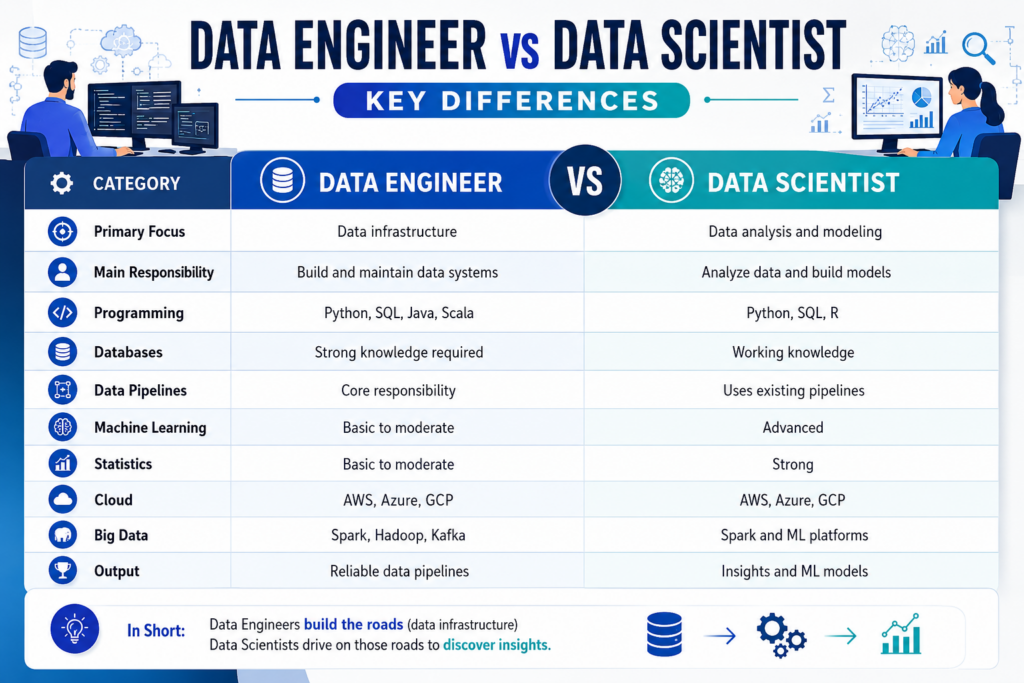
Data Engineer vs Data Scientist: Skills Required
To enter the field, you first need to understand what skills each role requires. Let’s start with Data Engineers.
Skills Required for Data Engineers
To excel as a Data Engineer, you need to develop solid capabilities in the following core areas:
Programming: You must learn at least one of Python, SQL, Java, or Scala, which is the foundation for writing code to complete work.
Databases: You need to master MySQL, PostgreSQL, MongoDB, and other core database technologies, and understand how to store data stably and retrieve it efficiently.
Data Engineering fundamentals: You must understand the logic of ETL, ELT, data pipelines, data warehouses, and data modeling—these form the core skeleton that connects scattered data into a usable system.
Big Data tools: You need to be proficient in Apache Spark, Kafka, Hadoop, and related technologies, to process massive datasets that often reach millions or tens of millions of entries.
Cloud Platforms: You must be able to skillfully operate mainstream cloud platforms such as AWS, Microsoft Azure, Google Cloud—most companies’ data services are now hosted on the cloud.
Workflow Tools: You need to use Apache Airflow and other scheduling technologies to automate the entire data processing workflow, eliminating the need for constant manual monitoring.
Skills Required for Data Scientists
Now looking at Data Scientists: the core capabilities they need to master overlap with those of Data Engineers, but there are also many role-specific requirements:
Programming: You need to know Python, SQL, and some positions additionally require mastery of R to conduct more detailed statistical analysis.
Statistics: You must thoroughly grasp foundational knowledge such as probability, Data Analysis, hypothesis testing, and regression analysis—this is the basic skill for extracting insights from data.
Machine Learning: You need to understand core algorithms including supervised learning, unsupervised learning, classification, regression, and clustering, and be able to apply these algorithms to practical problems.
Data Analysis: You need to use Pandas, NumPy, and other data analysis tool libraries to quickly organize raw data into a format ready for analysis.
Visualization: You must master tools such as Matplotlib, Seaborn, Power BI, or Tableau, to turn dry numbers into charts that everyone can understand.
Machine Learning Frameworks: You need to use Scikit-learn, TensorFlow, PyTorch, and other ML frameworks to quickly build and train your own models.
Generative AI: Knowledge of LLMs, RAG, Agentic AI, and related Generative AI content will bring significant advantages for contemporary Data Science positions.
Data Engineer vs Data Scientist: Which Is Easier
Many people new to these two roles first ask which is easier to enter. In fact, there is no universal answer to this question. The skill sets required for the two careers are completely different, each with its own specialization, so they cannot be compared for difficulty using the same standard.
If you are inherently interested in writing code, working with databases, researching cloud technologies, and building system architectures, and feel a sense of achievement when you connect scattered tools into a fully functional data pipeline, then Data Engineering may be more suitable for you. If you are more drawn to working with numbers and patterns, enjoy learning statistics, studying mathematical principles, researching Machine Learning models, are willing to dive into data to run experiments and extract insights, and enjoy the process of using these findings to solve the company’s actual business problems, then Data Science will align better with your interests.
Beyond interests, your past professional and educational background will also largely influence which path is smoother for you. People with solid software development or database experience will have an easier transition to Data Engineer, as most of their previously accumulated experience can be directly applied. People with strong foundations in mathematics, statistics, or analytical work will often naturally lean toward choosing Data Science—statistical theories that others find difficult to grasp may just be basic skills for you.
Data Engineer vs Data Scientist: Career Scope
Now companies across all industries are integrating data, analysis, cloud computing, artificial intelligence, and Machine Learning into their core businesses. Whether for business decision-making or cost reduction and efficiency improvement, professional data talent is indispensable, so the market demand for all data-related practitioners continues to rise, and there are large talent gaps for both roles.
Career Opportunities for Data Engineers
Working as a Data Engineer does not mean staying in the same position forever; its promotion path is very clear. You can develop step by step in these directions: Data Engineer, Big Data Engineer, Cloud Data Engineer, Data Architect, Analytics Engineer, Senior Data Engineer, Data Engineering Manager. You can gradually grow from a frontline coder into a technical expert responsible for overall architecture, or a manager leading a team, with a well-defined career track.
Career Opportunities for Data Scientists
Data Scientists also have a complete advancement path, and can deepen their expertise in these positions: Data Scientist, Machine Learning Engineer, Applied Scientist, AI Engineer, Senior Data Scientist, Machine Learning Architect, Data Science Manager. Similarly, you can pursue either a technical expert track or transition into a management role.
Moreover, beyond these traditional paths, practitioners in both fields can combine their core data skills with expertise in Generative AI and Agentic AI to explore the rapidly growing, newly emerged AI-focused career opportunities. The talent gap for these new positions is even larger than that for traditional data roles.
Data Engineer vs Data Scientist: Data Scientist Salary
After discussing development prospects, the topic everyone cares most about is definitely salary. The salary range for both jobs varies widely, with no fixed number. Specifically, it is affected by your work experience, location, the company you work for, the specific technologies you master, and your professional direction. The salary of a senior data talent in a first-tier city can be several times that of a new entrant, so it cannot be generalized.
However, both Data Engineers and Data Scientists can earn highly competitive salaries. Especially if you master the most in-demand skills in the current market, such as programming, cloud technology, Big Data, Machine Learning, or AI, your salary will be even more substantial, placing you in the top tier of the industry.
The original text specifically mentions the situation in the Indian market: in India, practitioners who master professional skills such as cloud computing, Big Data, Machine Learning, Generative AI, and AI engineering can access more career opportunities to increase their income potential.
A final reminder: when choosing a career, do not only focus on salary. Take the time to weigh your personal interests, existing skills, and long-term career goals to make the most suitable choice for yourself. After all, to build a long-term career in this industry, it is difficult to persist in a job you do not enjoy, no matter how much it pays.
Data Engineer vs Data Scientist: Which Career Should You Choose
After sharing all the information above, I have sorted out straightforward judgment criteria to help you roughly figure out which path suits you.
If the following apply to you, Choose Data Engineering is likely the right path for you: you enjoy programming, are willing to work with various types of technology, and get more happiness from writing code to build systems than from digging through data to find patterns; you like collaborating with partners to build and maintain databases, and keeping data secure and stable is your source of a sense of achievement; building usable systems and pipelines brings you great satisfaction, and seeing the pipeline you built stably process millions of data points every day feels valuable to you; you are curious about cloud computing and its applications, and willing to research new cloud services and architectures; or you prefer to work on backend, infrastructure-focused projects, do not like negotiating requirements with business departments every day, and only want to refine the technical work in your hands.
So who is suitable to Choose Data Science?
If the following apply to you, Data Science may be more suitable: you enjoy in-depth research of mathematics and statistics, and those formulas and principles are not a burden but a source of joy for you; you are willing to immerse yourself in data to unlock its full value, and extracting information that others cannot see from a pile of messy numbers gives you a strong sense of achievement; you are fascinated by Machine Learning and its practical applications, and want to build actionable AI models to solve real problems; you enjoy finding hidden patterns and actionable insights in massive datasets, and savor the feeling of being a “data detective”; or you want to use data as a core tool to solve tricky business problems, and use your analysis to directly influence the company’s decisions.
Additionally, it is important to remind you that the two careers also share a large number of overlapping areas. Choosing one does not mean you will never touch content from the other. No matter which role you work in, mastering core skills such as Understanding SQL, Python, databases, cloud platforms, and basic data concepts will be of great help to your work. Even if you switch roles later, these foundations will still be applicable.
Final Thoughts
When choosing between Data Engineer and Data Scientist as a career, the first thing to consider is your unique interests and long-term career goals. There is no absolute “better” or “worse”—only whether it is suitable for you.
The core division of labor is actually very simple: Data Engineers build the core data infrastructure that supports all data work, acting as the “infrastructure workers” of the entire data team, building the framework for storing and running all data. Data Scientists, by contrast, use this reliable data to produce actionable insights and build accurate predictive models, acting as the “analysts” who unlock the value of data. The two are sequential partners, and neither can function without the other.
In today’s technology industry, both careers have excellent growth opportunities, so you do not need to worry that choosing one will lead to a dead end. If you feel excited at the thought of building stable data systems, cloud platforms, and scalable data pipelines, then Data Engineering may be the most suitable choice for you. If you are passionate about analysis, statistics, Machine Learning, and artificial intelligence, and feel motivated by the idea of using data to solve major problems, then Data Science will better align with your career aspirations.
Provided you want to build strong practical skills and start a successful career in the data field, Data Science Training In Hyderabad can help you learn essential concepts such as Python, SQL, Machine Learning, data analysis, and real-world projects. With the right training and hands-on experience, you can prepare for exciting opportunities in the growing world of Data Science.
Frequently Asked Questions
Finally, I have sorted out the most frequently asked questions to explain them all at once:
What is the core difference between a Data Engineer and a Data Scientist?
Data Engineer and Data Scientist build and manage the data infrastructure and data pipelines that enterprises rely on, while Data Scientists analyze these organized datasets and develop statistical and Machine Learning models to support business decisions. The core logic remains the same: one builds the framework, the other uses what is in the framework to create value.
Is Data Engineering better than Data Science?
The answer is that no career is universally better than the other. Data Engineering suits people who enjoy programming, databases, and infrastructure work, while Data Science suits people who want to center their work on statistics, analysis, and Machine Learning. They only suit different groups of people, and there is no hierarchy between them.
Do Data Engineers need to know Python?
Yes. Python is a widely used tool in contemporary Data Engineering, supporting automation, large-scale data processing, pipeline development, and seamless use across all mainstream data platforms. It is an irreplaceable core tool for Data Engineers.
Do Data Scientists need a solid mathematical foundation?
For most Data Science positions, a solid mastery of statistics and core mathematical knowledge is very important. Especially for practitioners who need to develop and evaluate complex Machine Learning models, this knowledge is essential. Without a foundation in mathematics and statistics, the models you build are likely to be incorrect.
Can a Data Engineer transition to become a Data Scientist?
Yes. These two positions originally share many common foundational skills. As long as Data Engineers supplement targeted new skills such as statistics, Machine Learning, Data Analysis, and predictive modeling, they can successfully transition to work as Data Scientists, without needing to start from scratch.
Address:
Coding Masters – Data Science Online Training Hyderabad
Flat No: 303, Bhavya Krishna Residency, Siddartha Degree College, OPP:, Ameerpet Rd, Kumar Basti, Nagarjuna Nagar colony, Yella Reddy Guda, Hyderabad, Telangana 500073
Phone Number: 8712169228