

AI Workflow Automation
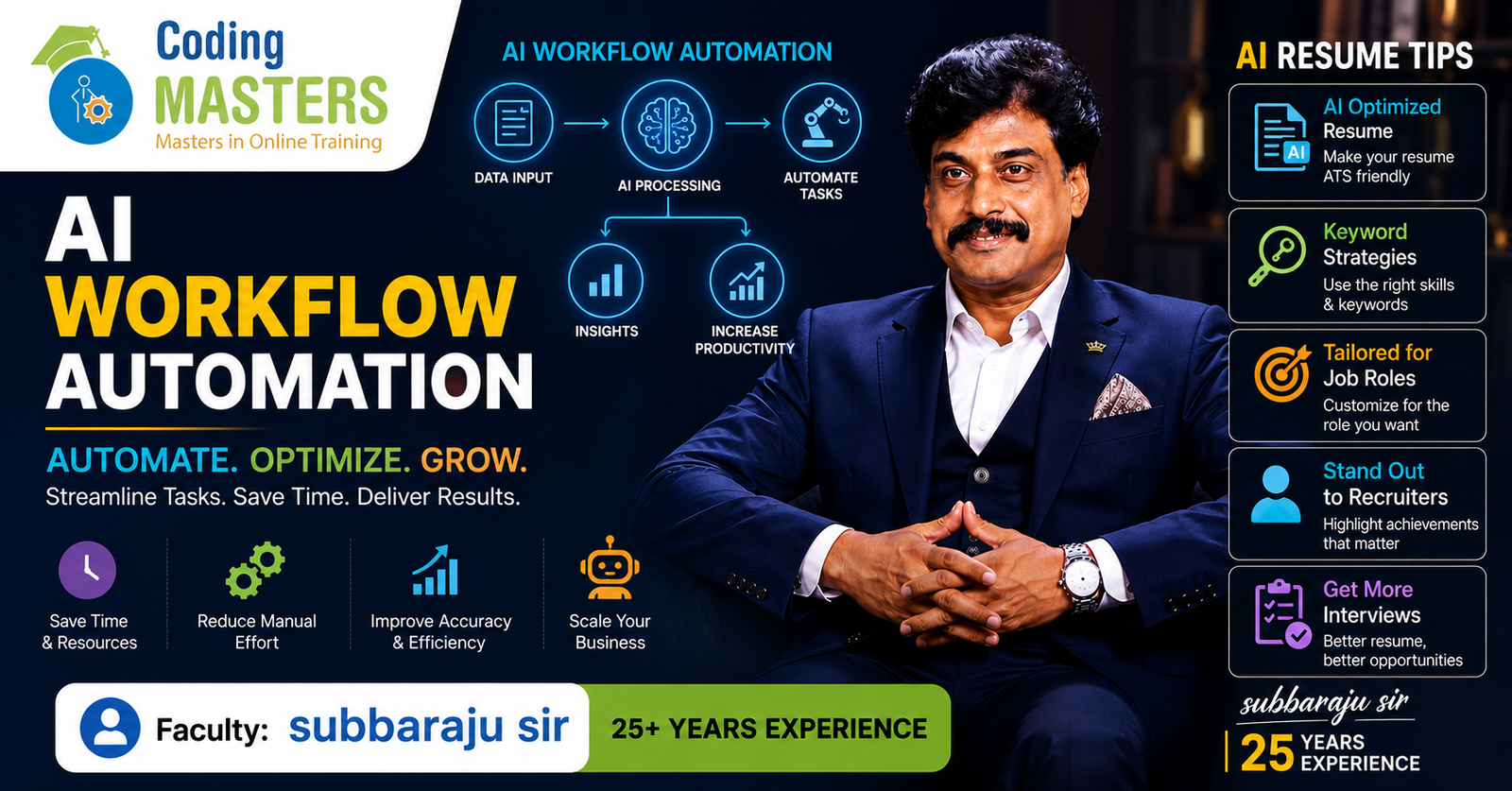
AI Workflow Automation uses artificial intelligence to automate repetitive tasks, connect business applications, and streamline daily operations with minimal manual effort. It can handle tasks such as data entry, email responses, lead management, document processing, customer support, reporting, and task scheduling. AI-powered workflows can understand information, make decisions, and trigger actions based on predefined conditions. Businesses can use workflow automation to save time, reduce human errors, improve productivity, and deliver faster customer service. Learning AI Workflow Automation also helps professionals build intelligent solutions using AI tools, APIs, automation platforms, and modern technologies.
AI Workflow Automation
AI Workflow Automation helps businesses automate repetitive processes and complete tasks faster with less manual effort. It combines artificial intelligence with automation tools to manage activities such as lead generation, customer support, email communication, data entry, reporting, document processing, and task scheduling. AI-powered workflows can analyze information, make decisions, and trigger actions automatically based on specific conditions. This reduces human errors, saves valuable time, and improves overall productivity. Organizations can use AI Workflow Automation to create smarter business processes, improve customer experiences, and reduce operational costs. Learning these skills can also help professionals build efficient, scalable, and intelligent automation solutions.
Automating Repetitive Business Tasks
AI Workflow Automation is an AI tool that can take over all the fixed, repetitive, mindless odd jobs: entering data into the system, organizing incoming and outgoing emails, following up with potential leads, generating business reports in fixed formats, and it can even handle routine customer inquiries on its own. After connecting these AI tools with the various business software that companies use in their daily operations, the amount of work that team members need to perform manually will be greatly reduced, and the overall speed and efficiency of work will be improved.
AI-Powered Decision Making
First, let us figure out what the AI workflow mentioned here refers to—it is a set of work procedures that involve AI and advance in a fixed sequence. This set of procedures can process the huge backlog of all types of information in one go, and all decisions it makes are not arbitrary; they all follow pre-established rules, models, or business requirements. Take a practical example: there is now a fully automated system that, relying on this AI workflow, can complete several tangible tasks: first, it screens out qualified potential leads from a pool of interested customers, then sorts and organizes all types of demands raised by customers, next extracts all important content from the massive volume of information, and finally assigns the corresponding to-do tasks to the matching responsible teams within the company.
Benefits of AI Workflow Automation
Equipping workflows with the automated operation function of AI allows businesses to complete far more work, cut significant operational costs, reduce human errors, and deliver much faster services to customers. Repetitive tasks that originally required employees to monitor and complete step by step can be handled by this set of automated workflows, eliminating the need to spend large amounts of time manually verifying and advancing processes. This naturally frees up energy to take on more core affairs, while also reducing the company’s operating expenses. Negligence common in manual processing, such as missing entries or miscalculations, can also be minimized through unified automatic rules. Even when customers reach out to inquire about or handle business, the automatically routed workflows can connect them to the responsible person much faster, avoiding delays stuck in the manual transfer process.
Lead Management Automation
Implementing Artificial Intelligence Workflow Automation can simplify and streamline lead management. In the past, customer follow-up required manually logging customer-submitted information one by one in the backend, sorting scattered prospective customers into a trackable list, timing follow-up messages to send to different customers, and manually updating the details of past discussions into records—all these tedious tasks will be completed automatically, with no need for people to monitor each one individually.
Customer Support Automation
Enterprises can launch AI-driven work processes to automatically handle many customer service tasks, eliminating the need for manual follow-up on each case one by one. For example, these processes can reply to customers’ frequently asked questions, sort various requests into categories, and transfer complex and hard-to-resolve problems to the appropriate teams. Chatbots and AI assistants can also stay online around the clock, sending instant replies to customers at any time, whether on workdays or late at night, without waiting for human customer service representatives to become available to respond. As a result, customers’ experience will improve and their satisfaction will increase, and they will not feel dissatisfied due to waiting for a reply or having their problem passed between multiple people before anyone handles it. Customer service teams will also no longer need to bear the repetitive and meaningless workload, and the time and energy saved can be dedicated to addressing more challenging customer needs — those that cannot be directly resolved by automated processes and require manual effort to sort out and coordinate.
Document Processing Automation
AI Workflow Automation can process all types of commonly used business documents in enterprises, covering invoices, forms, reports, applications, and a wide range of other corporate business documents. The entire process requires minimal manual intervention, and there is no need to assign dedicated staff to oversee the processing of these documents. The specific tasks of the Artificial Intelligence system that supports this automation are clearly divided: first, it extracts key information from the received documents and pulls out the core content required for use; next, it categorizes all documents to enable quick retrieval when needed later; then it verifies the data in the documents for errors or omissions to uphold the accuracy of the information; finally, it can directly transmit all the processed results to the various business software that the enterprise already uses, eliminating the need to arrange for manual data import. Converting these originally fully manual processes to automated processing brings tangible improvements: first, it reduces the errors that are prone to occur during manual data entry, eliminating low-level mistakes such as inputting incorrect numbers or writing wrong text; it also speeds up the overall document processing rate, so documents no longer pile up waiting to be processed one by one by humans; more importantly, it frees employees from these repetitive and trivial tasks, allowing them to spend the extra time on more valuable work that can generate revenue.
Marketing Workflow Automation
Using AI to conduct marketing nowadays saves a great deal of manual effort, as it can automatically complete many routine tasks. For example, it can handle distributing promotional content, preparing email marketing campaigns to send to customers, segmenting scattered customers into different groups, scheduling release times for social media content, and organizing various reports for every marketing campaign—none of these tasks require human oversight, as AI can manage them all. Beyond taking over these repetitive trivial tasks, the entire workflow supported by AI has even more flexible uses: it can sort and analyze all types of behavioral traces left by customers when they interact with a brand, then help businesses deliver information that meets the needs of these customer groups precisely to the corresponding specific Crowd, avoiding indiscriminate sends that disturb irrelevant customers. As a result, the efficiency of the entire marketing link is improved, and most of the repetitive manual work is reduced. Staff on the team no longer have their time occupied by trivial matters, so they can devote their energy to more important tasks: on one hand, developing more creative marketing directions and strategies, and on the other, focusing on communicating more with customers to strengthen and solidify the bond between the two parties.
flat no 101, Bhavya Krishna Residency, OPP: Siddartha Degree College, Ameerpet Rd, Kumar Basti, Nagarjuna Nagar colony, Yella Reddy Guda, Hyderabad, Telangana 500073