

Start with Generative AI Fundamentals
First, this Generative AI Roadmap organizes a clear, structured framework. Furthermore, it helps you master all the core concepts, technologies, and practical skills. Consequently, these are required to develop and use today’s cutting-edge Generative AI applications. However, many beginners fear missing out on learning content when starting out. Therefore, they try to master all related AI technologies in one go. As a result, this often leaves them with no thorough understanding of anything. Fortunately, you will not make this mistake. Simply follow this phased, progressive approach instead. Specifically, start with foundational entry-level knowledge. Then, gradually engage with Large Language Models (LLMs) and prompt engineering. Next, explore Retrieval-Augmented Generation (RAG) and AI agents. Finally, complete implementable practical projects to build a solid foundation at every step.
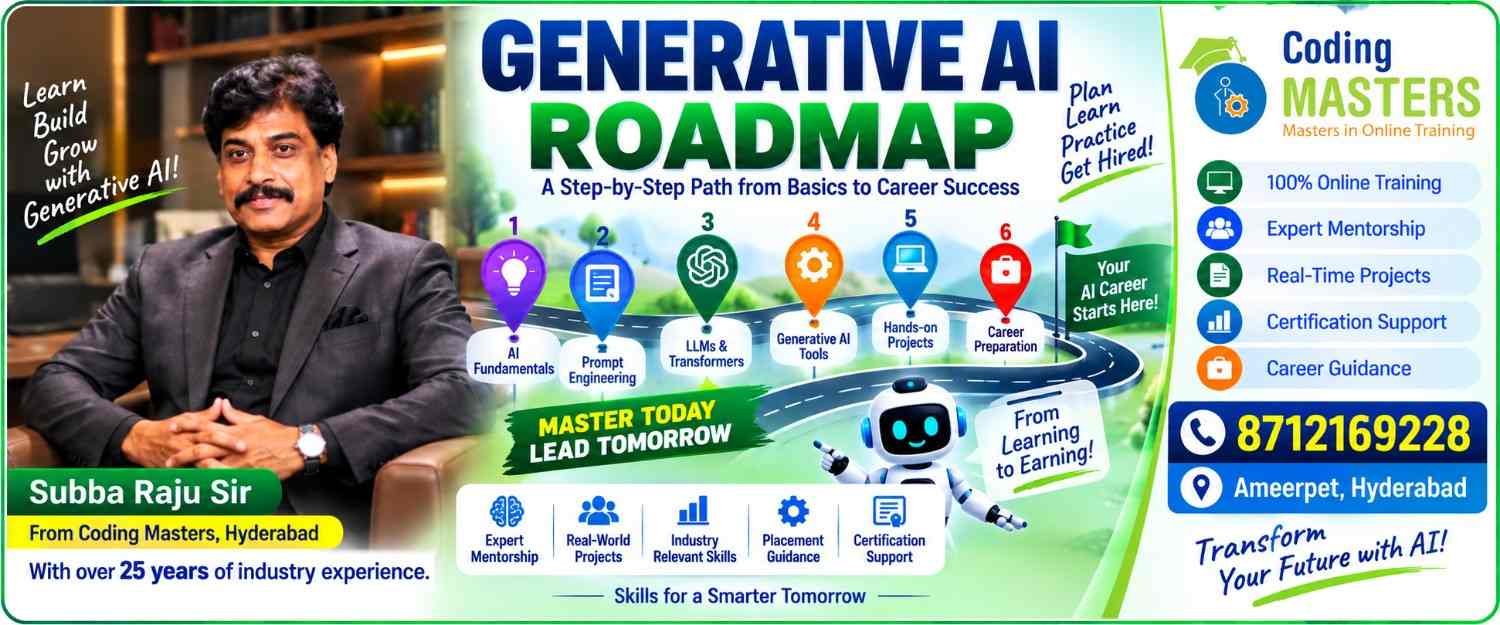
Generative AI Roadmap: Start with Generative AI Fundamentals
Initially, the first phase of the roadmap has a core goal. Specifically, it aims to establish a basic understanding of Artificial Intelligence, Machine Learning, and Generative AI principles. Generally, most newcomers tend to confuse the differences between various AI types. However, during this phase, you will gradually understand what sets Generative AI apart. Moreover, you will learn how it differs from older, traditional AI systems. In addition, you will also learn about its common application scenarios. For instance, these include everyday AI copywriting tools and AI illustration generators. Furthermore, they also include programmer AI coding tools, chatbots, and personal AI phone assistants. Ultimately, all these are real-world implementations of Generative AI. Thus, by exploring them one by one, you will build an overall perception of this field.
Learn Large Language Models and Prompt Engineering
Subsequently, after solidifying these foundations, you can move on to in-depth learning. To begin with, you will study Large Language Models and their core operating concepts. Key knowledge points include tokens, context windows, and model capability boundaries, specifically. Additionally, you will also learn the most widely used real-world scenarios for Large Language Models. In essence, all these are the underlying logics needed to use Generative AI tools well. Fortunately, there is no need to rush to master everything at once. Instead, just work through the concepts one by one.
Moving forward, the next critical learning phase is prompt engineering. For example, many people only know to say “write a copy for me” to AI. Consequently, the resulting content rarely meets their expected effects. Here, conversely, you will practice writing clear, actionable instructions for Generative AI models. Furthermore, you will learn various core prompt techniques. Namely, these include zero-shot, few-shot, role-setting, and structured prompting. Moreover, you will also learn about standardized output formats. Therefore, by mastering these, your collaboration efficiency with AI will improve by leaps and bounds.
Generative AI Roadmap: Explore RAG and AI Agents
Afterwards, the roadmap’s next phase shifts to hands-on use of various Generative AI tools. Primarily, this teaches you to apply mastered concepts to real daily tasks. Consequently, you will no longer just recite knowledge points. Instead, you will truly use AI to solve your own problems. Next, you will trial specialized AI tools for content creation and academic research. Additionally, software development and personal productivity improvement tools are also part of the process. Furthermore, image generation and end-to-end automated enterprise workflows are also covered. Ultimately, this helps familiarize you with foundational knowledge in your daily scenarios.
Importantly, you must first skillfully use basic prompts and fully grasp LLM concepts. Then, you can advance to learning more complex, high-level Generative AI technologies. As a result, these will help you solve complex problems that ordinary Large Language Models cannot handle.
First, you will learn Retrieval-Augmented Generation (RAG). Moreover, you will understand how AI systems retrieve verified, relevant external data. Subsequently, they integrate this information to generate accurate, evidence-based responses. By contrast, ordinary Large Language Models only answer using outdated training knowledge. Therefore, RAG effectively fills this knowledge gap. Furthermore, during this phase, you will explore document-based question-answering tools. In addition, you will also explore enterprise knowledge base applications. Also, you will understand how to feed your own materials to AI. Consequently, this allows the AI to output customized content exclusive to you.
Meanwhile, after mastering RAG, you can learn about AI agents. Notably, this is another highly practical and high-level field. Here, specifically, you will understand how to integrate various components. For instance, these include independent AI models, third-party tools, custom instructions, and serialized workflows. Accordingly, they work together to complete complex multi-step tasks. Unfortunately, no single tool can complete these tasks independently. Thus, examples include sorting a week of industry reports or scheduling a meeting. Ultimately, AI agents help you accomplish tasks requiring multiple processes.
Generative AI Roadmap: Build Practical Generative AI Projects
Undoubtedly, practical projects are indispensable after completing every phase of the roadmap. In fact, merely watching without practicing is essentially meaningless. Therefore, you must build projects with your own hands to connect scattered knowledge points. Moreover, through these projects, you will develop usable and implementable applications. Simultaneously, you will integrate all the concepts you have learned up to that point. Finally, this avoids the problem of forgetting earlier content while learning new material.
Develop Implementable AI Workflows
Generally, the projects you can complete cover a wide range of common scenarios. For example, these include custom AI chatbots and document question-answering systems. Additionally, they also include scalable content generation workflows and prompt-driven automation tools. Likewise, production-grade RAG applications and end-to-end AI agent solutions are also possible. Consequently, you can start from a scenario that meets your urgent needs. First, build a small project to solve minor problems. Then, you can gradually scale the project up.
Crucially, all learners must develop the habit of continuously testing their prompts. Furthermore, they must strictly evaluate AI-generated outputs to identify system vulnerabilities and limitations. Additionally, workflows must be constantly optimized. Because Generative AI tools and underlying models update very quickly, agility is necessary. Indeed, a good method yesterday may have a more efficient new version today. Therefore, you must learn persistently and experiment repeatedly. Ultimately, this keeps your practical skills up to date with updates.
Frequently Asked Questions
What is this Generative AI Roadmap?
-
Fundamentally, it is a set of step-by-step learning paths.
-
Specifically, it covers Generative AI Fundamentals, LLMs, and prompt engineering.
-
Additionally, it also covers AI tools, RAG, AI agents, and practical projects.
What is the first thing to learn when studying Generative AI?
-
First, learn the foundational content of Artificial Intelligence, Machine Learning, and Generative AI.
-
Then, advance to learning LLMs and prompt engineering.
Is prompt engineering important for Generative AI?
-
Undoubtedly, yes, it is very important.
-
Primarily, it helps learners write clear instructions.
-
Furthermore, it allows learners to collaborate with Generative AI models more efficiently.
What should I learn after completing prompt engineering?
-
Consequently, you can advance to learning high-level content like RAG and AI agents.
-
Moreover, you should also learn tool usage and automated AI workflows.
Is it necessary to build projects when learning Generative AI?
-
Certainly, practical projects help learners apply the concepts they have learned.
-
Additionally, they help learners understand how to use Generative AI technologies.
-
Ultimately, they are essential to develop implementable real-world applications.
How can I continuously improve my Generative AI skills?
-
First, regularly experiment with AI tools and practice writing prompts.
-
Next, evaluate AI-generated outputs and explore new technologies.
-
Finally, continuously complete more practical projects.
Want to learn more about Generative AI Roadmap in Hyderabad? Contact Coding Masters:
Gen AI and Agentic AI Training – Coding Masters
Flat No. 101, Bhavya Krishna Residency,
OPP: Siddartha Degree College,
Ameerpet Rd, Kumar Basti,
Nagarjuna Nagar colony,
Yella Reddy Guda,
Hyderabad, Telangana 500073
 Phone: 8712169228