

Fundamentals of Generative AI
A Generative AI Syllabus provides a path that guides learners from simple AI ideas to more difficult topics. It covers Large Language Models, commonly known as LLMs, and the art of engineering. The curriculum also explores Retrieval-Augmented Generation (RAG) and AI Agents. Finally, it concludes with projects that let learners apply these skills.
This section explains Artificial Intelligence, Machine Learning, and Generative AI sequentially. This progression helps learners grasp the basic logic of Generative AI. They then learn how these AI systems make text, images, code, and audio. It also covers why they can create these things from nothing.
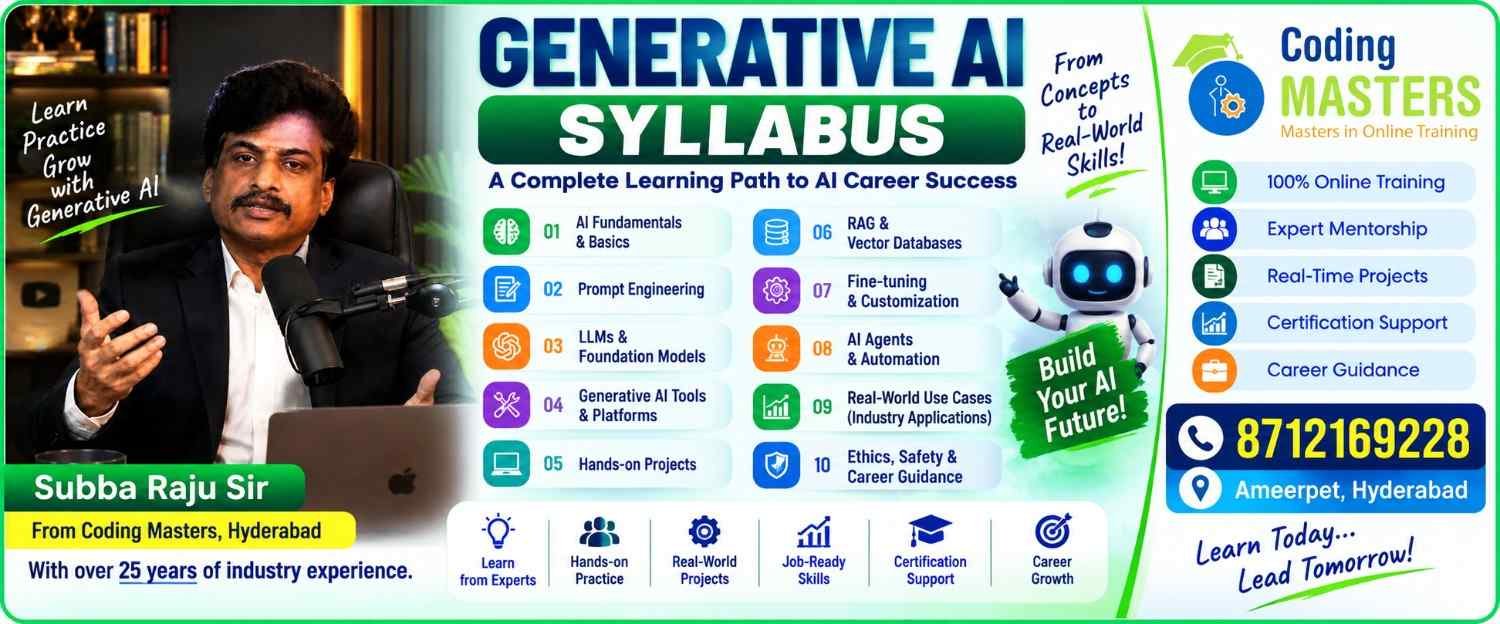
Generative AI Syllabus: Large Language Models and AI Application Scenarios
Large Language Models are the core foundation for all current Generative AI deployment processes. Learners first master the basic concepts of Large Language Models. This includes entry-level knowledge such as tokens, context, and model capabilities. Next, they familiarize themselves with common use cases. This step allows them to gradually apply these powerful systems to various personal or work tasks.
The syllabus also covers the practical uses of Generative AI. These range from chatbots and AI assistants to content generation and academic research. Code assistance and efficiency improvement workflows are also included. The deployment logic for each scenario is explained in detail. This ensures learners will not be confused by a mere list of terms.
Prompt Engineering and Generative AI Tools
Prompt engineering is a core skill for anyone interacting with Generative AI models. You need to learn it even if you only use off-the-shelf AI tools without training models. In this section, you will learn how to write clear, effective instructions. You will also learn to refine AI-generated responses for specific tasks. This helps avoid off-topic outputs that fail to meet your expectations.
Specific techniques covered include zero-shot, few-shot, role-setting, and structured prompting. Context management and output format specification are also covered with their applicable scenarios. Learners will practice different prompting techniques one by one. They will also learn to evaluate the results generated by AI models. This allows them to adjust usage methods based on output quality and understand application boundaries.
The syllabus also introduces commonly used Generative AI tools. These cover needs such as content creation, research, code writing, and efficiency improvement. Image generation and automation tools are also featured. You can find tool introductions to write copy, create designs, or simplify repetitive work. Supporting hands-on exercises help learners apply these tools to personal and work scenarios. This ensures they can actually use the tools instead of only knowing their names.
Generative AI Syllabus: RAG, AI Agents and Practical Projects
The advanced chapter explains Retrieval-Augmented Generation (RAG) and AI Agents. These are two highly practical frameworks for building complex Generative AI solutions. Mastering them means you will be able to use off-the-shelf AI tools. You will also be able to build your own AI applications to solve specific problems.
Deployment Processes for RAG and AI Agents
Learners first understand how RAG combines information retrieval with Generative AI. This technology solves a major problem with standard large models. It overcomes their limitation of only using old training knowledge and lacking access to exclusive materials. They then explore how to implement document-based question-answering workflows. An example is building an AI that queries a company’s internal knowledge base.
Content on AI Agents explains how models, tools, instructions, and workflows cooperate. They work together to complete complex multi-step tasks that a single Generative model cannot handle. This allows AI to independently research materials and organize information. It can then generate reports without step-by-step human supervision.
The final practical projects connect all the concepts covered in the syllabus. This ensures learners do not end up with a pile of scattered, unintegrated knowledge. Available projects include AI chatbots, document question-answering apps, and prompt-based automation tools. RAG applications, content generation workflows, and AI agent solutions are also available to solve real-world needs. Learners can choose projects matching their focus. This truly integrates all learned content into usable skills.
Frequently Asked Questions
-
What is a Generative AI Syllabus?
-
A Generative AI Syllabus is a list of topics that helps learners understand Generative AI.
-
It covers large language models, prompt engineering, and AI tools.
-
It also explores Retrieval-Augmented Generation, AI agents, and how to use them in real life.
-
-
What content does a Generative AI Syllabus typically cover?
-
Typical topics cover the basics of Generative AI and large language models.
-
They also include prompt engineering, AI tools, and Generation AI agents.
-
Automation and hands-on projects round out the curriculum.
-
-
Is engineering included when learning Generative AI?
-
Yes.
-
Prompt engineering is a part of Generative AI learning.
-
It teaches you how to write instructions and work together with Generative AI models.
-
-
What is RAG in Generative AI?
-
Retrieval-Augmented Generation or RAG blends searching for information with Generative AI.
-
It lets different applications pull in outside data while they create answers.
-
-
What is an AI Agent?
-
An AI Agent is a system that can call AI models, tools, instructions, and workflows.
-
It uses these components to complete various tasks.
-
This includes complex tasks that require multi-step execution.
-
-
Are practical projects important in learning Generative AI?
-
Yes.
-
Practical projects help learners apply the Generative AI concepts they have learned.
-
They help users understand how to use AI tools and prompts.
-
They also demonstrate how to use RAG and AI Agents in real-world scenarios.
-
Want to learn more about Generative AI Syllabus in Hyderabad? Contact Coding Masters:
Gen AI and Agentic AI Training – Coding Masters
Flat No. 101, Bhavya Krishna Residency,
OPP: Siddartha Degree College,
Ameerpet Rd, Kumar Basti,
Nagarjuna Nagar colony,
Yella Reddy Guda,
Hyderabad, Telangana 500073
 Phone: 8712169228