

For current AI applications, whether they are customer service chatbots or enterprise-grade generative tools, Hallucination Testing is an unavoidable core link to verify whether the application can be used with confidence. Many people may not yet fully understand what “hallucination” means—it simply refers to AI fabricating content out of thin air: this content sounds coherent, extremely credible, but is entirely wrong at its core. If an AI system is hastily launched without targeted hallucination screening, this erroneous content will reach users through the system, disrupt many people’s judgment, and even lead users to make negatively impactful decisions based on these false pieces of information.
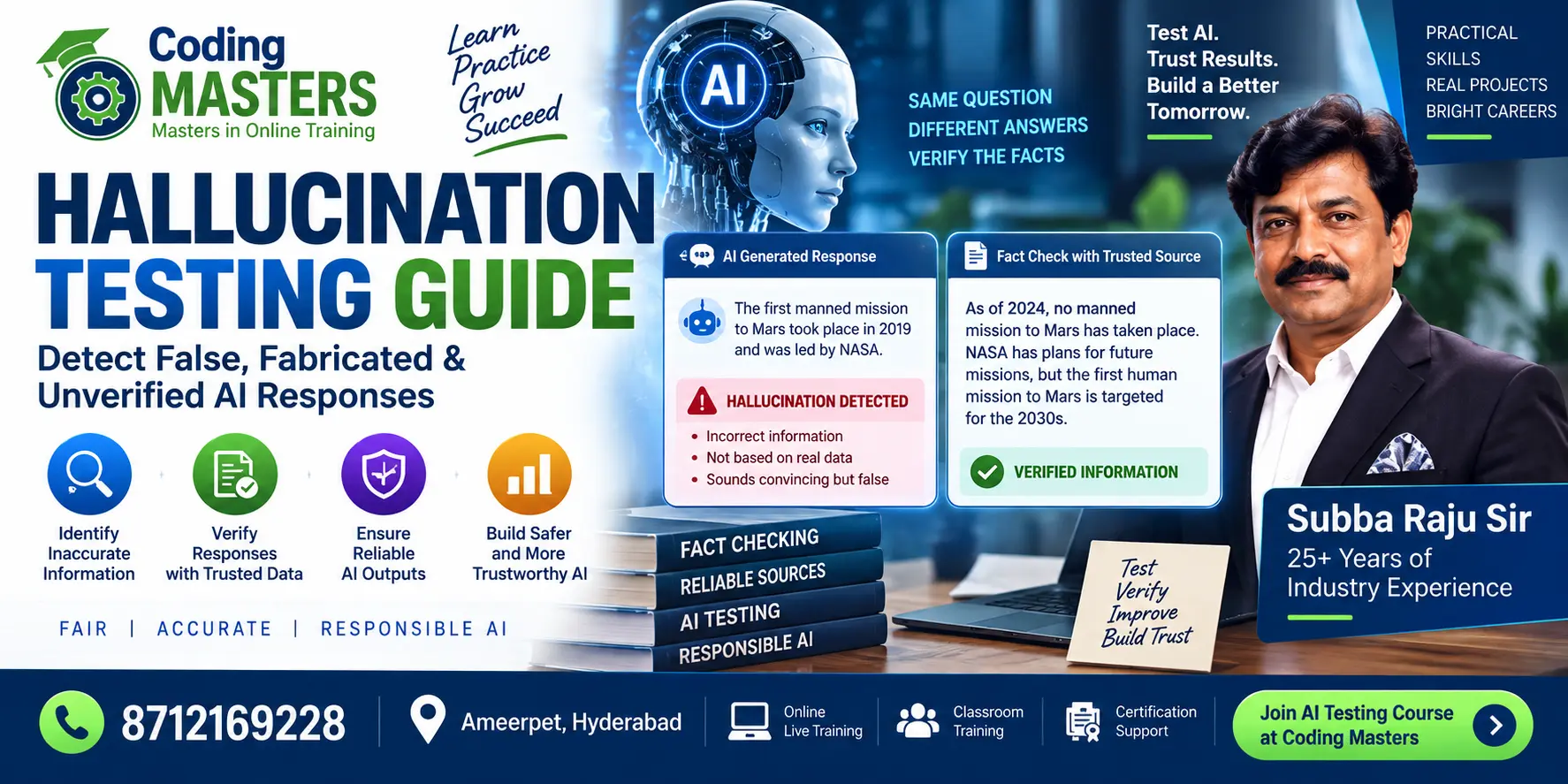
When conducting Hallucination Testing, QA specialists responsible for quality assurance use pre-verified, confirmed reliable source materials to systematically check every piece of response generated by the AI. They identify all unsubstantiated claims one by one, assess the factual accuracy of all output content, and patch the team’s core vulnerabilities before regular users encounter these issues.
What Is Hallucination Testing?
This testing is not only required for newly developed AI tools; even for old systems that have been online for a long time, when rolling out major version updates or expanding internal knowledge bases, the team must redo Hallucination Testing. This prevents unvetted erroneous content from being introduced into the already well-functioning daily workflow through this update, which would otherwise cause unnecessary trouble.
AI systems are now used in fields such as customer support, education, healthcare, finance, software development, and enterprise operations. Why must AI in these scenarios undergo Hallucination Testing? The answer is very simple:
Hallucination Testing ensures that the content output by these systems is accurate, reliable, and trustworthy for all end users. An AI application that has not passed Hallucination Testing will not only lead users to mistakenly believe false information and make wrong decisions, but also cause reputational damage to the institution it belongs to, gradually eroding users’ trust in the tools they use on a daily basis.
Why Is Hallucination Testing Important?
Teams that prioritize Hallucination Testing early in the development cycle can detect and resolve various common AI errors in advance—such as false facts fabricated by the AI, forged reference materials, technically inconsistent explanations, or outputs that conflict with internal knowledge base data. Ultimately, they can build more responsible AI tools that stably serve all users.
Beyond identifying generated errors, teams can also use this testing to verify a critical point: when the information the AI masters is insufficient to answer a question, will it clearly state that it cannot determine the answer, instead of filling the knowledge gap by fabricating a seemingly plausible response to fool users.
Common Types of AI Hallucinations
How exactly does one get started with Hallucination Testing? It is not enough to just ask the AI a few random questions; it is a structured process with fixed steps. The core task is to compare all outputs generated by the AI with trusted documents, verified datasets, and pre-set correct results one by one, to confirm that the information produced by the AI is factually compliant and logically consistent.
Testers who need to perform this work must first lay a solid foundation, practice designing test cases based on real users’ needs, and cannot just think up random questions to test the AI.
For every test conducted, several key details must be recorded: the initial prompt entered into the AI, the source materials used as references, the actual response given by the AI, and all verified errors.
They must also design tests that cover all scenarios, not just simple questions. These must include simple factual questions, complex multi-dimensional inquiries, prompts with incomplete input information, and questions that exceed the scope of knowledge the AI claims to have.
They use these different types of questions to stress-test the system, checking whether it can accurately answer the questions it is supposed to answer, or honestly state that it does not know the answer when it cannot respond.
How Do Testers Perform Hallucination Testing?
If testing an application that uses RAG technology, testers must add an additional layer of verification to confirm that the output generated by the AI fully aligns with the documents retrieved from the internal knowledge base. The AI must not produce content that contradicts the correct reference materials it has accessed.
They can also use specialized LLM evaluation frameworks to simplify and standardize fact-checking work, eliminating the need to rely entirely on manual sentence-by-sentence verification, thus improving testing efficiency.
Career Opportunities in AI Testing
By mastering these testing-related skills, one can apply for positions such as AI testing, LLM evaluation, AI quality assurance, and Generative AI verification. The core work of these positions is to ensure that AI tools in all scenarios are reliable and accurate.
Many educational platforms, including Coding Masters, offer structured AI testing courses that combine core concepts such as Prompt Engineering and model validation with hands-on, practical testing workflows.
Learners residing in Hyderabad can look into local in-person AI training programs to build the skills required to directly enter the workforce. You can also visit the Coding Masters AI Testing Centre in Hyderabad to learn more about the available training options.

Gen AI and Agentic AI Training – Coding Masters
Flat No. 101, Bhavya Krishna Residency,
OPP: Siddartha Degree College,
Ameerpet Rd, Kumar Basti,
Nagarjuna Nagar colony,
Yella Reddy Guda,
Hyderabad, Telangana 500073
 Phone: 8712169228