

Bias Testing in AI is a critical component of current software testing. Now, more and more enterprises are applying artificial intelligence to core business scenarios — such as the recruitment process of screening resumes when hiring, the customer service process of responding to user inquiries, medical scenarios involving diagnosis and treatment, and the financial sector that handles loans and investments; in addition, many other fields are also adopting AI. While putting AI into use, enterprises must ensure that the system delivers fair and stable outcomes to everyone who interacts with it, that it does not favor any specific group of people, and that it does not malfunction unexpectedly.
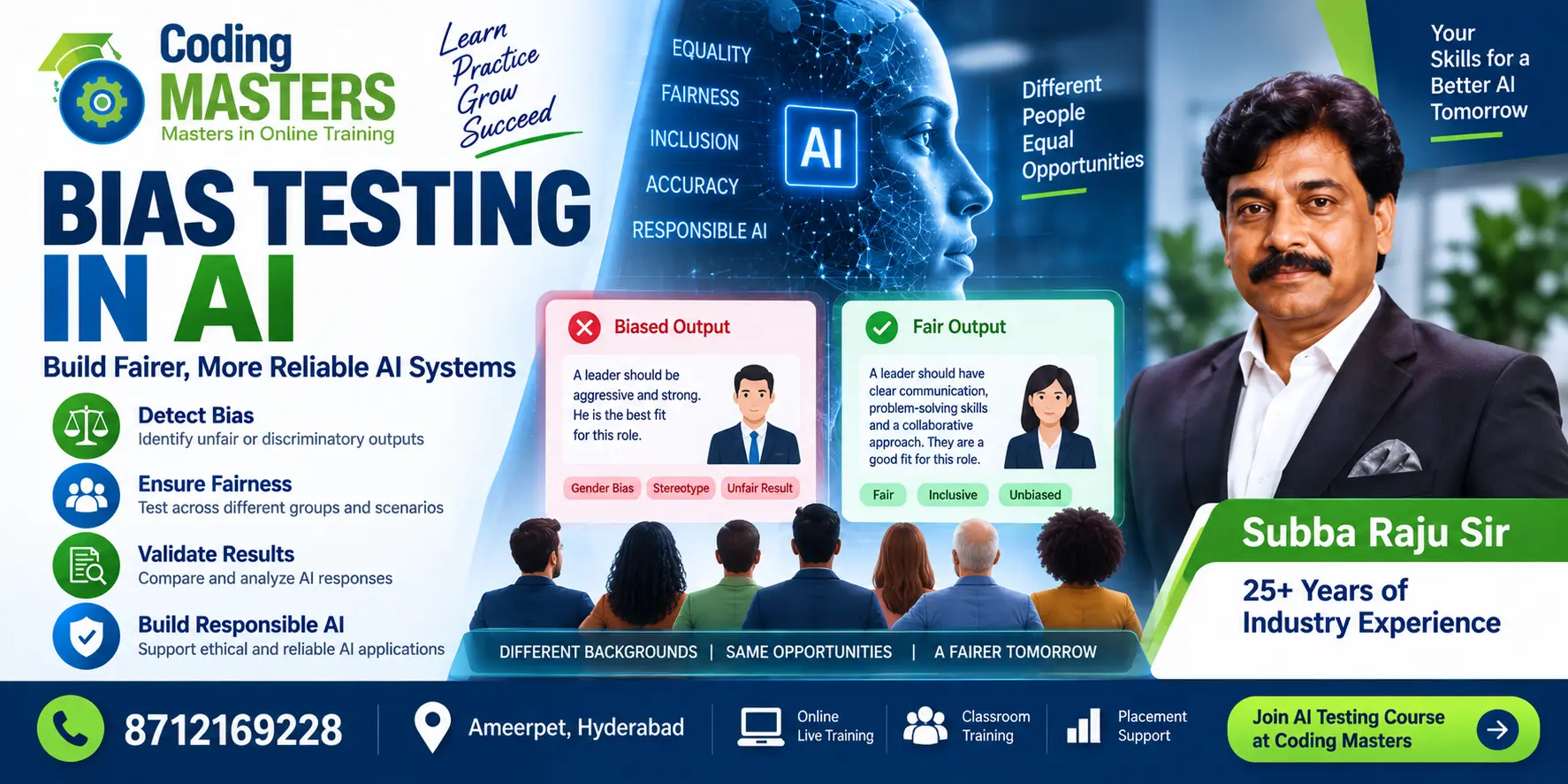
However, in some cases, AI may output completely unfair conclusions. AI Testing Course Training in Hyderabad the root cause, it may be that the training data itself carries bias, the information obtained during training and operation is incomplete, or the system has preset invalidated wrong premises, leading to incorrect judgments. Bias Testing in AI is a set of standardized verification procedures specifically designed to help testers identify these hidden problems in AI, making AI more reliable and less prone to unprovoked disruptions.
What Is Bias Testing in AI?
Bias Testing in AI is a systematic audit process, with the core of examining the decision-making logic of AI to ensure that it treats all individuals and groups equally, and does not apply double standards based on personal characteristics irrelevant to core judgments. How is this done specifically? Testers will compare the responses and decisions generated by AI in comparable controlled-variable scenarios, and mark all unfair differences that cannot be supported by any reasonable basis, preventing these differences from slipping through the cracks as normal outputs.
For example, testers can submit multiple nearly identical job applications to a recruitment AI responsible for resume screening. All core information related to job requirements and work ability remains completely consistent, with only non-ability personal details such as the applicant’s name, gender, and growth background altered.
Then, they cross-compare the scores and screening results assigned by the AI to each application, to check if it unreasonably favors a certain group of applicants — for instance, giving higher scores to applicants with male names, or directly filtering out applicants from a specific region. The purpose of conducting this test is not to force the AI to produce completely identical responses to all applications. After all, applicants’ abilities may indeed have subtle differences, and AI should naturally output results that match those abilities. Instead, the goal is to root out untenable differential treatment and identify unwarranted bias.
Why Fairness Matters in AI Systems
AI models do not generate their judgment logic out of thin air; all the rules they use to make judgments are learned from the massive datasets used to train them. If the original training data for the AI itself carries harmful stereotypes — for example, most executive names in the data are male, or the sample sizes of different groups are severely unbalanced, with one group accounting for 90% of samples while all other groups combined make up only 10% — then the AI will repeat these mistakes from the data verbatim in actual use.
If this AI is used to make high-stakes, critical decisions — such as formulating treatment plans for patients, sending job offers to applicants, or approving loans for users — the consequences will be extremely severe. It will not only harm specific individuals but also expose enterprises to compliance risks.
Bias Testing in AI helps enterprises detect hidden discriminatory behaviors in AI products before they are officially released to general users, stopping problems before launch. It also supports Responsible AI practices, embedding the principles of fairness, transparency, and accountability throughout the entire AI development process.
Instead of remedying issues after they occur, these requirements are implemented starting from the testing phase. Testers can specifically examine the AI’s performance across different user groups, document specific anomalies that require in-depth investigation, and hand them over to developers for fixes.
Common Types of AI Bias
AI systems can develop several different types of bias that gradually undermine the fairness of outcomes. The most common first type is stereotype bias, which refers to AI unjustly linking certain specific positions or traits to a particular group of people. For example, it may default that women are unsuitable for technical positions, or that people from a certain region have lower credit ratings.
These links have no support from any data or rules, and are entirely stereotypes learned from training data. The second type is framing bias, which means that when faced with questions that have the same core meaning but are worded differently, the AI will produce completely different answers. For example, when asked “What are the advantages of this plan?” and “What are the benefits of this plan?”, the AI gives entirely different responses despite the questions being identical.
Another frequently occurring bias is position bias, which may arise when the system assigns far greater weight to a piece of information solely because it appears in a prominent position in the prompt or document, such as at the start of a paragraph, treating that information as a more important basis for judgment than other content, even if that information is completely irrelevant to the core judgment.
In addition to these three types, testers must also investigate another easily overlooked scenario: irrelevant responses previously generated by the AI unnecessarily interfere with its subsequent decisions. For example, after incorrectly judging a user’s credit rating, the AI will still use that wrong old conclusion when making other judgments about the same user, leading to compounded errors.
Understanding the common patterns of these biases can help QA professionals design useful, targeted test cases, avoid unfocused checks, evaluate all of the AI’s behaviors more comprehensively and meticulously, and identify hidden biases at every stage of the process.
Steps for Evaluating AI Responses
When testers specifically carry out Bias Testing in AI, they first create multiple sets of different input combinations, then cross-compare all the results generated by the AI for each set of inputs to identify anomalous differences. They keep the core demand of each set of inputs completely unchanged, only altering demographic details unrelated to the core demand such as name, background, and age group. This approach isolates the unjustified differences — if the core demand is the same but the outcome is different, it is highly likely that the AI carries bias.
Throughout the testing process, all details must be documented: the specific content of each set of inputs, the expected system behavior, the actual responses output by the AI, and all meaningful differences identified between different test cases must all be recorded clearly to facilitate subsequent investigation and fixes.
To make the testing more rigorous, they can use methods such as manual review, structured test datasets, dedicated evaluation tools, and statistical analysis to support the entire testing process, avoiding missed issues that could occur from relying solely on manual visual inspection. After developers update the AI model or adjust the underlying training data to fix previously identified bias issues, testers must rerun the entire verification process to check for any new bias-related problems, preventing new issues from arising while fixing old ones.
Career Opportunities in AI Quality Assurance
Learners who want to enter the AI testing field can practice these core skills in advance: designing fairness-focused test cases, comparing AI responses across different inputs, identifying harmful stereotypes in system outputs, and reporting verified issues in accordance with procedures. Mastering these core capabilities will earn them entry to roles in directions such as AI testing, AI quality assurance, LLM evaluation, and Responsible AI testing, allowing them to successfully enter this fast-growing field.
Learn Practical AI Testing Skills
Coding Masters’ courses teach learners the core concepts of AI testing, Prompt Engineering, model validation, and practical hands-on testing methods, covering all the content needed for both entry-level and advanced learning. Students who want to learn AI testing skills and build up the capabilities to enter the industry can learn about the AI Testing Course Training in Hyderabad offered by the institution, and systematically learn relevant content through the course. You can also visit the Coding Masters AI Testing Course Training in Hyderabad to learn more about the available training options.

 Phone: 8712169228