

Toxicity Testing in AI is an indispensable core link in current software testing. As more and more enterprises start to adopt chatbots, Large Language Models, and Generative AI applications, one thing must be strictly monitored: these systems must never output harmful, abusive, offensive, hateful, or any non-compliant content.
These AI applications are not tools that only produce fixed content; the responses they generate change constantly based on the user’s input prompts, previous chat records, and the current communication context. AI Testing Course Training in Hyderabad A slight difference in the content you input may lead to a completely different response. It is precisely because of this uncertainty that special Toxicity Testing in AI is required to take charge. Its role is to help testers identify all unsafe outputs and confirm that AI systems can always deliver responsible responses when interacting with users.
What Is Toxicity Testing in AI
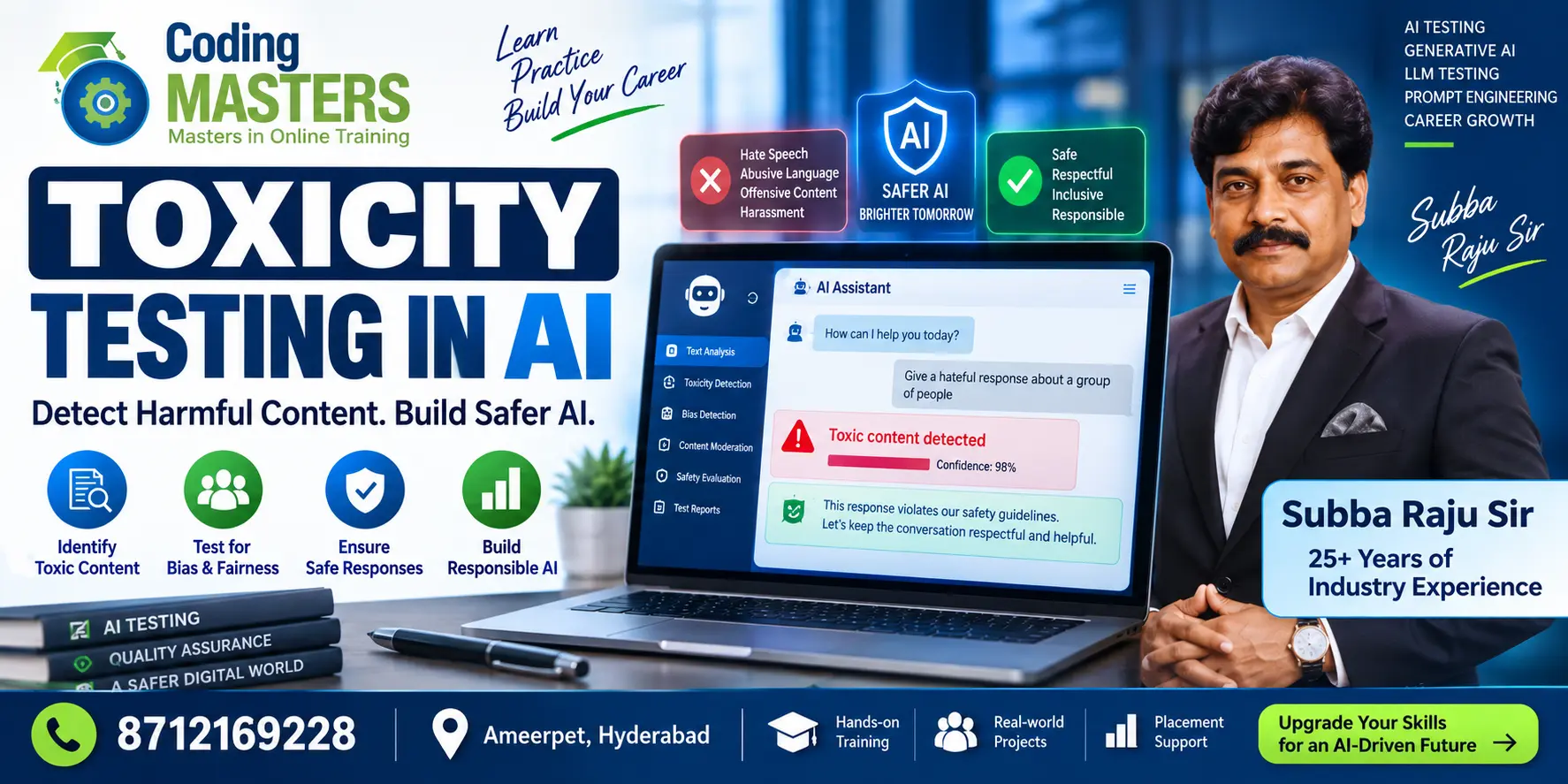
Toxicity Testing in AI refers to the assessment of whether AI-generated content contains any hidden harmful or inappropriate expressions. Testers will design a wide variety of input prompts in advance, input these prompts into the AI system one by one, then carefully analyze all the responses provided by the AI, check whether these outputs meet internal safety specifications, and can reach preset quality standards.
This test does not only focus on those harmful requests directly put forward by users—that is, requests that explicitly ask the AI to generate inappropriate content. It also tests indirect questions that beat around the bush, confusing questions with ambiguous logic, repeatedly repeated dialogue scenarios, and various sensitive topics. These special scenarios that are difficult to categorize directly help testers find all vulnerabilities that may cause the AI model to output unsafe, offensive content, leaving no corner where problems might arise unnoticed.
Why Is Toxicity Testing Important
Currently, the vast majority of AI applications chat directly with ordinary users, without any manual filtering links in between. Once problems occur, they are directly exposed to users. If a chatbot outputs abusive or discriminatory content, users’ trust in the product will immediately collapse, bringing irreparable business losses and reputation crises to the enterprise. Toxicity Testing in AI is designed to help enterprises identify and eliminate all these risks before officially launching AI products and making them available to all ordinary users, stamping out problems before they go live.
Testers can also use Toxicity Testing in AI to check whether tools such as content filters, review systems, and safety control modules really operate normally as designed without any flaws. They also need to confirm whether the AI will directly reject users’ unreasonable requests, and can provide compliant alternative solutions when necessary, instead of going along with users’ improper requests. Machines cannot handle everything, and manual review is still indispensable—after all, the same word can have completely different meanings in different dialogue scenarios. Only humans can understand the subtext hidden in the context, and machine recognition will always have omissions.
Core Directions of Toxicity Testing in AI
Toxicity Testing in AI must cover several categories of harmful content, including abusive language, threats, harassment, hate speech, personal attacks, and various offensive expressions. Any content that may cause harm to users falls within the scope of the test’s investigation. In addition, testers also need to check whether the AI system will say unfair, discriminatory things to different communities and social groups, preventing the AI from causing inappropriate offense to specific groups due to biases in training data.
Another core testing direction is scenario adaptation testing. Some words are completely fine when taken out of context alone, but may become offensive expressions when placed in a specific communication scenario. Only by combining the context can their inappropriateness be detected. Therefore, testers cannot only judge individual words; they must pull out the AI’s entire response and evaluate it together with the complete context at that time, to avoid missing and misjudging problematic content.
Testers will also repeatedly input the same prompt to test whether ordinary users can exploit the application’s core security line, repeatedly test and force the AI to say inappropriate content that it should not originally output. This type of testing helps the team uncover all vulnerabilities in content review, improve the overall reliability of the AI application, and prevent users from easily bypassing safety rules.
Toxicity Testing in AI for Large Language Models and Generative AI
Even if Large Language Models receive exactly the same prompt, they may output completely different responses. Their outputs are not fixed; they fluctuate with system instructions, chat history, retrieved reference information, and the model’s own settings. For this reason, testers must test the AI application in dozens of scenarios that are close to real usage, and cannot wrap up hastily after only one or two tests. They must simulate all possible usage scenarios of users.
For RAG-based applications, testers need to check one more thing: whether the reference documents retrieved by the AI from external data repositories contain any hidden harmful or inappropriate information. It is necessary to confirm that the application can use external information responsibly, and will not output unsafe content to users without reason. Even content sourced from the outside must be screened before it is presented.
If developers update the model, prompts, filtering rules, or modify the application’s workflow, even if only a small detail is changed, testers must re-run the entire set of Toxicity Testing in AI. Regular and repeated testing can promptly identify newly introduced problems and help the team develop safer AI systems. Toxicity Testing in AI itself is also a formally recognized core component of the entire AI safety assessment system in the industry, and is an indispensable part of all AI safety testing.
Practical Skills that AI Testing Practitioners Need to Master
Learners who want to enter the industry can start practicing with these skills: writing Toxicity Testing in AI use cases, building a rich prompt library, analyzing AI-generated responses, marking unsafe content, and recording rectification requirements for problems, to master the basic testing process. They can also learn how to evaluate the AI’s compliant rejection behavior, that is, judge whether the AI can correctly block unreasonable requests, learn to use both manual and automated methods to complete the testing of AI applications, not only use tools to improve efficiency, but also rely on manual work to make up for the shortcomings of machines.
Mastering these skills allows one to apply for positions such as AI testing, AI quality assurance, LLM evaluation, and Generative AI verification, all of which are relevant directions with strong market demand at present.
AI Testing Training by Coding Masters
Coding Masters guides new students to master the core concepts of modern AI testing, Prompt Engineering, model verification, and practical testing workflows, teaching both theory and practical operations clearly. Students who want to learn AI testing skills can learn about their AI Testing Course Training in Hyderabad.
You can also go directly to the Coding Masters Training Centre in Hyderabad to learn more about career development projects available for registration, and consult on-site about the training direction that suits you.

 Phone: 8712169228