

Introduction to LLMs:
The Introduction to LLMs course helps learners build a strong foundation in modern generative AI. Large language models (LLMs) have completely transformed how humans interact with artificial intelligence. Today, they power chatbots, content creation tools, programming assistants, search systems, and a wide range of commercial use cases. Therefore, AI professionals looking to enter the field must master LLM-related knowledge. The course Introduction to Large Language Models helps learners build a foundational understanding of modern generative AI.
LLMs can understand and generate human-like text. They can summarize information, answer questions, and write code. LLMs can also support automated workflows. These workflows help businesses improve productivity and customer experiences. At Coding Masters, students learn LLM concepts through hands-on practice. In addition, Subba Raju Sir, who has 25 years of industry experience, guides participants to connect theoretical knowledge with real-world implementation. This program also supports learners seeking generative AI training in Hyderabad. Students can gradually master core concepts such as language models, prompt engineering, tokens, embedding vectors, and APIs. These skills provide a strong foundation for advanced AI development.
What Are Large Language Models?
Large language models use artificial intelligence to process and generate human language. During training, They learn language patterns from massive amounts of training data, then make accurate predictions about word order and output meaningful responses. These models are built on neural networks, especially Transformer-based architectures. They can understand connections between words in different contexts. This allows them to handle complex language tasks more efficiently. For example, applications include chatbots, writing assistants, programming tools, document analysis, and virtual assistants; enterprises also use them for customer support and knowledge management.
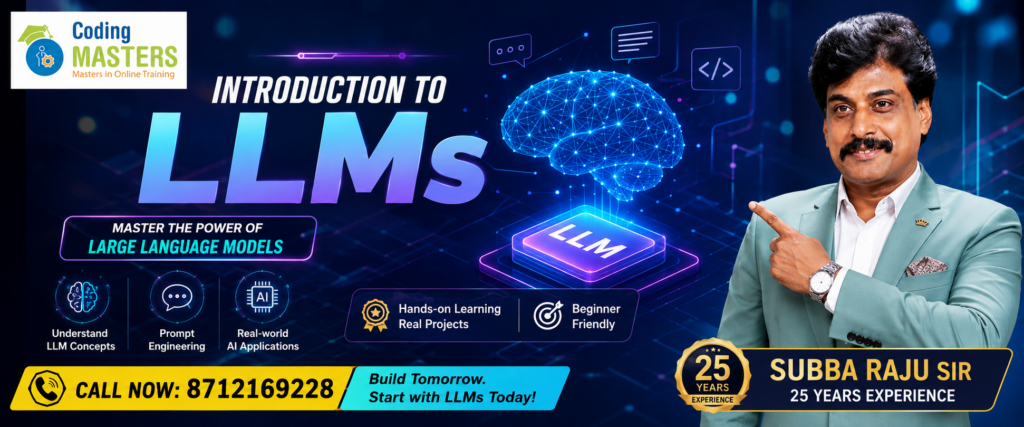
First, Mastering the fundamentals of large language models helps students grasp the operating logic of modern AI applications, As a result, it creates a foundation for learning advanced generative AI concepts. The course Introduction to LLMs builds this necessary foundation: it systematically explains model architectures, core training concepts, inference mechanisms, and real-world applications. It also covers how to integrate large language models with APIs and software applications, to support students’ subsequent learning of prompt engineering and AI application development.
How Introduction to LLMs Works:
Large language models rely on several core mechanisms to process language. First, the model splits text into smaller units called tokens, then processes these tokens through neural network layers. The Transformer architecture plays a key role in this process. It helps the model understand relationships between different tokens. This allows the model to generate responses that match the given context. Training allows large language models to learn patterns from massive datasets. During training, the model repeatedly processes samples and adjusts its internal parameters.
After training, users can enter prompts to receive generated responses. Therefore, prompt quality can have a major impact on model output. Learners enrolled in generative AI courses in Hyderabad can benefit greatly from mastering these foundational concepts, which form the basis for operating modern AI tools. In addition, learners can further explore five key elements to gain a more thorough understanding of the model’s operating logic: the temperature parameter, context window, tokens, embedding vectors, and model parameters.
Introduction to LLMs and Generative AI Applications:
Large language models (LLMs) can support a wide range of applications in science, technology, and business. For example, enterprises use LLMs to build customer service assistants and knowledge systems. Developers use them for code generation, debugging, and documentation. LLMs can also support software development workflows. Marketing teams can use them for content planning and communication. LLMs can also summarize long documents and extract key information, helping enterprises improve the efficiency of information processing.
Currently, generative AI applications continue to expand across industries, and teams in healthcare, education, finance, retail, and technology are all exploring AI-driven solutions. Learners enrolled in generative AI training courses in Hyderabad can study these practical applications, master methods for integrating LLMs into modern AI workflows, and gain exposure to advanced topics such as retrieval-augmented generation, AI agents, and enterprise-level AI applications.
Building Skills with Introduction to LLMs:
Learning to work with large language models cannot stop at only mastering basic terminology; learners must accumulate practical knowledge through continuous experimentation and application. First, they need to grasp fundamental concepts in artificial intelligence and machine learning. Next, they can learn about tokens, transformers, embeddings, and various model architectures. Then they can practice writing qualified prompts, using prompt engineering effectively to convey instructions to models clearly.

Essential LLM Concepts for Beginners:
For beginners aiming to enter the advanced development of large language models, they must first clarify several core concepts: Tokens are the smallest units processed by models when they generate language; embeddings convert information into numerical vectors, enabling AI to identify connections between words, documents, and concepts. The Transformer architecture allows models to process relationships between different tokens, while the attention mechanism enables models to capture critical contextual links.
Prompt engineering focuses on building clear instructions for AI, and high-quality prompts can produce outputs that better align with requirements. The context window determines the amount of information a model can process in a single interaction, and understanding this concept helps people design more reasonable AI workflows. Learners who take generative AI courses at Amirkabir University of Technology can steadily build up these competencies, then transition to advanced generative AI development. After mastering the fundamentals, they can also explore retrieval-augmented generation, fine-tuning, AI agents, and multimodal AI.
Learning LLMs at Coding Masters:
The structured generative AI training program launched by Coding Masters helps learners explore modern generative AI concepts. Its learning framework is built around four core dimensions: concepts, tools, practical cases, and application development. The course is taught by Subba Raju Sir, who has 25 years of industry experience, and enables students to connect technical concepts with real workplace scenarios.
The training is designed for novices and working professionals who aim to solidify their knowledge of generative AI. It follows a structured learning path that starts with prerequisite LLM fundamentals, then progresses to advanced AI technologies. Learners can also study content including prompt engineering, AI tools, APIs, and real-world implementation of generative AI. Users searching for generative AI training in the Ameerpet area can access services from this institution. The organization also offers online Gen AI training and courses to meet the flexible scheduling needs of different learners, who can choose a learning format that fits their personal goals.
Why Learn LLMs Now?
Generative AI continues to exert influence across the fields of software development, business operations, marketing, education, and customer support. Mastering LLMs can help professionals adapt to evolving technical requirements. Organizations are exploring AI solutions that boost productivity. These solutions can also automate repetitive workflows. LLMs play a core role in many of them. Learning LLMs early helps learners understand this fast-evolving technology. It also creates a foundation for advanced AI applications. LLM skills can support programming, data analysis, testing, marketing, and automation.
Learners can start with basic concepts and gradually refine advanced skills; this structured approach reduces learning difficulty and supports steady progress. For those looking to select a generative AI course in Hyderabad, they should prioritize programs that combine theoretical learning with hands-on practice, as a solid foundational background will allow learners to explore all types of advanced generative AI technologies with confidence.
Gen AI and Agentic AI Training – Coding Masters
Address
flat no 101,
Bhavya Krishna Residency,
OPP: Siddartha Degree College, Ameerpet Rd, Kumar Basti,
Nagarjuna Nagar colony, Yella Reddy Guda,
Hyderabad,
Telangana 500073