

LangGraph Projects: Build Practical AI Agent Applications
Whether you are a practitioner who has already started development, or an AI learner who has just entered the field, LangGraph Projects can provide you with an implementable, hands-on path to help you understand stateful, multi-step AI applications, and exactly how to build an AI Agent’s workflow step by step. You will no longer have to only study abstract knowledge points; you can follow the projects to build these processes yourself.
Right now, Generative AI is still developing continuously, and the tasks it can accomplish have long gone beyond simple question-and-answer interactions. In the past, AI could only take one question you raised and provide a corresponding answer. Today, the AI systems people aim to build are far more complex — they must be able to figure out how to handle complex tasks on their own, call external tools to assist with work, store key information in the process so they do not forget earlier content while working on later stages, and finally complete all multi-phase tasks from start to finish. LangGraph provides the foundational framework to help you build these advanced workflows.
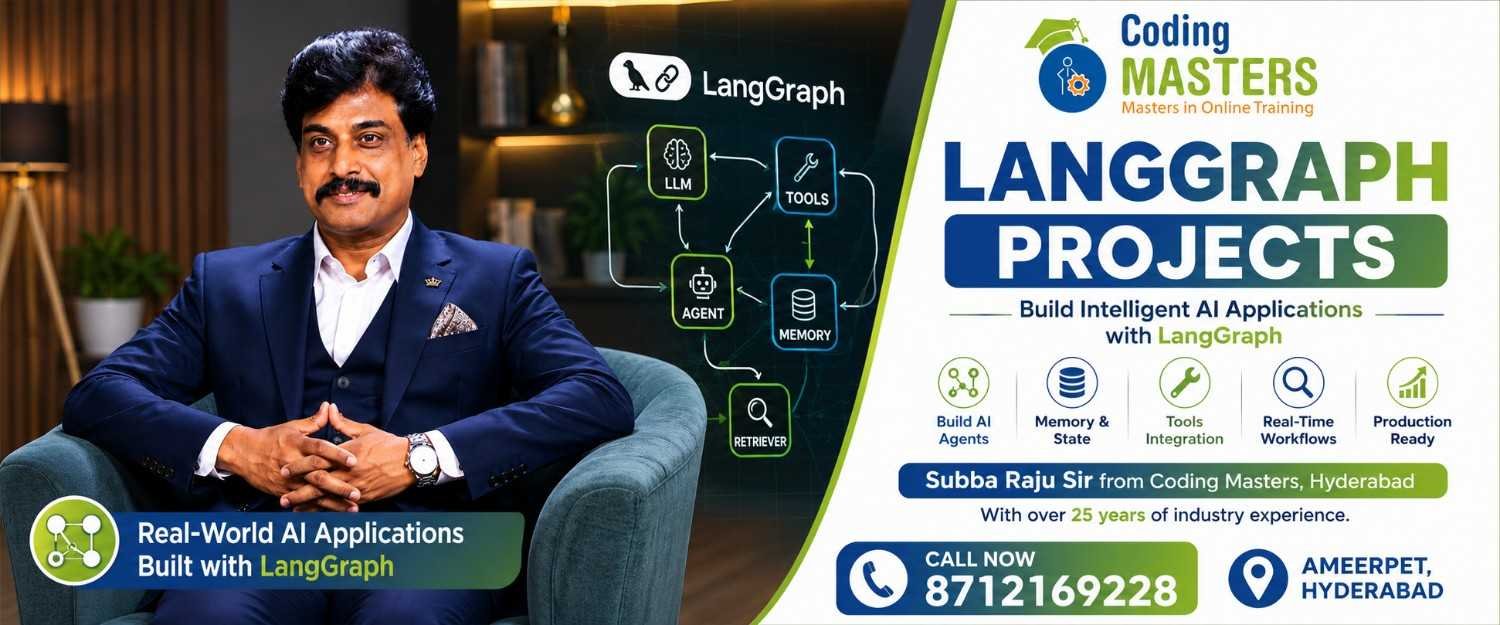
What Is LangGraph? A Foundation for AI Agent Projects
The LangGraph framework serves two specific goals: first, building stateful applications, and second, building AI Agent workflows that rely on Large Language Models (LLM). When you use it, you do not have to worry about a pile of scattered logic; you can map the core logic of the entire application into an interconnected graph. Each node in this graph represents an independent small step you need to complete, and clear predefined paths connect the nodes. After finishing one step, you can follow the path to move to the next required step. After finishing one step, you can follow the path to move to the next required step.
As long as the AI application you are building needs to perform a series of operations in sequence, make independent decisions on the next step at any time, retain core data without loss between different steps, or even connect with various tools outside the Large Language Model itself, this graph-based structure will be of great help. A rigid one-way linear process will not constrain you — that is, the inflexible workflow where you must complete A first, then only B after A, and only C after B. Instead, you can build sufficiently flexible applications that switch to different paths to continue running based on currently stored state data or the results of previous steps, without restricting you to a fixed sequence.
Why Work on LangGraph Projects?
Building projects hands-on is one of the most effective ways to understand exactly how the workflow of an AI Agent operates in real-world scenarios. You will no longer only study scattered, isolated individual knowledge points from textbooks. After completing this project, you will be able to build and refine a fully functional complete application from start to finish, connecting all the fragmented content you have learned before.
Working on projects will also guide you to fully master all core key points, so you will not only have a vague impression: for example, state management that enables AI to store key information in the process without loss, workflow orchestration that arranges the logic and sequence of all steps properly, tool integration that connects external tools to your own AI, conditional logic that allows AI to choose different operations based on different conditions, and the complex interaction logic that enables all independent components in the application to work together. The experience accumulated from building these practical applications is extremely valuable for any developer who wants to pursue a career in Generative AI and AI Agent development.
Building AI Agent Workflows
AI Agent development is one of the most valuable directions you can explore in depth with LangGraph. A standard AI Agent follows a clear workflow: first, it receives the user’s request, then it decomposes and analyzes the next tasks it needs to complete. Next, it selects the appropriate tools for the task, processes the output the tools return, and finally organizes a coherent response to send back to the user, completing the entire process.
By following LangGraph Projects to practice hands-on, you will personally see how these scattered steps integrate into a coherent and reliable workflow, and you will no longer see these steps as abstract, unattainable knowledge points. For example, you can start by building a simple AI assistant to practice: it first receives the user’s question, then judges on its own whether it needs additional information to answer the question accurately. If needed, it calls the corresponding external tool to collect the required data. After the tool returns the information and the agent processes the content, it delivers a complete and accurate response to the user. By running through the entire process once, you will fully understand the logic.
Exploring Implementable LangGraph Project Directions
There are many meaningful and practical projects you can build with LangGraph, so you do not have to worry about not finding a direction to start. You can build a customer support chatbot that can independently judge how to respond to users, a research assistant that integrates information from various sources, a document analysis process that can parse long texts and summarize key points, a task management AI Agent that tracks and updates deadlines as the project progresses, a programming assistant that helps write and debug code, or a custom information retrieval system that pulls data from various sources inside the company and across the internet. All of these are real, implementable projects.
While working on these projects, you can also connect a wide variety of external tools: for example, databases that permanently store users’ context information, third-party APIs that pull real-time data, search engines that collect the latest online information, and countless other external services you can connect to your AI.The process of completing these integrations will practically teach you how to build an AI Agent that can stably connect with systems outside the core Large Language Model, and you will no longer find connecting with external systems a difficult task.
Refining Practical LLM Skills with Hands-On LangGraph Examples
Working on LangGraph Projects gives you continuous hands-on opportunities to operate Large Language Models, so you will not only stay at the level of watching others use them. At the same time, you will learn all the skills required to manage complex, scalable application workflows. During the hands-on practice, you will fully grasp all core concepts, and professional terms will no longer confuse you. You will easily understand, for example: the prompts you give to AI, how you must properly store state data, the nodes and edges that connect the workflow graph we mentioned earlier, conditional routing that chooses different paths based on conditions, tool calling that explains how to invoke external tools, and how the entire workflow runs from start to finish. You will understand all these concepts completely after building them once yourself.
The process of building projects hands-on will also push you to test different implementation methods, find and debug hidden errors in the workflow, optimize the logic to be smoother and the performance to be better, and judge whether the quality and accuracy of AI-generated responses are high enough.The experience you accumulate from these real project scenarios will prove extremely valuable when you later build Generative AI applications that withstand real user needs and deploy them in production environments. You cannot learn these practical insights from textbooks.
Using LangGraph Applications to Build an AI Portfolio
Crafting Your Portfolio Content
After completing all these practical projects, you can demonstrate to potential employers or partners that you truly understand current AI technology, rather than only being able to recite knowledge points. A presentable personal portfolio can include detailed descriptions of these projects, workflow diagrams that clearly label all nodes and edges in the graph, implementation notes explaining your core technology choices, and a summary of the biggest challenges you encountered while working on the projects, as well as the specific solutions you developed to solve these problems. Organizing this content clearly will showcase your abilities in a tangible way.
Standing Out in Technical Interviews
A portfolio centered on LangGraph Projects can prove that you truly have hands-on experience in AI Agent, Large Language Model application development, workflow orchestration, cross-tool integration and other related fields, rather than only having a superficial understanding. When you attend technical interviews later, these projects will be solid talking points that let you discuss specific details with interviewers; when applying for AI development-related positions, they are also work samples that help you stand out from other candidates, far more useful than vague resume descriptions.
Building a Foundation for Continuous Growth
Today, AI Agent technology is still iterating and updating rapidly. The practical experience accumulated from working on projects can help you deepen and consolidate your understanding of modern Generative AI application development, so you will not fall behind in technological advancement. Building, testing, and refining LangGraph workflows by hand is a key step for you to grow into a qualified AI engineer and accumulate all necessary practical skills. This hands-on experience will become an important foundational accumulation on your path to entering the industry.
Want to learn the LangGraph Projects in Hyderabad? Contact Coding Masters:
Gen AI and Agentic AI Training – Coding Masters
Flat No. 101, Bhavya Krishna Residency,
OPP: Siddartha Degree College,
Ameerpet Rd, Kumar Basti,
Nagarjuna Nagar colony,
Yella Reddy Guda,
Hyderabad, Telangana 500073
 Phone: 8712169228