

Modern web applications require reliable and fast test automation. Playwright with Python is a powerful combination for automating web applications, validating user workflows, and building reliable end-to-end tests.
In this tutorial, you will learn what Playwright is, how to install it with Python, write your first automation script, work with locators, handle browsers and pages, perform assertions, and build practical test cases.
What is Playwright?
Playwright is an open-source browser automation framework developed by Microsoft. It allows testers and developers to automate modern web applications across major browsers such as Chromium, Firefox, and WebKit.
Playwright supports multiple programming languages, including Python, JavaScript, TypeScript, Java, and .NET.
With Python, Playwright can be used for:
- Web application testing
- End-to-end testing
- UI automation
- Cross-browser testing
- Regression testing
- API testing
- Test automation frameworks
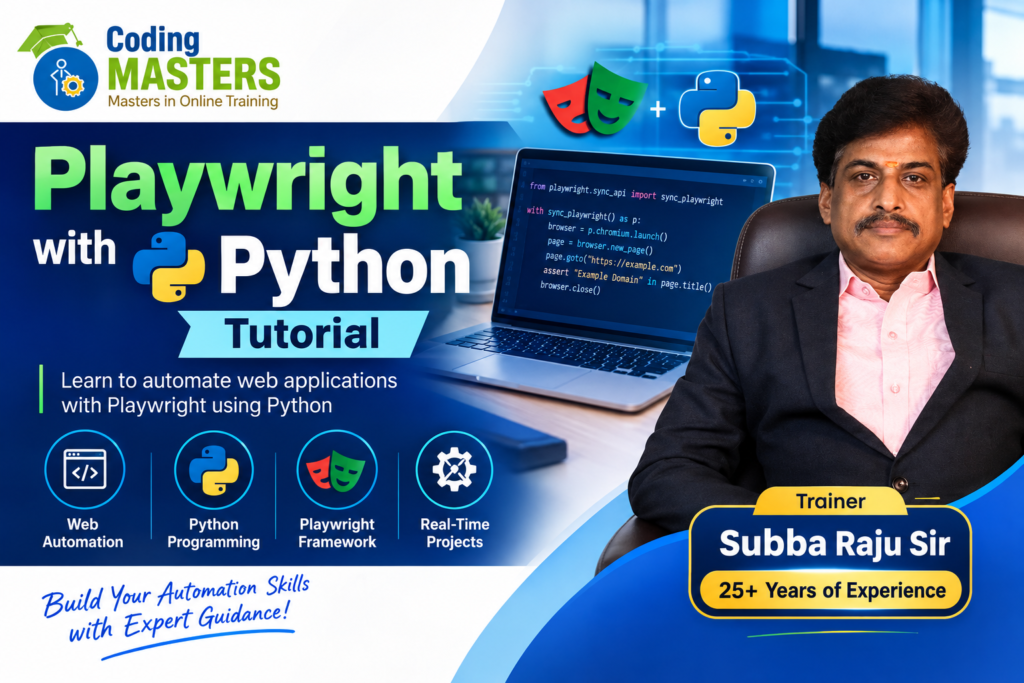
Why Use Playwright with Python?
Python is one of the most popular programming languages for automation because of its simple syntax and extensive ecosystem. When combined with Playwright, it becomes a strong solution for modern web testing.
Key benefits include:
- Easy-to-write automation scripts
- Cross-browser support
- Fast test execution
- Automatic waiting
- Powerful locators
- Screenshot and video support
- Parallel test execution
- Network interception
- API testing capabilities
- Support for modern web applications
How to Install Playwright with Python
Before starting, make sure Python is installed on your system.
Open your terminal or command prompt and install the Playwright package:
pip install playwrightNext, install the required browsers:
playwright installYou are now ready to create your first Playwright automation script.
Your First Playwright Python Program
Create a Python file such as:
first_test.pyA simple Playwright script can launch a browser, open a website, and display its title.
from playwright.sync_api import sync_playwright

with sync_playwright() as p:
    browser = p.chromium.launch(headless=False)
    page = browser.new_page()

    page.goto("https://example.com")

    print(page.title())

    browser.close()
Here, Playwright launches Chromium, creates a new page, navigates to the website, prints the page title, and closes the browser.
Understanding Playwright Locators
Locators help Playwright identify elements on a web page.
Common locator methods include:
page.get_by_role("button", name="Login")
page.get_by_text("Welcome")
page.get_by_label("Username")
page.get_by_placeholder("Enter username")
page.locator("#username")
For example:
page.get_by_label("Username").fill("testuser")
page.get_by_label("Password").fill("password123")
page.get_by_role("button", name="Login").click()
Using reliable locators makes automation scripts easier to maintain.
Handling Buttons, Text Boxes and Links
Playwright makes it simple to interact with web elements.
Enter Text
page.get_by_label("Email").fill("test@example.com")Click a Button
page.get_by_role("button", name="Submit").click()Click a Link
page.get_by_role("link", name="Home").click()Select an Option
page.locator("select").select_option("option1")These actions can be combined to automate complete user workflows.
Assertions in Playwright
Assertions help verify whether an application behaves as expected.
Playwright provides built-in assertions through its Python testing support.
For example:
from playwright.sync_api import expect

expect(page).to_have_title("My Website")
expect(page.get_by_text("Login Successful")).to_be_visible()
Assertions are important because automation should not only perform actions but also verify the expected results.
Taking Screenshots
Playwright can capture screenshots during test execution.
page.screenshot(path="homepage.png")You can also capture a full-page screenshot:
page.screenshot(path="fullpage.png", full_page=True)Screenshots are useful for debugging failed test cases and documenting test results.
Running Playwright Tests with Python
For structured automation projects, Playwright works well with pytest.
Install pytest and the Playwright pytest plugin:
pip install pytest pytest-playwrightYou can then create a test file:
from playwright.sync_api import Page

def test_homepage(page: Page):
    page.goto("https://example.com")
    assert "Example" in page.title()
Run the test using:
pytestThis approach helps you organize multiple test cases and build scalable automation frameworks.
Playwright with Python for Cross-Browser Testing
One of Playwright’s major advantages is its support for multiple browser engines.
You can automate:
- Chromium
- Firefox
- WebKit
This allows teams to test whether web applications work correctly across different browsers and environments.
Advanced Playwright Features
Once you understand the basics, you can explore advanced Playwright capabilities such as:
1. Page Object Model
The Page Object Model helps organize locators and application actions into reusable classes.
2. Parallel Testing
Run multiple tests simultaneously to reduce overall execution time.
3. API Testing
Playwright can send API requests and validate API responses alongside UI tests.
4. Network Interception
You can monitor, modify, or mock network requests during testing.
5. Authentication
Playwright supports reusable authentication states, making it easier to automate applications requiring login.
6. Trace Viewer
Playwright’s tracing capabilities help analyze test failures by capturing actions, screenshots, network activity, and other execution details.
Playwright with Python vs Selenium
Both Playwright and Selenium are widely used for web automation. However, Playwright provides several modern capabilities such as built-in auto-waiting, browser contexts, network interception, tracing, and strong support for modern web applications.
The right tool depends on your project requirements, existing automation framework, browser needs, and team expertise.
Real-World Playwright Automation Examples
Playwright with Python can be used to automate practical scenarios such as:
- Login and logout testing
- Registration forms
- E-commerce checkout
- Search functionality
- File upload and download
- Form validation
- Payment workflow testing
- Dashboard testing
- Multi-page workflows
- Cross-browser testing
- Regression test suites
Best Practices for Playwright with Python
To create reliable automation scripts:
- Use stable and meaningful locators.
- Prefer Playwright’s built-in auto-waiting instead of unnecessary delays.
- Keep test cases independent.
- Use Page Object Model for larger projects.
- Add meaningful assertions.
- Capture traces and screenshots when debugging.
- Avoid hard-coded waits whenever possible.
- Run tests across multiple browsers.
- Keep test data separate from test logic.
- Integrate automated tests into CI/CD pipelines.
Frequently Asked Questions
Is Playwright good for Python beginners?
Yes. Playwright’s Python API is relatively easy to learn, especially if you already understand basic Python programming.
Is Playwright better than Selenium?
Playwright offers many modern automation features, but whether it is better depends on your project requirements and existing testing ecosystem.
Can Playwright with Python test Chrome?
Yes. Playwright can automate Chromium-based browsers, including Chrome configurations.
Can Playwright perform API testing?
Yes. Playwright supports API testing, allowing teams to validate API responses and combine API and UI testing workflows.
Is Playwright used for automation testing?
Yes. Playwright is widely used for end-to-end, UI, regression, and cross-browser test automation.
Conclusion
Playwright with Python provides a modern approach to web test automation. From basic browser interactions to advanced capabilities such as API testing, network interception, authentication, cross-browser testing, and tracing, Playwright can help teams build reliable automation frameworks.
If you are starting your automation testing journey, learning Python + Playwright + pytest can give you a strong foundation for modern web automation and testing projects.
At Coding Masters, we provide Playwright Training with real-time projects and placement assistance, helping learners gain practical automation skills and prepare for opportunities in software testing and automation.