

Introduction
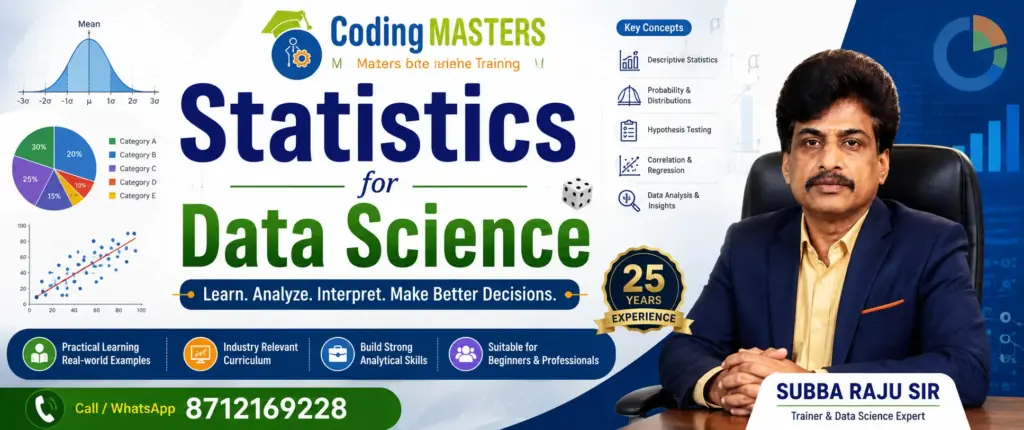
Statistics is the core of learning data science. Statistics for Data Science helps learners build solid analytical thinking, enables practitioners to identify patterns, trends, correlations, and uncertainties in data, and runs through the entire process from exploring datasets and building models to formulating business decisions. It also boosts confidence in working with real-world data. Coding Masters, located in Ameerpet, offers a statistics training course instructed by Subba Raju Sir.The instructor has 25 years of teaching experience. The course focuses on practical content, covers core statistical knowledge points, integrates mainstream data tools, and includes hands-on training exercises. It is suitable for learners with no prior background, graduates, working professionals, and individuals aiming to become data analysts.
Why Statistics Matters in Data Science
Statistics is a core foundation for effective data-driven decision-making, and its role for data science practitioners can be implemented at different levels. First, data scientists must rely on statistics to accurately interpret large datasets, and three types of basic tools each have practical value: descriptive statistics can summarize the core information of complex datasets, probability can estimate uncertainty and potential outcomes, and statistical distributions help people grasp the distribution patterns of data. Practitioners must also master indicators such as mean, median, and mode to identify trends and outliers.
Similarly, correlation analysis helps understand the associations between variables, while regression analysis examines the impact of variables on specific outcomes. As a result, statistics supports multiple core machine learning techniques. For example, hypothesis testing verifies assumptions based on sample data, and confidence intervals quantify the uncertainty of statistical estimates. In addition, statistical knowledge can improve both analytical accuracy and business understanding. Learners can strengthen their problem-solving skills by practicing these concepts, which ultimately makes statistics an essential core skill in the data science and analytics industry.
Statistics Topics Covered in Data Science Training
Descriptive Statistics and Data Exploration
Descriptive statistics enable learners to quickly summarize and understand datasets. The teaching logic aligned with this core goal unfolds its knowledge modules in sequence: first, learners study measures of central tendency such as the mean, median, and mode; then they master dispersion indicators including variance, standard deviation, range, and percentiles, so as to comprehend the distribution and variation of data. Next, they learn methods to identify and handle outliers, as these values can indeed interfere with analysis results and machine learning models. They also connect visualization tools with frequency distributions and summary tables: using histograms to display data distributions, and boxplots to identify dispersion and outliers. Finally, they practice with real-world datasets, linking their hands-on work to actual scenarios, which builds their confidence to conduct exploratory data analysis.
Probability and Statistical Distributions
Probability helps data professionals understand uncertainty and potential outcomes, so learners must master relevant knowledge through practical examples. Core learning content includes conditional probability, independent events, and probability rules. In addition, learners need to master four types of probability distributions commonly used in the field of data science: the normal distribution is mostly applied in general statistical analysis, the binomial distribution is suitable for analyzing binary outcomes, and the Poisson distribution and uniform distribution each have their own applicable scenarios. This probability knowledge underpins machine learning algorithms and predictive analysis. Learners must also practice probability calculations using real datasets, understand the impact of distributions on statistical conclusions, and consolidate the foundation for advanced data science study by combining theory with practice.
Hypothesis Testing, Correlation, and Regression
This teaching module builds a progressive learning pathway around three core statistical methods: hypothesis testing, correlation analysis, and regression analysis. First, it introduces hypothesis testing to help data practitioners assess the core value of sample-based assumptions, and sorts out basic concepts including the null hypothesis, alternative hypothesis, and p-value. It then covers practical techniques such as the t-test and chi-square test. Next, it explains the function of correlation analysis in measuring associations between variables, with a key focus on clarifying the cognitive boundary that “correlation does not equal causation”. Finally, it elaborates on the logic of simple linear regression and multiple linear regression, and connects this knowledge to predictive modeling capabilities. The module is ccompanied by hands-on practical training throughout the entire learning process. It ultimately builds the foundational skills needed for machine learning projects, and supports career development in the fields of data analysis and business intelligence.
Benefits of Learning Statistics for Data Science
Statistical training brings multiple layers of practical benefits to data professionals in the entry-stage of their careers. First, it strengthens learners’ analytical thinking and refines their core ability to solve problems in a structured way. Second, it boosts these professionals’ confidence in interpreting datasets, enabling them to independently identify hidden patterns behind data without relying entirely on automated tools. Furthermore, it helps analysts communicate research findings with solid evidence, providing reliable support for business decisions across all sectors.
It also lays a solid foundational knowledge of machine learning for practitioners—most algorithms are centered on statistical probability, and mastery of statistical knowledge allows them to evaluate model performance and prediction outcomes, and even identify misleading conclusions, a capability that has grown increasingly critical amid the continuous expansion of enterprises’ data application scale. Ultimately, these abilities equip learners with practical knowledge suited to multiple career tracks, supporting them to pursue paths such as data science, data analysis, and business intelligence, and building a solid foundation for their long-term career development.

Statistics Training at Coding Masters
The Statistics for Data Science training program, launched by Coding Masters, is purpose-built for job seekers in the data industry. The lead instructor, Subba Raju Sir, has 25 years of experience working in the training field. The course uses a structured, practice-oriented design that integrates statistics with core data technologies including Python, SQL, machine learning, and data visualization. It provides learners with access to real industry datasets for hands-on practice, breaks down complex knowledge points using simple case studies, and includes regular exercises to strengthen analytical skills. The program is suitable both for beginners with no prior background entering the field and for working professionals who aim to fill gaps in their analytical knowledge. It helps learners understand how statistics underpins real-world business decision-making. Prospective learners who wish to inquire about the course framework and study requirements may call 8712169228. A solid foundation in statistics is the core support for advancing one’s data science capabilities.
Frequently Asked Questions
What is statistics in the field of data science?
It is an academic discipline that teaches methods for understanding, analyzing, and interpreting data. Its core content covers foundational concepts that support data analysis and machine learning, including probability, distributions, correlation, regression, and hypothesis testing.
What is the value of learning this content?
It helps you understand datasets, make evidence-based decisions, and deepen your knowledge of machine learning algorithms. It is also a critical foundation for pursuing careers related to data science.
Can beginners master this subject well?
You can make steady learning progress as long as you follow structured courses, combine your studies with practical case studies, master basic concepts first before advancing gradually, and complete regular practice exercises.
What content is included in related training programs?
The training covers descriptive statistics, probability, distributions, correlation, regression, hypothesis testing, and statistical interpretation. It also connects statistical theory to real-world applications in data science.
Can data analysts benefit from this training?
Absolutely. Analysts use statistics whenever they explore and interpret datasets. This knowledge also helps you communicate valuable insights and strengthen your practical data analysis skills.
Can statistics support machine learning?
Yes. Probability can explain uncertainty and prediction problems in machine learning, while regression and statistical evaluation underpin predictive modeling. These provide foundational support for a wide range of machine learning technologies.
I am located in Ameerpet, India. Where can I go to learn this?
You can sign up for the related training program offered by Coding Masters. The course instructor, Subba Raju Sir, has 25 years of teaching experience. You can call 8712169228 to inquire about the latest training details.
Who is suitable to learn this content?
This program is open to graduates, entry-level beginners, data analysts, working professionals, and aspiring data scientists who want to solidify their analytical foundations. It supports learners at different career stages to improve their professional abilities.
Address:
Flat No: 303,
Bhavya Krishna Residency,
Siddartha Degree College,
OPP: Ameerpet Rd,
Kumar Basti,
Nagarjuna Nagar colony,
Yella Reddy Guda,
Hyderabad,
Telangana 500073
📞 Call Now: 8712169228