

Introduction
Gen AI testing is changing how companies approach software quality and testing. Artificial intelligence is reshaping nearly every industry. The software testing sector is no exception.
Traditional software testing methods require large investments of manpower, time, and maintenance costs. In contrast, AI-powered testing is transforming the field of quality assurance.
It makes testing processes faster, smarter, and more accurate.
If you are planning a career in software testing, AI testing can help upgrade your skills.
Therefore, mastering AI testing has become an essential requirement.
This guide will introduce the definition, operating logic, and advantages of AI testing.
It also covers mainstream tools, career opportunities, and the growing adoption of AI-driven testing.
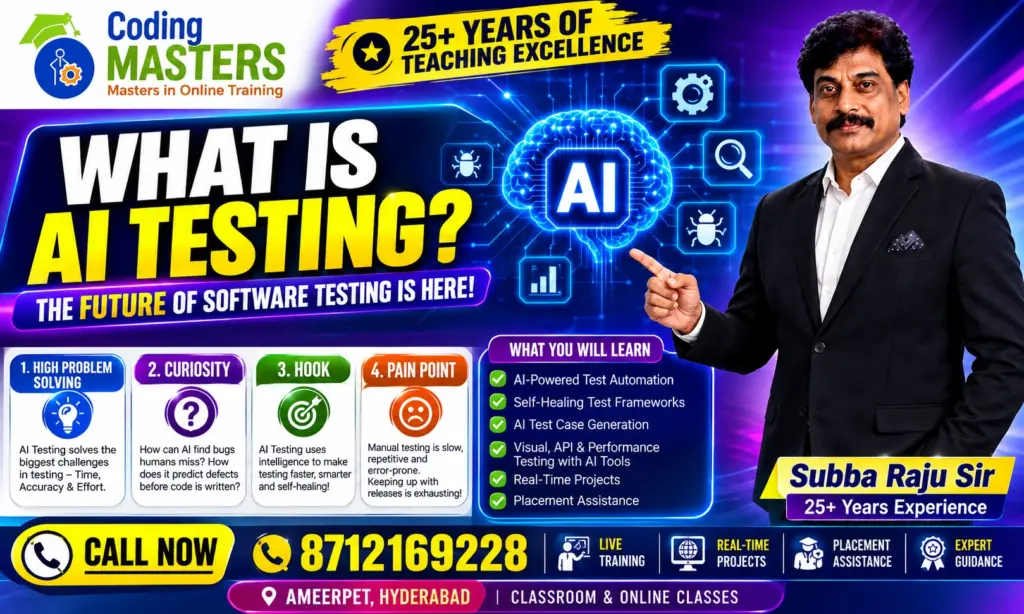
Gen AI testing is a process that uses artificial intelligence and machine learning technologies. It helps automate, optimize, and upgrade software testing activities.
Unlike traditional automated testing, it does not rely only on pre-defined scripts. AI testing can learn application behaviors and identify changes.
It can generate test cases and predict potential faults. It can even repair invalid test scripts without human intervention.
In Simple Words
AI testing integrates artificial intelligence with software testing. It creates a smarter, more efficient, and more reliable testing process.
It helps enterprises deliver high-quality software at a faster pace. It also helps reduce testing costs and labor inputs.
Why AI-Powered Testing Is Important
Modern software is updated frequently. Every update may damage existing automation scripts.
Traditional testing requires QA engineers to spend hours manually updating these scripts.
AI-powered testing solves this pain point by adapting to application changes.
Core Advantages
- Faster software release speed
- Lower maintenance costs
- Higher testing accuracy
- More comprehensive test coverage
- Earlier defect detection
- Lower total testing costs
Therefore, many enterprises are investing heavily in AI-powered testing solutions.
How the Technology Works
The technologies used in intelligent software testing include:
- Machine Learning (ML)
- Natural Language Processing (NLP)
- Computer Vision
- Predictive Analytics
- Intelligent Automation
How These Technologies Help
These technologies enable testing tools to achieve a range of capabilities.
Meanwhile, Gen AI can continuously learn from historical execution data. This reduces full reliance on manual scripts.
AI can also analyze testing patterns. It can identify areas that require additional attention.
As a result, testing teams can make better decisions during the testing process.
AI Testing vs Traditional Testing
Traditional testing and AI testing follow different approaches. The following comparison shows the major differences.
| Traditional Testing | AI Testing |
|---|---|
| Requires manual script writing | Automatically generates test scripts |
| High maintenance costs | Features self-healing automation processes |
| Slow execution speed | Higher execution efficiency |
| Requires human intervention | Achieves intelligent automation |
| Fixed test cases | Dynamically generates test cases |
| Time-consuming | Extremely efficient |
| Limited analytical capabilities | Equipped with predictive analytical capabilities |
AI-powered testing can greatly reduce repetitive work for QA engineers.
It can also help teams focus more on complex testing activities.
Core Features
Intelligent Test Case Generation
Artificial intelligence can analyze application requirements and automatically generate test cases.
This approach greatly reduces manual input. It also helps QA teams create broader testing scenarios.
Self-Healing Automation
When interface elements change, AI tools can automatically update locators. This process can prevent damage to existing test scripts.
Self-healing automation remains one of the most prominent advantages of AI-powered automation.
Visual Testing
Artificial intelligence compares screenshots to detect interface issues. These issues can be easily missed by human users.
It applies to:
- Web applications
- Mobile applications
- Responsive websites
Defect Prediction
Artificial intelligence analyzes historical data to predict areas where defects may occur.
This approach helps teams prioritize their testing activities.
Therefore, QA teams can focus more attention on high-risk areas.
Testing Optimization
Artificial intelligence can identify core test items without running every test case.
This approach can shorten test execution time.
It also helps teams use their testing resources more efficiently.
Intelligent Reporting
Artificial intelligence can automatically analyze failed test cases.
It can also provide root cause analysis. Therefore, QA engineers can spend less time troubleshooting problems.
Key Advantages for QA Teams
Faster Testing
AI executes tests much faster than manual testing.
Therefore, teams can complete testing activities more quickly. They can also release software faster.
Lower Maintenance Costs
Automated solutions with built-in self-healing capabilities can reduce script failures.
As a result, teams can save hundreds of hours on maintenance work each year.
Improved Test Accuracy
AI reduces human errors and makes the testing process more reliable.
However, teams should still validate AI-generated results before making final decisions.
Expanded Test Coverage
AI can identify test scenarios that manual testers might miss.
As a result, teams can improve overall test coverage.
Reduced Long-Term Costs
AI testing tools require upfront investment.
However, long-term use across organizations can generate substantial cost savings.
Support for Continuous Testing
AI can integrate into DevOps pipelines.
It can support continuous integration and continuous delivery (CI/CD).
Therefore, teams can include intelligent testing within modern development workflows.
Popular Tools in the Market
Several AI-driven testing tools are widely used in the industry today.
Popular AI Testing Tools
- Testim
- Applitools
- Functionize
- Mabl
- KaneAI
- ACCELQ
- TestSigma
- Perfecto AI
- Selenium with AI plugins
- Playwright AI
- Cypress AI
These tools can automate web, mobile, desktop, and API testing.
Each tool offers different capabilities. Therefore, organizations should choose tools based on their testing requirements.
Application Scenarios
Generative AI can meet testing needs across multiple fields.
Common Use Cases
- Web application testing
- Mobile application testing
- API testing
- Performance testing
- Security testing
- Regression testing
- Visual testing
- Cross-browser testing
- Accessibility testing
Nowadays, large enterprises increasingly rely on AI to improve software quality.
As testing requirements grow, intelligent solutions can support teams across different application areas.
Industries Adopting Intelligent Testing
AI-powered testing is widely adopted across industries such as:
- Banking
- Healthcare
- Insurance
- E-commerce
- Telecommunications
- Automotive
- Manufacturing
- Retail
- Education
- FinTech
Nearly all software companies are exploring artificial intelligence-powered quality assurance solutions.
This trend shows the growing importance of AI skills in modern software testing.
Skills Required for a Career
To become an AI testing engineer, you need to learn several important skills.
Essential Skills
- Manual testing
- Automated testing
- Selenium
- API testing
- SQL
- Java or Python
- Fundamentals of machine learning
- Prompt engineering
- AI testing tools
- CI/CD concepts
- Git & GitHub
Mastering AI tools can give professionals a competitive edge in the job market.
In addition, combining testing knowledge with AI skills can create more career opportunities.
Who Can Learn These Skills?
AI testing is suitable for the following groups.
Ideal Learners
- Recent graduates
- Manual testers
- Automated testers
- QA engineers
- Software developers
- DevOps engineers
- Test leads
- Working professionals
- Students majoring in engineering
Even professionals with no programming experience can start learning with beginner-friendly AI testing tools.
Therefore, learners from different technical backgrounds can explore this field.
Career Opportunities
Demand for professionals with AI-driven testing skills is growing rapidly.
Popular Job Roles
- AI Testing Engineer
- QA Automation Engineer
- Software Test Engineer
- AI Quality Engineer
- Automation Test Architect
- SDET (Software Development Engineer in Test)
- QA Analyst
- AI Validation Engineer
Companies of all types are actively recruiting professionals who master AI testing skills.
However, career outcomes depend on skills, experience, projects, and interview performance.
Therefore, learners should combine formal training with continuous practice.
The Future of Software Testing
The future of software testing lies in intelligent automation.
Emerging Trends
- Autonomous testing
- AI-generated automation scripts
- Generative AI for testing
- Natural language test creation
- Self-healing frameworks
- AI-based defect prediction
- Intelligent vulnerability analysis
- Predictive quality engineering
As AI continues to develop, software testing will become more automated, efficient, and data-driven.
At the same time, QA professionals will need to understand both testing fundamentals and AI technologies.
Why Learn These Skills Now?
Companies are shifting from traditional automation to AI-enabled testing.
Benefits of Learning AI Testing
- Higher salaries
- Better career opportunities
- Stronger job stability
- Faster career growth
- Global work opportunities
- Future-proof skills
Learning AI testing now prepares you to work on the next generation of software quality assurance.
It can also help professionals adapt to changing technology requirements.
Conclusion
Gen AI testing is a technology that combines artificial intelligence with modern automation technologies.
It helps redefine software testing processes and supports smarter quality assurance.
It helps enterprises deliver smarter and more reliable software at a faster pace. It also reduces manual workload and maintenance costs.
Whether you are an entry-level IT professional or a seasoned QA practitioner, learning this skill can provide valuable career opportunities.
The industry’s demand for AI testing continues to grow. Related tools are also gaining widespread use at a rapid pace.
Mastering this skill can help you access professional opportunities. It can also help you maintain a strong position in the testing field.
Gen AI and Agentic AI Training – Coding Masters
Address
flat no 101,
Bhavya Krishna Residency,
OPP: Siddartha Degree College,
Ameerpet Rd,
Kumar Basti,
Nagarjuna Nagar colony,
Yella Reddy Guda,
Hyderabad,
Telangana 500073,
India
phone no.91- 87121 69228