

AI Testing Explained
Artificial intelligence is reshaping the entire process of software development, testing, and delivery.
Today, most enterprises have adopted Agile, DevOps, and CI/CD development models.
Traditional software testing methods have long failed to keep up with faster release cycles and higher quality requirements, which has given rise to AI testing.
Centered on artificial intelligence, machine learning, and intelligent automation, AI testing can speed up test execution, identify defects at an earlier stage, cut maintenance costs, and support the stable delivery of high-quality software.
It has become an essential skill for beginners, software testers, developers, and QA professionals.
Understanding AI Testing
What Is AI Testing?
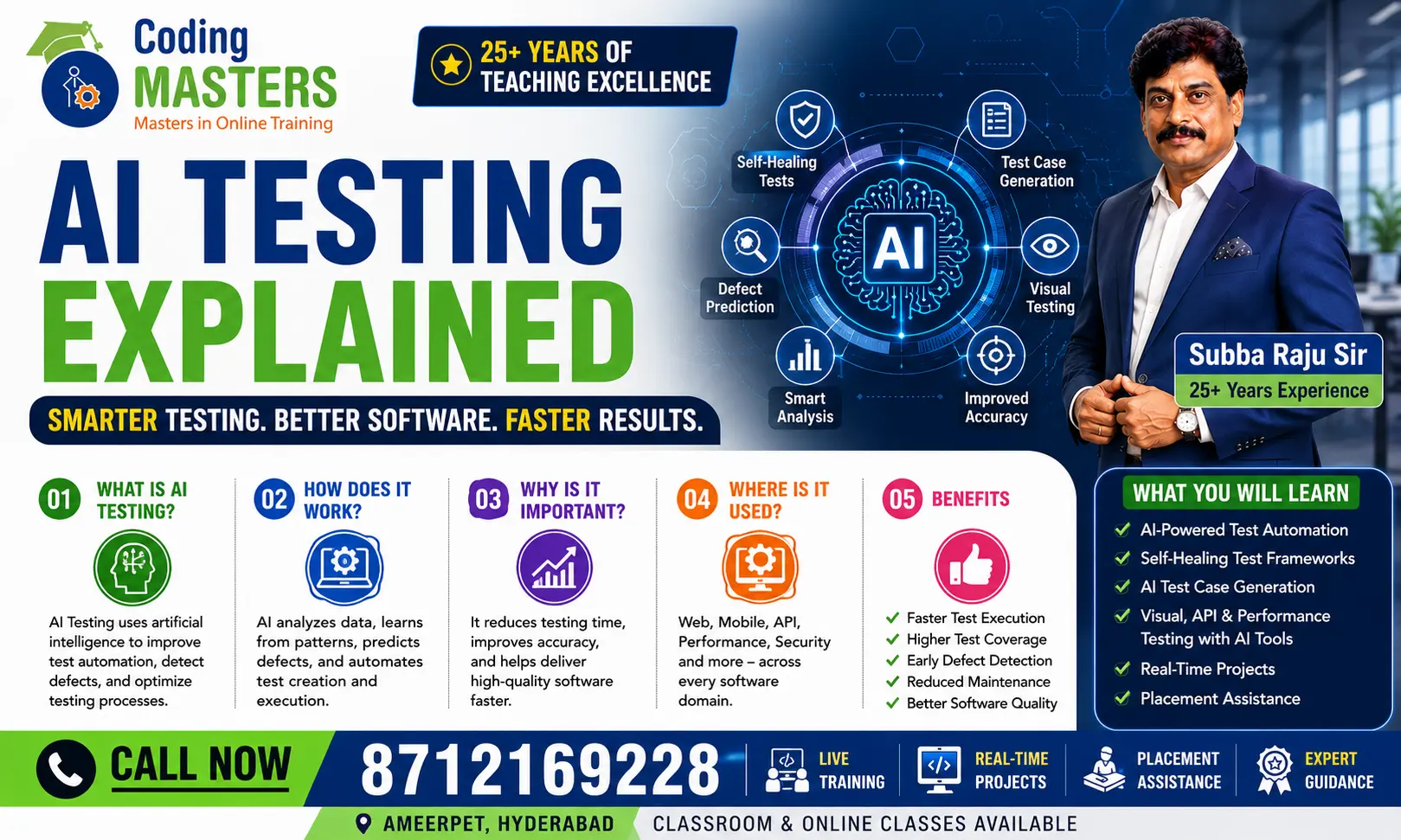
It is a new testing solution that relies on AI and ML technologies to realize the automation, optimization, and upgrade of software testing activities.
Unlike traditional automated testing, which relies on manually written scripts and predefined test cases, AI-powered testing tools can independently learn application behaviors, analyze historical test data, automatically generate test cases, detect software defects, and even repair invalid automated scripts—all without human intervention throughout the entire process.
AI Testing in Simple Words
In short, by reducing repetitive work, AI testing enables QA teams to focus on improving software quality, making software testing smarter, faster, and more efficient.
Why AI Testing Is Critical
Modern software applications receive frequent updates, and every update may disrupt existing automated scripts.
QA engineers often spend a large amount of time updating and maintaining test scripts before they can resume testing work.
AI testing can automatically adapt to application changes: intelligent testing tools can identify changes to the application and update object locators, allowing tests to continue running without manual script modifications, which perfectly solves this problem.
With the widespread adoption of agile development, DevOps practices, and continuous delivery, AI testing has become one of the most valuable technologies in the field of software quality assurance.
How AI Testing Works
AI testing relies on multiple advanced technologies to improve test efficiency and software quality.
Machine Learning Technology
Machine learning enables testing tools to analyze historical test execution data and continuously optimize test strategies.
Natural Language Processing
Natural Language Processing (NLP) allows testers to write test cases in simple English instead of complex programming languages.
Computer Vision Technology
Computer vision can identify interface elements based on visual appearance rather than fixed object locators, which improves the reliability of UI testing.
Predictive Analytics Process
Predictive analytics can identify high-risk modules that are prone to defects, helping teams prioritize test tasks efficiently.
Intelligent Automation Process
Intelligent automation allows AI to automatically execute test cases, analyze failures, generate reports, and put forward optimization suggestions, requiring minimal human intervention.
AI Testing vs Traditional Testing
Traditional software testing and AI-driven testing have several key differences.
The former requires manual script writing and frequent maintenance, which consumes a large amount of human resources.
The latter can automatically generate test cases, support self-healing automation to adapt to application changes, and also provide predictive insights to optimize software quality.
These capabilities enable AI testing to reduce repetitive work while improving the overall efficiency and accuracy of testing.
Key Features of AI Testing
AI testing is equipped with a range of intelligent features that can enhance testing effectiveness.
Intelligent Test Case Generation
AI analyzes application workflows and automatically generates valid test cases, reducing human resource input.
Self-Healing Automation Feature
When user interface elements change, AI automatically updates object locators to prevent automated testing from failing, and lowers the workload required for maintenance.
Visual Testing Capability
Artificial intelligence can compare screenshots pixel by pixel and identify visual defects that are easily missed by traditional testing methods.
Defect Prediction System
Artificial intelligence analyzes historical defect patterns to predict high-risk areas that require additional testing.
Test Optimization Process
Artificial intelligence identifies duplicate or low-priority test cases and optimizes execution processes to shorten test duration.
Intelligent Reporting System
Mainstream AI testing tools can automatically generate detailed reports, classify faults and locate potential root causes, accelerating the speed of problem resolution.
Advantages of AI Testing
Organizations across the globe are adopting AI testing because it combines multiple commercial and technical advantages.
Major Business Benefits
The key advantages include:
- Faster software release speeds
- Improved test accuracy
- Reduced labor input
- Lower maintenance costs
- More comprehensive test coverage
- Support for continuous testing
- Faster defect identification speeds
- Increased production efficiency
- Better software quality
- Achievement of long-term cost savings
These advantages help organizations deliver reliable software while enhancing overall development efficiency.
Mainstream AI Testing Tools
The software industry currently uses several artificial intelligence-driven testing tools on a wide scale.
Popular AI Testing Platforms
Popular AI testing platforms include:
- Testim
- Applitools
- Functionize
- Mabl
- KaneAI
- ACCELQ
- TestSigma
- Perfecto AI
- Selenium with AI Plugins
- Playwright AI
- Cypress AI
These tools support web testing, mobile testing, API testing, visual testing, regression testing, and cross-browser testing.
Application Scenarios of AI Testing
AI testing can cover multiple software testing fields.
Common Application Areas
Its common application areas include:
- Web application testing
- Mobile application testing
- API testing
- Regression testing
- Performance testing
- Security testing
- Accessibility testing
- Cross-browser testing
- Visual UI testing
- Cloud application testing
When various organizations adopt AI testing, they can not only improve software reliability, but also shorten testing duration and reduce maintenance costs.
Required Skills for AI Testing
Practitioners who intend to work in AI testing need to master both testing knowledge and AI-related skills.
Essential Technical Skills
Core skills include:
- Manual testing
- Automated testing
- Selenium
- API testing
- SQL
- Java or Python
- Basics of machine learning
- Prompt engineering
- CI/CD concepts
Mastering cloud computing and DevOps practices will be an added advantage for practitioners.
Career Opportunities in AI Testing
Global demand for AI testing professionals in the IT industry is growing rapidly.
Popular AI Testing Roles
Popular job roles include:
- AI Testing Engineer
- QA Automation Engineer
- Software Test Engineer
- AI Quality Engineer
- SDET (Software Development Engineer in Test)
- Automated Test Architect
- QA Analyst
- AI Validation Engineer
Many multinational companies are actively recruiting talents with AI testing capabilities, and intelligent automation has become a core part of modern software development.

Future of AI Testing
The future of software testing is increasingly led by artificial intelligence.
Emerging Industry Trends
Emerging trends include autonomous testing, AI-generated automation scripts, self-healing frameworks, predictive defect analysis, intelligent reporting, natural language test creation, and generative AI-powered quality assurance.
As AI technology continues to advance, software testing will become more intelligent, automated, data-driven, and efficient.
Why Learn AI Testing
Learning AI testing right now can provide excellent career opportunities for both students and working professionals.
Career Growth Benefits
Professionals who master AI testing skills can gain the following benefits:
- Higher salary compensation
- Better career development prospects
- More job openings
- Global employment demand
- Technical capabilities aligned with future development needs
- Opportunities to participate in cutting-edge AI projects
All types of companies are rapidly shifting from traditional testing methods to AI-driven testing, which makes AI testing one of the most valuable skills in the current software industry.
Conclusion
AI testing represents the next generation of software quality assurance solutions.
It combines artificial intelligence, machine learning, and intelligent automation to help companies develop faster, smarter, and more reliable software applications.
From intelligent test case generation and self-healing automation to predictive analysis and automated reporting, AI testing greatly optimizes the software development lifecycle.
Whether you are a new graduate, manual tester, automation engineer, software developer, or senior QA professional, learning AI testing can help you build a successful career path in the fast-growing software industry.
As companies continue to advance their digital transformation, AI-driven software testing will become the industry standard, and right now is the best time to learn AI testing and prepare for the future.
Coding Masters