

The core value of software testing is to guarantee the reliability, security,
and high quality of applications. Against the industry trend of faster iteration in software development, testing methods are constantly evolving. Manual testing, which has long served as a core pillar of quality assurance, relies on testers to manually execute test cases to identify defects. In contrast, AI testing, spawned by advances in artificial intelligence, has emerged as a new testing format. Today, various organizations are adopting AI-driven testing tools to
achieve the goals of speeding up software delivery, improving testing accuracy, and cutting maintenance costs. Even so, manual testing still retains irreplaceable value in the fields of exploratory testing, usability testing, and user experience testing. This paper will
break down the differences between these two testing methods, compare their respective strengths and limitations, and sort out their practical application scenarios, to help readers determine the solution that fits their own projects and career development needs.
What Is Manual Testing?
Manual testing refers to the process of conducting tests on a software application without the use of automated tools. Testers manually execute test cases to verify the application’s functions, identify defects, and then report identified issues to the development team. Every step in manual testing is completed by manual testing personnel. QA engineers check whether the software meets business requirements to ensure the application can deliver a smooth user experience. This type of testing is mostly used in the early stages of software development, as well as in application scenarios that require human judgment.
What Is AI Testing?
AI testing refers to the process of leveraging artificial intelligence (AI), machine learning (ML), and intelligent automation technologies to optimize software testing activities. Unlike manual testing, AI testing tools can automatically generate test cases, identify software defects, and adapt to application changes. They also use self-healing capabilities to fix broken test scripts and analyze historical test data, which allows them to optimize test execution without requiring extensive manual intervention. This helps enterprises deliver software faster while maintaining high-quality standards.
Manual Testing vs AI Testing
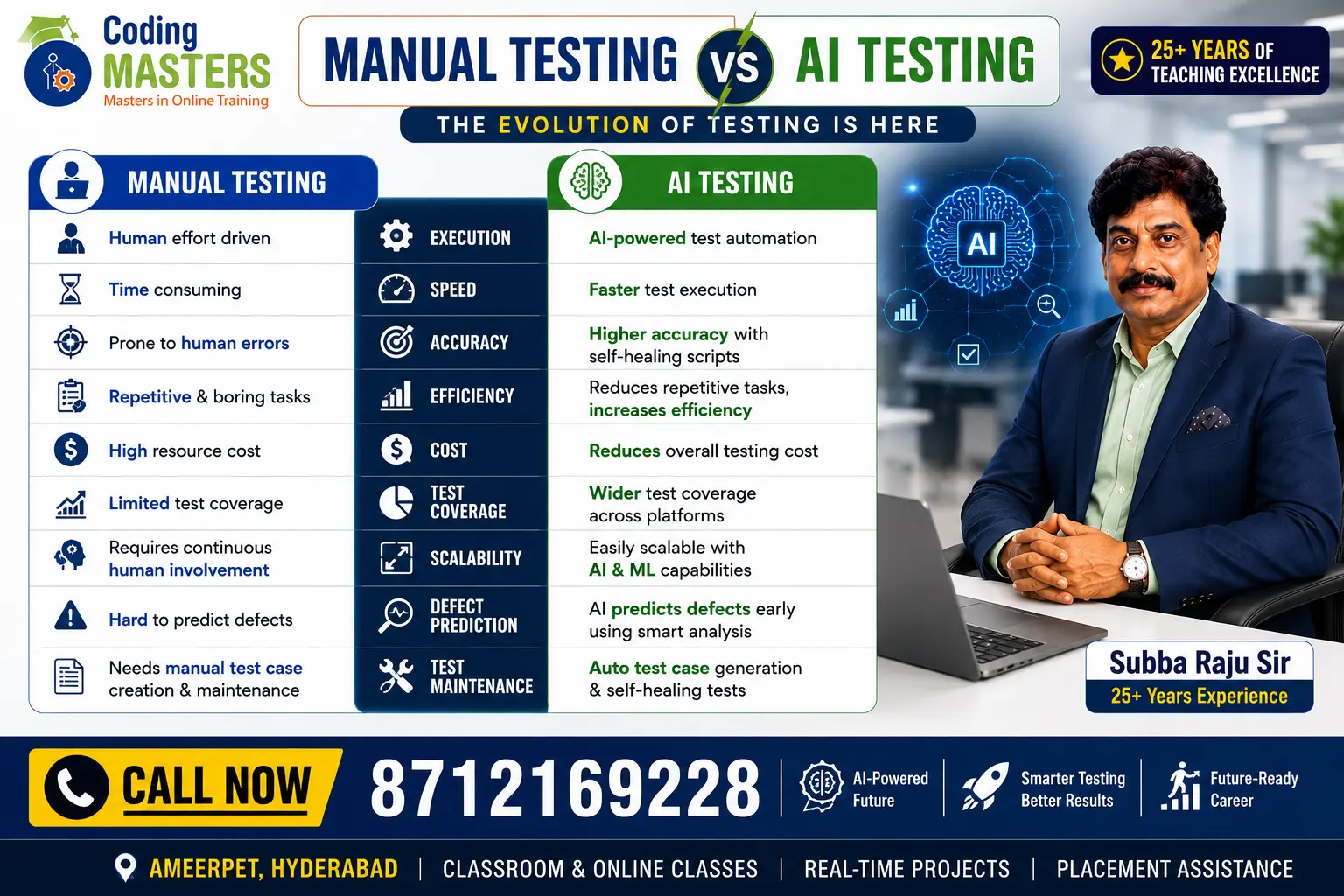
Although the core goal of both manual testing and AI testing is to improve software quality, there are significant differences between the two in dimensions including execution method, efficiency, maintenance cost, and scalability.
| Comparison dimension | Manual testing | AI testing |
| —- | —- | —- |
| Test execution | Manual operation | AI-driven automatic execution |
| Test case creation | Manual writing | AI can automatically generate cases |
| Speed | Relatively slow | Much faster |
| Labor input | Extremely high | Very minimal |
| Maintenance cost | High | Extremely low due to self-healing mechanisms |
| Accuracy | Dependent on testers’ capabilities | Strong consistency and high accuracy |
| Test coverage | Limited scope | Comprehensive coverage |
| Defect detection | Purely manual identification | AI-assisted and predictable |
| Scalability | Limited adaptability | Extremely strong scalability |
| Continuous testing support | Hard to implement | Easily adapts to CI/CD pipelines
Operation process of manual testing
Manual testing is carried out following a set of standardized procedures
Requirement analysis
First, testers sort out business requirements and clarify all functional logic of the application.
Test case development
QA engineers write detailed test cases that cover both functional and non-functional requirements.
Test execution
Testers manually operate the application one by one to execute all pre-set test cases.
Defect reporting
All detected defects are registered and reported through defect tracking tools.
Regression testing
After defects are fixed, testers conduct regression testing to verify that original functions remain unaffected.
How AI Testing Works
AI testing integrates multiple intelligent technologies to achieve automated software quality assurance.
Machine Learning
Machine learning can analyze historical test execution data to continuously optimize testing strategies.
Natural Language Processing
Natural language processing allows testers to write test cases using simple English instead of programming languages.
Self-Healing Automation
When the user interface changes, AI can automatically repair invalid object locators.
Predictive Analytics
AI can predict high-risk modules in an application that have a high occurrence of defects.
Intelligent Reporting
AI can automatically analyze failures and generate comprehensive test reports.
Advantages of Manual Testing
Manual testing still offers a number of unique values.
Human Observation
Human testers are far more efficient than automated tools at evaluating usability, accessibility, and user experience.
Flexible Testing
Manual testing adapts to application scenarios that undergo frequent updates.
Exploratory Testing
Testers can use exploratory testing methods to discover unforeseen unknown defects.
No Automation Investment
In the early stage of a project, organizations of all types do not need to purchase expensive automated testing frameworks.
Improved User Perspective
Manual testers evaluate applications from the perspective of end users, which helps boost customer satisfaction.
Advantages of AI Testing
Compared with traditional testing methods, AI testing has multiple notable strengths.
Faster Test Execution
AI can execute thousands of test cases in a much shorter period than manual testing requires.
Higher Test Accuracy
Artificial intelligence reduces human error and produces stable, consistent test results.
Self-Healing Capability
When changes are made to an application, AI can automatically update object locators.
Broader Test Coverage
AI can explore more scenarios and edge cases than manual testing.
Continuous Testing Capability
AI can integrate with CI/CD pipelines to support continuous software delivery.
Lower Maintenance Costs
The self-healing automation feature greatly reduces the workload of script maintenance.
Limitations of Manual Testing
Although manual testing has practical value, it still has some inherent shortcomings.
- Long execution time
- High labor costs
- Prone to human error
- Limited scalability
- Difficulty conducting repetitive regression testing
- Slower software release cycles
Limitations of AI Testing
AI testing also faces several challenges
- High initial implementation costs
- A steep learning curve for AI tools
- Reliance on high-quality training data
- Tool licensing fees
The continued need for human judgment in certain exploratory testing tasks
When Should You Use Manual Testing?
Manual testing is recommended for
- Exploratory testing
- Usability testing
- User interface testing
- User Acceptance Testing (UAT)
- Small-scale software projects
- Early-stage development
- Applications that require human judgment
When Should You Use AI Testing?
AI testing is ideal for
Regression testing
- Large enterprise applications
- Continuous Integration and Continuous Delivery
- Web application testing
- Mobile application testing
- API testing
- Cross-browser testing
- Performance testing
- Visual testing
- Large-scale automation projects
Can Manual Testing and AI Testing Work Together?
Yes. The most effective software testing strategy integrates both manual and AI testing. Manual testing brings human intelligence, creativity, and rigorous usability evaluation, while AI testing offers speed, automation, predictive analytics, and uninterrupted test execution. Many top software companies adopt this hybrid testing approach, where manual testers focus on exploratory testing, and AI-powered tools automate repetitive, large-scale testing tasks.
Required Skills: Manual Testing
Practitioners who wish to pursue a career in manual testing need to learn the following content
- Fundamentals of software testing
- Software Development Life Cycle (SDLC)
- Software Testing Life Cycle (STLC)
- Defect life cycle
- Test case design
Defect reporting
- SQL fundamentals
- Agile methodology
Required Skills: AI Testing
Practitioners in AI testing need to master the following content
- Automated testing
- Selenium
- Playwright
- API testing
- SQL
- Java or Python
- Fundamentals of machine learning
- Prompt Engineering
- AI testing tools
- Git & GitHub
- CI/CD concepts

Career Opportunities
Both manual testing and AI testing offer high-quality career development opportunities, with popular positions including
- Manual testing engineer
- Quality Assurance (QA) engineer
- Automated testing engineer
- AI testing engineer
- Software testing engineer
- QA automation engineer
- Software Development Engineer in Test (SDET)
- AI quality engineer
However, as enterprises across all sectors continue to implement intelligent automation technologies, market demand for AI testing practitioners is growing rapidly.
The Future of Software Testing
The author of this paper argues that the future of software testing is by no means replacing manual testing with AI, but rather empowering quality assurance practitioners with artificial intelligence. AI will only automate repetitive tasks, while human testers can still focus on refining creative approaches, assessing usability, verifying business logic, and polishing user experience. At the same time, practitioners who master both manual testing knowledge and AI testing skills will have stronger career competitiveness and higher income potential.
Conclusion
When comparing manual testing and AI testing, each has unique advantages and both play important roles in modern software development: manual testing remains an essential link for conducting exploratory testing, usability assessment, and user experience verification, while AI testing excels in automation, testing speed, accuracy, scalability, and continuous testing. Today, a growing number of enterprises are adopting AI-driven testing solutions to speed up software delivery and improve software quality. Meanwhile, manual testing is still indispensable for all scenarios that require human intelligence and real user perspectives. For learners who want to enter the software testing field, learning both the fundamentals of manual testing and AI testing technologies is the optimal path. Mastering these two sets of skills will help you adapt to the future development of the software quality assurance field, and secure high-quality career opportunities in the fast-evolving IT industry.