

Introduction
Large language model (LLM) testing is the process of verifying an LLM’s performance across diverse tasks and scenarios.
Today, large models power chatbots, applications, search systems, and enterprise workstreams. Therefore, businesses need reliable methods to assess large model performance.
Traditional software testing focuses on fixed rules and predictable outputs. However, LLMs require new testing methods because AI-generated content can vary.
This testing framework checks accuracy, relevance, safety, consistency, and response quality. It also identifies erroneous or harmful outputs.
The growth of generative AI has increased demand for relevant professional skills.
Coding Masters, an institution based in Hyderabad, has launched a related training program. Subba Raju Sir leads the program with 25 years of industry experience.
The program uses real-world cases to explain modern testing concepts. It connects software testing knowledge with AI principles.
It also covers essential topics, including prompt engineering and model behavior.
Understanding LLM Testing
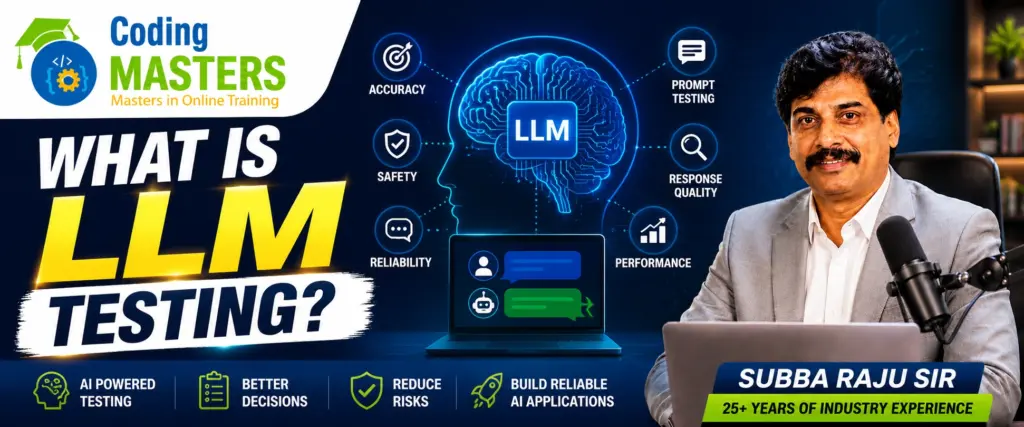
The core function of LLM testing is to evaluate model performance and reliability.
Large language models generate outputs by analyzing patterns in their training data.
Testers can ask the same question with different prompts. They can then compare the accuracy and consistency of the resulting outputs.
In addition, testing covers three important dimensions. These dimensions examine knowledge, logical reasoning, and content compliance.
Unlike traditional software testing, LLM outputs do not always have clear right or wrong answers.
For this reason, testers need specialized evaluation methods.
Testing should also examine output fluency. Fluency can directly affect the user experience.
As Generative AI continues to grow, LLM testing has become an important part of AI quality assurance.
Why LLM Testing Matters
Large language model applications can influence important business decisions.
For this reason, enterprises need reliable testing processes before launching these applications.
Insufficiently tested models may provide incorrect information. They may also misunderstand user instructions or generate irrelevant responses.
Security testing adds another important layer.
It checks whether models respond correctly to harmful and sensitive requests. It also verifies whether responses follow application rules.
As a result, testing can reduce risks and improve user trust.
It can also help development teams identify problems early. Teams can then improve applications through continuous iteration.
Key Areas of LLM Evaluation
Accuracy and Relevance
Testers verify whether the model provides accurate answers that meet requirements.
They compare model responses with authoritative and credible information.
They also use preset evaluation criteria.
This process confirms whether the model understands the user’s question correctly.
It also checks whether the response directly addresses the user’s needs.
Consistency and Context Testing
Large language models may produce different responses to similar prompts.
Therefore, testers assess response consistency across different scenarios.
They also check whether the model retains relevant information during conversations.
This type of testing helps identify problems in multi-turn interactions.
Safety and Reliability Testing
Safety testing evaluates how models handle sensitive and harmful requests.
Testers check whether the model follows safety specifications.
They also test non-standard prompts and attempts to bypass system instructions.
These checks help organizations build safer AI applications.
How LLM Testing Works
First, teams clarify the objectives of LLM testing.
They define the core areas they want to evaluate.
Next, they create test datasets and prompts based on real user scenarios.
Testers then enter these prompts into the target model.
They collect the generated responses for evaluation.
The team measures accuracy, relevance, consistency, safety, and response time.
Sometimes, automated scoring cannot cover every evaluation requirement.
In such cases, human review becomes important.
Automated tools can also compare responses against predefined standards.
This approach improves the efficiency of repetitive testing tasks.
Finally, teams document the results and identify existing problems.
They then share these findings with the development team.
Developers can use the findings for further optimization.
This process continues throughout the AI application lifecycle.
It creates a continuous testing and improvement cycle.
Common LLM Testing Challenges
LLM testing creates several challenges for QA practitioners.
First, model outputs can be unpredictable.
The same prompt may generate different responses at different times.
Second, evaluation can involve subjectivity.
Different reviewers may have different opinions about the quality of the same response.
Third, data quality can affect test results.
Low-quality test data can produce misleading evaluation conclusions.
Fourth, prompt design can influence model responses.
Even small wording changes can alter the output.
Therefore, testers need structured testing strategies.
They should also create diverse testing scenarios.
Addressing the Hallucination Problem
Large language models can sometimes generate content that appears correct.
However, the information may lack factual support.
During evaluation, testers need to identify these hallucinations.
They can compare model responses against credible sources.
They can also create test cases around factual questions.
This approach helps teams identify areas that require additional oversight.
Testing Prompt Injection
Prompt injection represents another important testing area.
Testers use specially designed inputs to attempt to manipulate the model.
They then verify whether the application follows its original instructions.
This type of testing can help identify security weaknesses in AI applications.
LLM Testing Tools and Techniques
Several tools and techniques support large language model evaluation.
Teams can use automated frameworks to test large numbers of prompts.
They can also conduct manual assessments for complex responses.
Prompt testing provides another useful technique.
Testers can create different prompt variations and compare the results.
Regression testing also plays an important role.
Teams should perform regression testing after modifying prompts or models.
This process helps detect unexpected changes in model behavior.
Automated and Human Evaluation
Automated evaluation can reduce repetitive testing workloads.
Related tools can compare output content against preset criteria or reference answers.
However, automated systems cannot fully understand complex human preferences.
Therefore, teams should combine automated methods with manual reviews when necessary.
Manual reviewers can assess output quality from the user’s perspective.
They can identify problems that automated systems may miss.
For example, an output may contain accurate information but still confuse users.
Human evaluation can identify these communication-level problems.
Generative AI Training for LLM Testing in Hyderabad
The development of Generative AI has increased demand for modern AI skills.
Quality assurance professionals can no longer rely only on traditional automation technologies.
They also need skills in prompt engineering, AI tools, LLM concepts, and AI-assisted testing.
Coding Masters has launched a Generative AI training program in Hyderabad.
The program focuses on practical concepts and real-world scenarios.
Subba Raju Sir teaches the program with 25 years of industry experience.
The training helps learners connect AI concepts with workplace requirements.
Professionals searching for Generative AI training in Ameerpet can also explore this practical learning option.
The online learning model also supports working professionals who need flexible schedules.
Skills Required for LLM Testing
LLM testing requires knowledge of both software testing and artificial intelligence.
Required Skills
- Fundamentals of software testing
- Manual testing
- Automated testing
- API testing
- Prompt engineering
- Generative AI concepts
- Fundamentals of large language models
- Test case design
- Python or Java
- SQL
- API tools
- Basic machine learning knowledge
- Test automation concepts
- AI evaluation technologies
QA practitioners can gradually develop these skills through structured learning.
At the same time, they should gain hands-on experience with real-world AI applications.
Project experience can also help them understand practical testing challenges.
Career Opportunities in LLM Testing
LLM testing has created new career opportunities for software testing professionals.
QA engineers can expand their existing skills into AI quality assurance.
Automation test engineers can explore AI-assisted testing workflows.
Developers can also learn AI evaluation and model testing concepts.
Popular Career Roles
- AI Test Engineer
- LLM Test Engineer
- AI Quality Engineer
- QA Automation Engineer
- Generative AI Testing Specialist
- AI Validation Engineer
- Software Test Engineer
- Software Development Engineer in Test (SDET)
However, career outcomes depend on individual skills and experience.
Practical projects can demonstrate your ability to apply LLM testing technologies.
Meanwhile, AI technology continues to change rapidly.
Therefore, continuous learning remains important for long-term career development.

Frequently Asked Questions
What Is Large Language Model (LLM) Testing?
LLM testing evaluates the performance, reliability, security, and overall quality of large language models.
Why Do Enterprises Need LLM Testing?
Enterprises need LLM testing to identify inaccurate, unsafe, inconsistent, or irrelevant content.
Is LLM Testing Different From Traditional Testing?
Yes. Traditional testing works with preset and predictable outputs.
LLM testing evaluates variable outputs generated by AI.
Can Manual Testing Practitioners Learn LLM Testing?
Yes. Manual testers can learn relevant skills through basic AI concepts and prompt engineering.
Do I Need Coding Skills to Learn LLM Testing?
Programming helps with test automation.
However, beginners can start with basic testing methods and core AI concepts.
What Should I Learn for LLM Testing?
Learners should study software testing fundamentals, prompt engineering, Generative AI, LLM concepts, test automation, and AI evaluation technologies.
Is LLM Testing Useful for QA Engineers?
Yes. LLM testing can help QA engineers expand their AI-driven QA skills.
Does Coding Masters Offer Generative AI Training?
Yes. Coding Masters provides training for learners interested in Generative AI and modern AI applications.
Who Teaches the Training?
Subba Raju Sir leads the training.
He has 25 years of industry experience.
Can Working Professionals Learn Online?
Yes. Online learning can support working professionals with busy schedules.
Conclusion
LLM testing is an important part of modern AI quality assurance.
It helps organizations evaluate the accuracy, reliability, security, and practicality of AI applications.
Unlike traditional testing, LLM testing handles variable and context-dependent outputs.
Therefore, testers need new testing strategies and evaluation techniques.
They also need a strong understanding of prompts, AI models, test data, and automation tools.
As Generative AI becomes widely adopted, the demand for AI quality and testing skills continues to grow.
Mastering these skills can help QA practitioners keep pace with changing technology requirements.
Coding Masters, based in Hyderabad, offers practical Generative AI training.
Subba Raju Sir leads the program with 25 years of industry experience.
With consistent practice, learners can build the skills needed for modern AI testing environments.
Gen AI and Agentic AI Training – Coding Masters
Address
flat no 101,
Bhavya Krishna Residency,
OPP: Siddartha Degree College,
Ameerpet Rd,
Kumar Basti,
Nagarjuna Nagar colony,
Yella Reddy Guda,
Hyderabad,
Telangana 500073,
India
phone no.91- 87121 69228