

Complete Guide for Beginners to Unsupervised Learning on the Coding Masters Platform
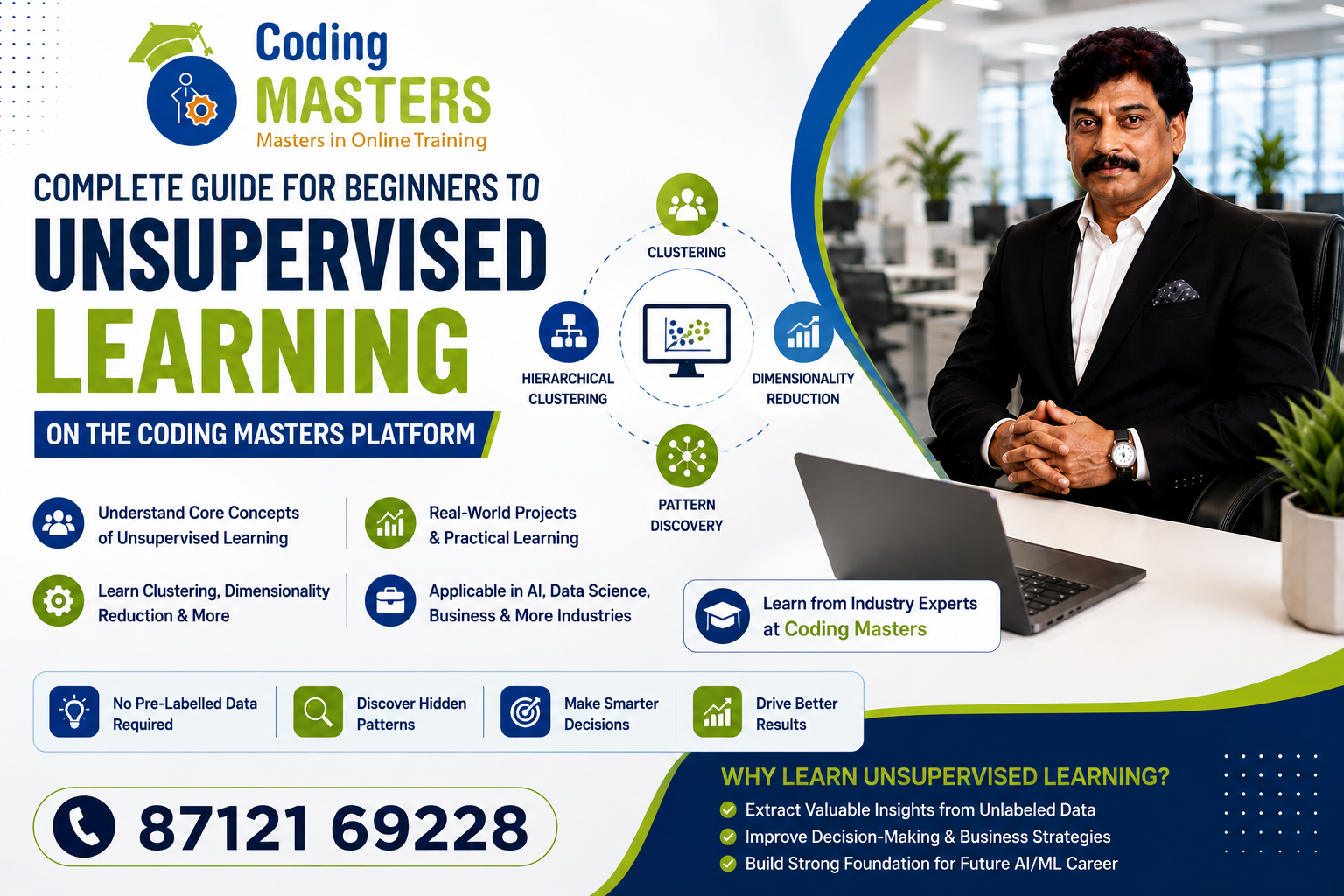
Unsupervised Learning is a core pillar of Machine Learning. You can understand it as a set of technologies that allows computers to work on their own without pre-labeling any data in advance.
It can dig out hidden patterns, correlations between different data points, and the underlying structure of the data itself from messy datasets.
This set of methods is now practically applied in a huge number of real-world work scenarios, ranging from ordinary data analysis and grouping customers by their characteristics, to e-commerce recommendation systems.
And identifying abnormal anomalies from a pile of data; it is used everywhere.
Whether you are a student currently studying Artificial Intelligence and Machine Learning, or a working professional who has already entered the industry and wants to deepen your relevant skills, you can come to Coding Masters to learn this technology.
Here, you will not only master the core fundamentals of Unsupervised Learning, but also learn how to implement these technologies in practical problems that require hands-on solutions, instead of only learning vague theories.
What Is Unsupervised Learning
It is a branch of Machine Learning, and all the algorithms it uses process datasets that have never been pre-labeled with output tags.
What does it mean to not pre-label data? It means you do not need to tell the computer “what kind of data is correct”, nor input any explicit rules about “the correct answer” to it.
The algorithm can sort through all available data on its own, identify meaningful patterns, and group similar data into clear, independent clusters.
Let me give you a simple example to make this easy to understand. Suppose a company has stored all the data of thousands of customers, recording each person’s usual shopping habits, interested categories, as well as their approximate monthly spending power and consumption patterns in detail.
In the past, to classify these customers, people had to manually label each customer and sort them into preset categories, which was time-consuming and error-prone.
But with Unsupervised Learning algorithms, none of these manual operations are needed; the algorithm can sort through all the data on its own and automatically group customers with similar characteristics into the same cluster.
It is precisely this flexibility of not requiring pre-labeling that makes Unsupervised Learning the most suitable choice for institutions that have accumulated a large amount of data but lack sufficient manpower or ready-made frameworks to label each piece of data.
How Does Unsupervised Learning Work
The entire workflow generally starts with collecting and cleaning raw data. The raw data you collect will contain various characteristics, that is, the “features” that algorithms can use for analysis.
And all these will be left to Machine Learning algorithms to sort through and calculate.
Once the entire dataset is properly organized, the next step is to select a suitable Unsupervised Learning technology based on your specific business goals or technical needs.
After selection, the algorithm will start to sort out the correlations between each independent data point, striving to identify stable patterns, independent groups that can be clustered together, or those rare abnormal values that deviate from the normal range.
Finally, the results output by the algorithm will be reviewed and interpreted by humans, helping you sort out the complete underlying structure of the original dataset.
Depending on the specific scenario in which you use this technology, the patterns discovered in this process can have many uses: they can guide the company’s business decisions, provide references for academic or industry research.
They can also support the company’s automated workflows, and even lay the foundation for more subsequent Machine Learning development work.
Common Unsupervised Learning Technologies
Clustering
Clustering is one of the most widely used Unsupervised Learning technologies today, and its logic is very simple: it only groups similar data points into the same cluster based on their shared features.
K-Means Clustering is one of the most popular specific implementations of clustering technologies. It is often used for customer segmentation, product classification, analyzing user behavior habits.
And organizing large-scale datasets into clear, usable categories to sort out messy big data.
Hierarchical Clustering
Hierarchical Clustering is different from ordinary clustering. It builds a layered grouping framework layer by layer based on the similarity between individual data points.
This hierarchical structure helps data analysts sort out more detailed and hidden correlations in the dataset, identify multi-level groups that other simple clustering methods cannot detect, and clarify the relationships within the data.
Dimensionality Reduction
Dimensionality Reduction is another commonly used Unsupervised Learning technology. Its function is to reduce the number of features in the dataset, remove redundant and repetitive features, while retaining all key core information as much as possible without loss.
Common dimensionality reduction technologies such as Principal Component Analysis can simplify complex and difficult-to-understand datasets, making it easier for teams of all technical levels to visualize the data and carry out subsequent analysis work.
Application Scenarios of Unsupervised Learning
The scenarios where Unsupervised Learning can be implemented cover almost all mainstream industries.
Ordinary commercial companies can use clustering to split customer groups into different clusters based on shopping behavior, so that marketing teams can create more precise, higher-conversion marketing campaigns based on these segmented customer groups.
Instead of blindly pushing advertisements as they did in the past.
In the field of cybersecurity, Unsupervised Learning can identify abnormal patterns, which often represent malicious or suspicious activities in the network, helping security personnel detect risks early.
In the financial field, it can support banks or payment platforms to analyze user transaction patterns, mark potentially abnormal or high-risk consumption behaviors, and intercept problems such as fraudulent card swiping in advance.
In addition, it is also the core support for many of the recommendation systems, image analysis tools, customer behavior tracking frameworks that we commonly use in daily life.
As well as the exploratory data analysis workflow that first explores new data. Many of the familiar Internet products we use have it to thank for their success.
Why Learn Unsupervised Learning
Mastering Unsupervised Learning can help students who study this technology gain a deeper understanding of how Machine Learning algorithms sort through the various messy data in the real world and extract useful conclusions from it.
During the learning process, you will also master core concepts such as data preprocessing, feature analysis, clustering, pattern recognition, and model interpretation.
These concepts are not only applicable to Unsupervised Learning, but are also universal fundamentals that all Machine Learning work cannot do without.
If you are a student planning to work in Artificial Intelligence, Machine Learning, Data Science, or other related technical fields in the future, mastering both supervised learning and Unsupervised Learning methods will help you build a more solid and comprehensive professional foundation.
With a broader range of capabilities than those who only understand one type of method.
Learning Unsupervised Learning at Coding Masters
Coding Masters offers a systematic training program that is well-organized, focused on key points, and features a hands-on learning mode that helps all learners build their technical capabilities step by step.
Students studying here can break down the core concepts of Machine Learning step by step, gradually apply the skills they have learned to real datasets and the capstone projects they need to complete for graduation.
And truly master the content they have learned.
Throughout the learning process, hands-on practical learning is particularly important. Because relying solely on theoretical knowledge from books is almost impossible to solve the various messy and unique challenges encountered in real data processing.
Data in real work will never be as neat as it is in exercise questions.
Only by personally processing raw datasets, testing different algorithms, sorting out the results output by the algorithms, and truly understanding why the algorithm draws a specific set of conclusions can you develop the practical skills that will help you stand out in the workplace.
Instead of just memorizing theories and being able to only talk on paper.
Final Summary of Unsupervised Learning
Unsupervised Learning is an extremely valuable Machine Learning framework that enables computers to identify hidden patterns and structures in datasets without any labels.
Technologies related to it, such as clustering and Dimensionality Reduction, have been implemented in many industries including technology, business, finance, and marketing, generating tangible and important value.
For students and working professionals who want to develop long-term careers in Artificial Intelligence, Machine Learning, or Data Science, Learning Unsupervised Learning is a key step in building a solid and comprehensive technical foundation.
At Coding Masters, all learners can delve into every core concept, accumulate sufficient practical experience, and lay a solid foundation that can support their career growth for their long-term development in the technology industry.
+91-87121 69228
Address:
Coding Masters