

Introduction
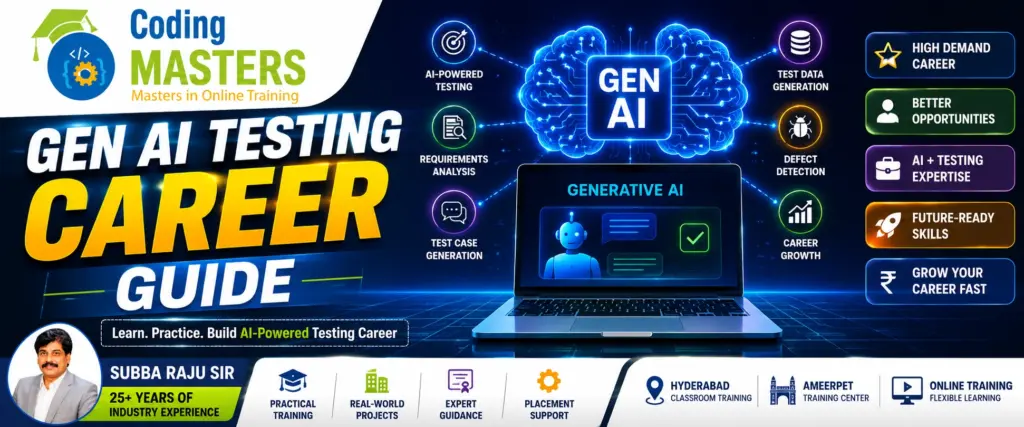
Our Professional Guide to Generative AI Testing focuses on the core logic of how artificial intelligence transforms modern software testing.
Today, generative AI already supports a large number of software development and testing activities, forcing quality assurance practitioners to master new AI-driven testing methods.
While traditional testing still plays a critical role in software quality, modern projects increasingly rely on AI tools to improve testing speed and coverage. Generative AI provides four core forms of support for testers:
creating test cases, analyzing requirements, generating test data, and identifying potential defects. The guide is designed for manual testers, automation testers, QA engineers, developers, and recent graduates. Practitioners can upgrade their professional capabilities by combining their existing testing knowledge with new AI skills.
In addition, Coding Masters has launched a matching practical training program in Hyderabad, led by Subba Raju Sir, who has 25 years of industry experience.
Understanding the Gen AI Testing Career Path
To pursue a career in generative artificial intelligence (Gen AI) testing, professionals must master two core foundational skill sets: software testing knowledge and generative AI capabilities.
Learners need to balance mastery of traditional quality assurance (QA) concepts and modern AI applications. These AI tools can provide support across the entire software testing workflow: testers can use them to organize requirements, generate test scenarios, produce test cases based on functional requirements, and create test data.
This cuts down on repetitive manual work and improves testing efficiency. In the debugging phase, AI can also assist with error analysis and flag potential root causes, but testers must verify all AI-generated outputs before making any critical decisions. Additionally, prompt engineering is a critical skill:
testers must write clear instructions to obtain usable outputs from AI tools. This career path does not require practitioners to transition into machine learning engineers. Instead, they only need to focus on practical AI applications within QA contexts, build a solid skill system, and the path holds practical value for both experienced industry professionals and new entrants.
Skills You Need for Gen AI Testing
Building a suitable skill system can help testing practitioners transition more smoothly to an AI-driven testing model.
First, practitioners must solidify their foundation in software testing and master the core concepts of manual testing:
test cases, test scenarios, defect reporting, regression testing, and functional testing. These elements form a solid base for their capabilities. Next, they need to learn automation skills, master automation framework tools such as Selenium to adapt to AI-assisted workflows, and additionally develop skills in API testing and SQL to support the implementation of testing projects.
Prompt Engineering Skills
Prompt engineering helps testers communicate efficiently with AI systems. Well-designed prompts can generate more practical test scenarios and outputs, which can be applied to four scenarios:
test case generation, requirement analysis, test data creation, and defect troubleshooting. However, this skill requires repeated practice.
Practitioners need to try different instructions and compare their results, and also learn to verify the information generated by AI to avoid problems such as incorrect or incomplete AI outputs.
AI and Testing Knowledge
Professionals need to understand the basic concepts of generative AI and large language models, and master the logic behind how AI tools generate responses, as well as the reasons for variations in their outputs.
Testing personnel must also recognize the core challenges of AI testing, including hallucinations, inconsistent responses, security risks, and prompt injection. By combining foundational QA knowledge with AI expertise, professionals can build a more solid career foundation.
Career Opportunities in Hyderabad
Hyderabad has a well-developed technology ecosystem that hosts a large number of software and IT companies.
Professionals with modern testing skills can access diverse career opportunities.
Generative AI testing is applicable to positions such as QA automation, AI quality assurance, software testing, and AI validation. Manual testers can add AI-aided testing skills to their resumes, while automation testers can explore AI-supported test generation and debugging workflows.
Gen AI Training in Hyderabad
Coding Masters has launched a generative AI training program in Hyderabad for learners who aim to master practical knowledge.
This course focuses on modern AI concepts and their workplace applications. The lead instructor, Subba Raju Sir, has 25 years of industry experience, and he breaks down complex concepts using real-world cases.
The program is suitable for recent graduates and working professionals, and it can also help employed QA practitioners expand their technical capabilities.
Generative AI Training (Amberpet Area)
Amberpet is a well-known gathering place for vocational and technical training in Hyderabad. Learners who want to find local generative AI training can prioritize programs that offer hands-on practice opportunities.
When choosing a course, they should focus on four key factors:
course quality, practical training arrangements, instructor experience, and industry relevance. Working professionals who cannot attend regular in-person classes can also opt for online learning.
Building a Successful Career
To learn generative artificial intelligence testing, you must persist in continuous practice and must never rely solely on theoretical knowledge.
Start with basic testing concepts, gradually introduce AI tools, and then practice prompt engineering combined with real-world testing scenarios. You can build sample projects:
for example, construct test cases based on AI-generated requirements, or use AI tools to generate test data and analyze sample defects.
Practical Project Experience
Projects can prove your ability to apply technical knowledge. High-quality projects must cover the entire process of requirements analysis, test case generation, test data creation, automation, and defect analysis. You must clearly record each step to make it easy to explain during interviews. You also need to continuously follow up on new AI tools, as technology updates and iterates extremely quickly.
Career Growth
Generative AI testing can unlock a range of career development opportunities, with potential roles including:
- AI Test Engineer
- QA Automation Engineer
- Generative AI Testing Specialist
- AI Quality Engineer
- Software Test Engineer
- AI Validation Engineer
- Software Development Engineer in Test (SDET)
- Automation Test Engineer
It is important to note that no course can guarantee that learners will secure a specific job or salary level. Career outcomes depend on an individual’s skills, project experience, hands-on practical experience, and interview performance.

Frequently Asked Questions
What is generative AI testing?
Generative AI testing refers to the use of generative AI technologies to support and optimize all types of software testing work.
Who can learn generative AI testing?
Manual testers, automation testers, QA engineers, developers, new graduates, and working professionals can all learn the relevant skills.
Is programming knowledge required?
Basic programming knowledge is helpful for automation testing, but beginners with no prior experience can start by learning the fundamentals of testing and core AI concepts first.
What skills do I need to master?
You will need to learn software testing, automation technologies, prompt engineering, generative AI, API testing, and AI-assisted testing technologies.
Is generative AI testing useful for QA professionals?
Yes, it helps QA practitioners optimize their existing work processes and master AI-related skills aligned with industry development trends.
Can new graduates learn generative AI testing?
Yes, new graduates can start with the basics of software testing, then gradually learn the relevant concepts of AI testing.
Where can I learn generative AI in Hyderabad?
Coding Masters offers practical generative AI training in Hyderabad, led by instructor Subba Raju Sir, who has 25 years of industry experience.
Is there any online training available?
Online training provides flexible learning options for working professionals and learners with limited scheduling availability.
Conclusion
The Career Guide to Generative AI Testing points out that generative AI has opened up entirely new development possibilities for the field of software quality assurance.
It can support a full range of testing activities, including test case generation, requirement analysis, test data generation, and debugging. For this reason, QA practitioners need to supplement relevant skills, starting by consolidating knowledge in four core areas:
software testing fundamentals, automation technology, prompt engineering, and generative AI. The Coding Masters institution based in Hyderabad offers a generative AI training course taught by Subba Raju Sir, who has 25 years of industry experience.
Practitioners can adapt to AI-driven testing environments through hands-on practice and drills.
Gen AI and Agentic AI Training – Coding Masters
Address
flat no 101,
Bhavya Krishna Residency,
OPP: Siddartha Degree College,
Ameerpet Rd,
Kumar Basti,
Nagarjuna Nagar colony,
Yella Reddy Guda,
Hyderabad,
Telangana 500073,
India
phone no.91- 87121 69228