

LangChain and LangGraph are both development tools specifically built to construct Generative AI applications, which can help developers build highly functional Generative AI applications—that is, the AI programs we usually encounter that can automatically generate content such as text and images. However, the development challenges these two frameworks address are different; while both are used to build Generative AI programs, their respective use cases are completely distinct.
LangChain simplifies the development workflow for Generative AI applications. It connects AI models, prompts, tools, databases, and retrieval systems. These components help developers build applications without creating every connection from scratch. LangGraph focuses on two important development processes. The first is state full workflows that can record changes and retain previous information. The second is complex agent workflows that can complete tasks autonomously. Understanding their differences helps developers choose the right technology for their projects. In addition, Coding Masters has launched a practical Gen AI Training in Hyderabad, which is taught by Subba Raju Sir.
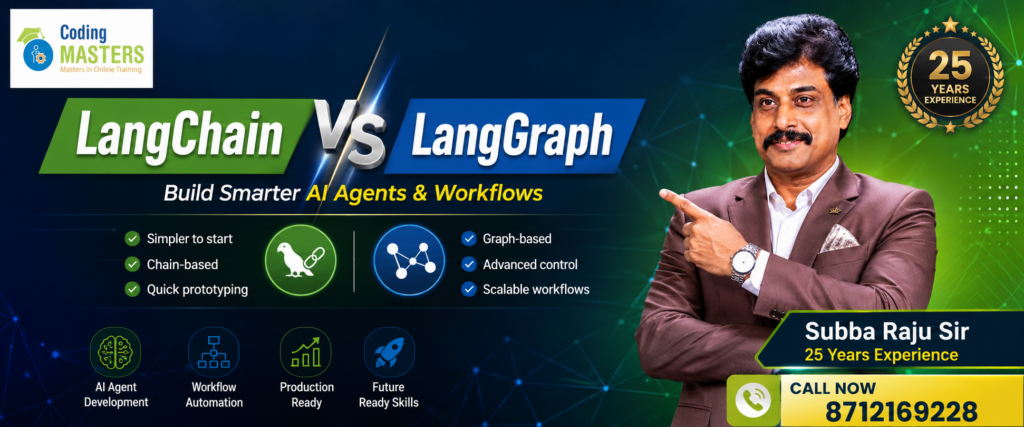
LangChain vs LangGraph:Gen AI Training in Hyderabad:
LangChain is a development framework for creating Generative AI applications. It provides many core components required for application development. Developers can use these components instead of writing everything from scratch. Developers can use LangChain to connect large language models with prompts, tools, databases, and retrieval systems. This reduces the need to handle each integration separately.
In contrast, LangGraph is designed for a different type of development need. It helps developers build structured agent workflows with persistent state. The system can save the state generated during each stage of the workflow.
Because the positioning of the two tools is inherently different, most developers will choose LangChain when building simple applications. On the other hand LangGraph is often more suitable. It can handle multiple steps, decisions, and agent coordination.
Key Differences for Gen AI Course in Hyderabad:
First of all, I would like to introduce two tool frameworks that are essential for working with Generative AI. To begin with, The first framework is LangChain. It provides core components for building Generative AI applications. It can also streamline AI workflows and reduce unnecessary development steps. For more structured applications, LangGraph can track workflow states from start to finish, helping developers manage complex processes without losing important information.
However, The two frameworks have different responsibilities. Furthermore, LangGraph can also work with LangChain components. As a result, This allows developers to combine their capabilities in advanced applications. Developers can combine both frameworks to build advanced Generative AI applications. This approach supports complex technical requirements. Some of these functions may be difficult to achieve with only one framework.
Both frameworks provide valuable capabilities for Generative AI development. Students in the Gen AI Course in Hyderabad can learn both technologies. Understanding both frameworks can help them work on different types of AI projects. If you find it difficult to work through these concepts, there is a solution: practice with hands-on practical projects, and these interconnected abstract concepts will become much easier to understand.
Choosing the Right Framework:
Choosing between LangChain and LangGraph depends on your project requirements. Do not choose a framework based only on intuition. First, identify your project requirements. Then select the appropriate tool. If you are building a simple information retrieval application, using LangChain can often save a lot of work. This tool is perfectly suited for such projects with uncomplicated needs and provides great support to the development process. However,LangGraph is useful for complex multi-agent applications. It provides features for managing advanced workflows and agent coordination. These capabilities make it suitable for complex AI projects.
In addition Developers do not always need to choose only one framework. Many projects combine LangChain and LangGraph. This approach can support advanced workflows and provide greater flexibility. Coding Masters, a technical education platform, guides learners to understand the concepts related to these two tools through hands-on learning. Instead of just explaining theory, it teaches users while they operate, making these technologies clear and easy to grasp. Subba Raju Sir leads the relevant training at Coding Masters.
He brings 25 years of industry experience to the training approach. Rather than mechanically reciting a set of universal teaching materials, he has incorporated the experience he accumulated through years of working in the industry into the process of teaching everyone to learn these technologies.

LangChain for Generative AI Training:
LangChain is a development framework for Generative AI applications. It helps developers integrate large language models into their applications. These models can generate text and understand natural language. LangChain supports several important development capabilities. These include prompts, chains, tools, and retrieval systems. It can also connect applications with different large language models. Developers can combine these components to create functional AI applications.
In addition to these core capabilities, it also has many pre-written components that can be called repeatedly. Developers do not need to write these components from scratch. This saves time and speeds up application development. These useful features allow LangChain to be used smoothly by both novice developers who have just entered the field and veteran developers with rich experience.
Based on these points, the original text puts forward a suggestion: in the Generative AI Training in Hyderabad, theoretical content should not be the only focus, and practical projects related to LangChain should be added. Only a learning method that allows training participants to practice with their own hands can help them move beyond empty textbook theories and truly understand how to develop deployable, practically usable applications.
LangGraph for Gen AI Training in Ameerpet:
LangGraph can support complex AI workflows that require state management and rule-based operation control. In some development scenarios, a single change in the AI process can trigger impacts across the entire system: the operation status of each step must be clearly recorded, and the process must advance step by step in accordance with preset logic, without disorder, and LangGraph is capable of handling such complex requirements. Developers can use it to build applications where intelligent agents each complete their own distinct exclusive tasks.
There is no need to assign all tasks to a single AI module; by splitting tasks among different intelligent agents, each can focus on processing the link it is responsible for. Such workflows can also embed conditional judgments, cyclic execution, and preset human intervention nodes. When the process reaches a branching point, the system can select the next stage of the process based on conditions; links that require repetitive processing can also be set to execute cyclically; when reaching nodes that require human review and adjustment, the process can be paused to wait for human intervention.
To develop high-end AI intelligent agents, LangGraph is a very practical tool. Its capabilities perfectly match the complex operation logic required by high-end AI agents. Students who participate in Gen AI Training in Ameerpet can learn these technical concepts one by one through hands-on projects and real development scenarios, and gain a thorough understanding and mastery of the functions and logic mentioned above through hands-on practice.
Why Learn Both Frameworks?
Once you fully master both the LangChain and LangGraph frameworks, when you develop AI applications, you can choose the most suitable approach to move forward, you will not be tied down by the limitations of only being able to use a single tool, and you will have far more room to maneuver.
LangChain comes with a large number of easy-to-use components. These ready-made components are just like the parts for building with building blocks; you can take them, assemble them and piece them together, and you can build a workable solution with AI functions. LangGraph is different; its strengths complement those of LangChain. If what you need to build is an intelligent agent system with complex logic that can independently handle multi-round tasks, using LangGraph allows you to manage every step of the entire workflow more solidly, with no risk of things going wrong.
Furthermore, these two tools are not opposing options that force you to pick only one. You do not have to force yourself to choose between them; even within the same application, you can combine their capabilities, leveraging the strengths of each. Mastering both of these technologies will not only tangibly improve your skills in Generative AI development, but you will also have more confidence when you actually take on real-world projects, and you will never run into difficulties because the tools at hand are not suitable for the task.
Practical Learning Approach:
Coding Masters does not teach vague, pure theory; its core focus is on training in practical, applicable technical skills, fundamentally eliminating the problem of struggling through abstract concepts from textbooks yet being unable to produce anything tangible. Students attending the classes do not stay stuck at the stage of only memorizing knowledge points: they can personally try writing prompts, building AI agents and retrieval systems, and also gain exposure to tools such as LangChain and LangGraph, gaining solid, hands-on familiarity with every technology they learn.
Beyond learning individual technical points, the course also includes hands-on practical projects, ensuring students do not master a collection of disjointed tools yet have no idea how to integrate them for use. As they advance through the projects, these scattered technical skills gradually connect into a cohesive framework, allowing students to fully understand what role each technology plays in the overall workflow, and how to coordinate them to complete a full set of tasks.
Guidance from Experienced Trainers:
Leading the entire learning process is Subba Raju Sir, who explains practical knowledge points in thorough detail, leaving no ambiguous zones of half-understanding. He also teaches specific development methods step by step, and provides timely guidance whenever students hit a stumbling block.
By following this learning path from start to finish, students will not only accumulate a pile of disconnected nouns and concepts, but will build a solid foundational skill set. This puts them in a far stronger position to enter the workforce in roles related to modern Generative AI: they can meet the threshold for entry into the field, and also uphold the practical work requirements that come after starting their careers.
Gen AI and Agentic AI Coding Master
Address
Flat No: 303,
Bhavya Krishna Residency, Siddartha Degree College,
OPP:, Ameerpet Rd, Kumar Basti,
Nagarjuna Nagar colony, Yella Reddy Guda,
Hyderabad,
Telangana 500073